

Calacatta quartz gives homeowners the bold, dramatic veining of natural Italian marble without the maintenance headaches that come with real stone. In a city like Winnipeg, where temperature swings between a humid summer and a dry, cold winter, engineered quartz also holds up more consistently than natural stone, which can be more sensitive to those shifts. This guide covers what Calacatta quartz actually is, how it differs from similar-looking options, what installation involves, and what you should realistically expect to pay and maintain once it’s in your kitchen.
Standing in a stone yard staring at slab after slab of white countertop options is enough to overwhelm anyone. If you’re searching for low-maintenance quartz countertops in Winnipeg and keep landing on the name Calacatta, you’re not alone. It’s become one of the most requested looks for kitchen renovations across the city, and for good reason, but there’s a lot of confusing information out there about what you’re actually paying for.
Key Takeaways
- Calacatta quartz is engineered stone designed to mimic the look of rare Calacatta marble, not the marble itself
- It’s more durable and lower maintenance than natural marble, with no sealing required
- Winnipeg homeowners typically pay more for large-format slabs with dramatic veining versus simpler patterns
- Proper installation matters more with bold veining patterns, since seams are harder to hide
- Local climate has minimal effect on quartz performance indoors, unlike some natural stones
- Getting an in-person slab viewing before ordering avoids surprises in veining and tone
What Is Calacatta Quartz Exactly?
Calacatta quartz is an engineered stone surface made from crushed natural quartz combined with resin and pigments, manufactured to replicate the look of genuine Calacatta marble. It is not a natural stone itself, but a manufactured product designed to capture that same dramatic white-and-gold veined appearance.
Real Calacatta marble comes from a specific quarry region in Carrara, Italy, and it’s known for its bold, thick veining set against a bright white background, often with warm gold or beige undertones running through it. Because natural Calacatta marble is rare and expensive, and because marble as a material stains and etches easily, manufacturers developed quartz versions that recreate the look using digital printing and pattern layering technology. The result is a surface that looks remarkably close to the real thing but performs like engineered quartz, meaning it resists stains, doesn’t need sealing, and holds up to daily kitchen use far better than the natural stone it’s copying.
How Does Calacatta Quartz Differ From Calacatta Marble?
The core difference is durability and maintenance. Natural Calacatta marble is porous, needs regular sealing, and can etch or stain from acidic foods like lemon juice or wine, while Calacatta quartz is non-porous, requires no sealing, and resists both staining and etching.
This distinction matters a lot for a working kitchen. Marble is a beautiful material, but it’s genuinely high maintenance, and homeowners who choose it often accept some patina and wear over time as part of its natural character. Quartz doesn’t age that way. It stays looking the same on day one thousand as it did on day one, which is part of why so many Winnipeg homeowners doing kitchen renovations gravitate toward quartz versions of the Calacatta look rather than sourcing the real marble. The visual difference between a high-quality Calacatta quartz and genuine marble is often difficult to spot once installed, especially at typical kitchen counter viewing distances.
Calacatta Quartz vs Other Popular White Quartz Patterns
Not every white quartz with veining is Calacatta style. Carrara-inspired quartz has finer, greyer, more subtle veining, while Calacatta-inspired quartz features bolder, thicker veins with higher contrast and often warmer gold tones. Statuario-style quartz sits somewhere between the two, with more defined veining than Carrara but less dramatic than Calacatta.
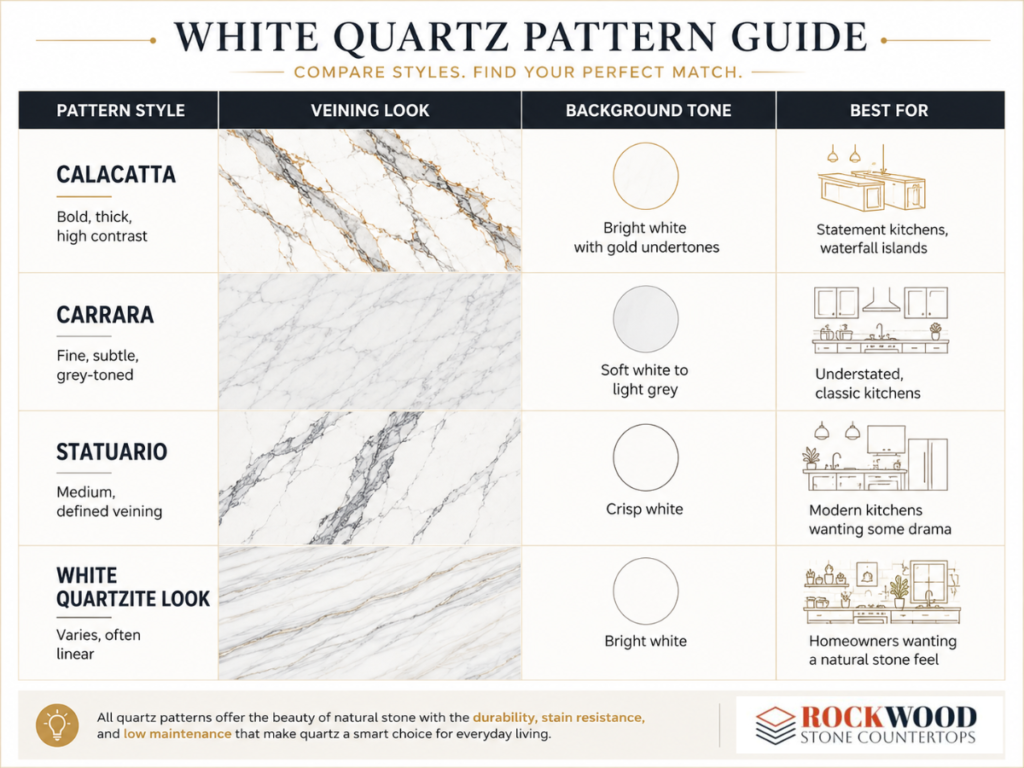
Homeowners who like the bright white base of Calacatta but want a different veining texture sometimes also look into white quartzite countertops as a related but distinct option, since quartzite is a natural stone with its own characteristics worth understanding before deciding between the two.
What Should You Expect During Calacatta Quartz Installation?
Installation typically takes one to two days from templating to final placement, and it requires precise seam planning because Calacatta’s bold veining makes mismatched seams far more noticeable than with simpler patterns. A skilled installer plans seam placement around the vein movement so the pattern reads as continuous.
The process starts with a template of your existing cabinets, usually done after cabinets are installed but before the old countertop is fully removed if you’re doing a renovation. The slab is then cut at a fabrication facility, and the finished pieces are delivered and set in place, with seams sealed and polished on site. Because Calacatta veining runs in bold, sweeping directions rather than a uniform pattern, an experienced fabricator will show you exactly where the slab will be cut and how the veining will flow across seams before cutting begins. This step matters more with Calacatta than with plainer quartz colors, since a poorly planned seam can visibly interrupt a vein line and become a permanent eyesore in the kitchen.
A soft but useful piece of advice here: always ask to see the actual slab your countertop will be cut from, not just a sample chip. Quartz slabs, even within the same product line, can vary slightly in veining density and placement from batch to batch, and seeing the real slab avoids any surprise once it’s installed in your home.
What Does Calacatta Quartz Cost in Winnipeg?
Calacatta quartz typically costs more than solid-color or simpler-patterned quartz because of the complexity involved in manufacturing realistic, large-scale veining. Pricing depends on slab size, thickness, edge profile, and how much of the kitchen the countertop needs to cover, including islands and backsplashes.
Homeowners planning a full kitchen with a large island, especially one using a waterfall edge where the veining wraps continuously down the side, should expect a higher cost than a standard L-shaped counter layout, simply because waterfall edges require more careful slab matching and use more material. Getting a detailed quote based on your actual kitchen layout, rather than a generic per-square-foot estimate, gives a much more accurate picture of total cost.
Bringing Calacatta Quartz Into Your Winnipeg Kitchen
Calacatta quartz gives homeowners a striking, timeless look that holds up to real daily life, without the sealing schedule and staining risk that comes with natural marble. The bold veining makes a statement in a kitchen renovation, but getting it right depends on choosing a well-manufactured slab and working with a fabricator who understands how to plan seams around dramatic patterns rather than against them.
If you’re ready to see how Calacatta quartz would actually look in your kitchen, the best next step is viewing real slabs in person rather than relying on small samples. Rockwood Stone Countertops works with Winnipeg homeowners through every stage of the process, from slab selection to precise fabrication of quartz kitchen worktops, helping you get a result that matches exactly what you pictured for your space.
People Also Ask
Is Calacatta Quartz More Expensive Than Regular Quartz?
Yes, generally. Calacatta quartz costs more than solid-color or simple-pattern quartz because replicating realistic marble veining requires more advanced manufacturing. The exact price difference depends on the brand, slab size, and how dramatic the veining pattern is.
Does Calacatta Quartz Need to Be Sealed?
No. Unlike natural marble, quartz is non-porous because of its resin content, so it never needs sealing. This is one of the main reasons homeowners choose quartz versions of the Calacatta look over the real marble.
Can Calacatta Quartz Be Used for Kitchen Islands and Backsplashes?
Yes. Calacatta quartz works well for islands, waterfall edges, and backsplashes, and using it across multiple surfaces creates a cohesive, continuous look throughout the kitchen. Matching veining across a waterfall edge requires careful slab selection during fabrication.
How Long Does Calacatta Quartz Last?
With proper installation, Calacatta quartz typically lasts as long as the kitchen itself, often 20 years or more, since it resists scratching, staining, and heat damage far better than many natural stone alternatives under normal daily use.
Is Calacatta Quartz Heat Resistant?
Quartz handles moderate heat well, but manufacturers generally recommend using a trivet or hot pad under very hot pots and pans. Direct, prolonged heat exposure can cause discoloration or damage over time, even though quartz resists everyday cooking heat.