
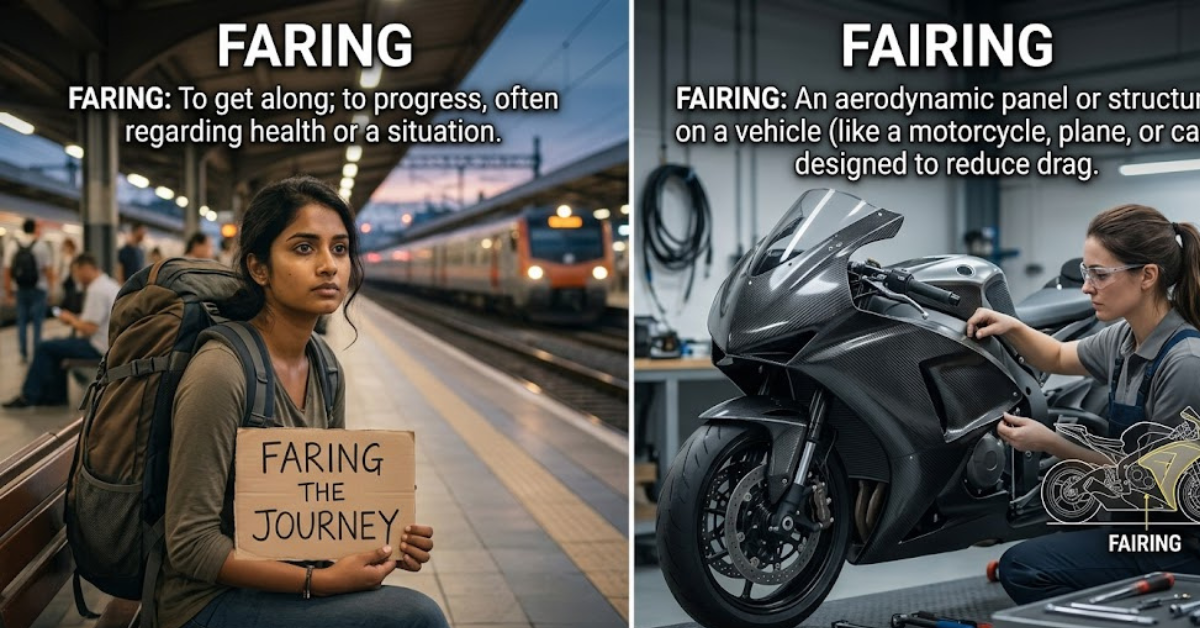
English has a way of creating confusion with words that sound similar but come from completely different roots. One such pair is faring vs fairing. At first glance, they may look like spelling variations of the same word, but in reality, they serve very different purposes in grammar and communication.
Understanding this difference is especially useful for learners, writers, and anyone who wants to avoid common spelling mistakes. One word relates to how someone is doing, while the other is a technical term used in engineering and design.
This guide explains faring vs fairing meaning, differences, pronunciation, examples, and memory tricks in a simple and practical way.
What Is the Difference Between Faring vs Fairing?
The difference comes down to meaning and usage context.
- Faring comes from the verb “fare,” meaning how someone is doing or progressing.
- Fairing is a noun used in engineering, aviation, and design to describe a smooth outer structure that reduces drag.
Even though they sound alike, they are not interchangeable in any context.
Faring vs Fairing Meaning
To understand faring vs fairing meaning clearly, it helps to break them down separately.
Meaning of Faring
“Faring” is the present participle of the verb “fare.” It refers to how someone is doing, especially in terms of health, situation, or progress.
Examples:
- How are you faring after the surgery?
- He is faring well in his new job.
- They are faring better than expected.
It is often used in questions or descriptions of progress.
Meaning of Fairing
“Fairing” is a technical term used in engineering, aviation, automotive design, and spacecraft construction.
It refers to:
- A structure that reduces air resistance or improves aerodynamics
Examples:
- The airplane has a streamlined fairing.
- The motorcycle fairing improves speed and stability.
- Rocket fairings protect payloads during launch.
Faring vs Fairing Pronunciation
One reason people confuse faring vs fairing is pronunciation.
In most English accents, both words sound identical:
- /ˈfeərɪŋ/
Because they are homophones, spelling and context are the only ways to tell them apart.
How to Use “Faring” Correctly
“Faring” is used in everyday conversational and formal English.
Faring in Questions
Examples:
- How are you faring these days?
- How is the company faring in the market?
Faring in Descriptions
Examples:
- The students are faring well in exams.
- The project is faring better after improvements.
It usually appears with words like:
- well
- badly
- better
- worse
How to Use “Fairing” Correctly
“Fairing” is mainly used in technical fields.
Fairing in Aviation
Examples:
- The aircraft’s fairing reduces air drag.
- Engineers designed a new wing fairing.
Fairing in Automotive Design
Examples:
- The motorcycle fairing improves aerodynamics.
- Racing bikes use lightweight fairings.
Fairing in Space Technology
Examples:
- The rocket fairing protects the satellite.
- The payload fairing separates after launch.
Why People Confuse Faring and Fairing
There are several reasons for this confusion:
Identical Pronunciation
Both words sound the same in spoken English.
Similar Spelling
Only one extra letter changes the meaning.
Limited Exposure to “Fairing”
Most people encounter “faring” more often in everyday speech, while “fairing” is technical.
Fast Typing Errors
The similarity often leads to accidental misspellings.
Easy Memory Tricks
Simple associations can help you remember the difference.
Remember Faring = How You Are Doing
Think:
- Farewell
- How are you faring?
- Life progress
Faring always relates to condition or progress.
Remember Fairing = Engineering Shape
Think:
- Airplane
- Motorcycle
- Rocket
Fairing always relates to smooth design and aerodynamics.
Common Examples Using Faring
Here are practical examples of how “faring” is used:
- How are you faring in your new school?
- She is faring well after the move.
- The business is faring better this year.
- They are faring poorly in difficult conditions.
Common Examples Using Fairing
Here are examples from technical contexts:
- The rocket fairing separated successfully.
- The car’s fairing reduces wind resistance.
- Engineers improved the fairing design.
- The aircraft fairing enhances performance.
Faring vs Fairing in Real Life
These words appear in very different environments.
Faring in Daily Communication
Used in:
- Conversations
- Health updates
- Job performance discussions
Example:
- How are you faring today?
Fairing in Technical Fields
Used in:
- Aerospace engineering
- Automotive design
- Mechanical systems
Example:
- The fairing improves aerodynamic efficiency.
Why Context Matters
Because pronunciation does not help, context is essential.
For example:
- “How are you faring?” refers to personal condition.
- “The aircraft fairing” refers to physical structure.
Without context, meaning would be unclear.
FAQs
What is the difference between faring vs fairing?
Faring refers to how someone is doing or progressing, while fairing is a technical structure used to improve aerodynamics.
Are faring and fairing pronounced the same?
Yes, both are pronounced the same in most English accents.
What does faring mean?
Faring means how someone or something is performing or progressing.
What does fairing mean in engineering?
Fairing is a structure designed to reduce air resistance in vehicles or aircraft.
Why do people confuse faring and fairing?
Because they sound identical and have similar spelling patterns.
Where is fairing commonly used?
Fairing is commonly used in aviation, automotive design, and aerospace engineering.
Conclusion
Understanding faring vs fairing becomes simple once you focus on meaning and context. Faring is a general English word used to describe how someone or something is doing, while fairing is a technical term used in engineering and design to improve aerodynamics.
Although they sound identical, their usage is completely different. Recognizing this distinction helps you avoid common spelling mistakes and improves clarity in both everyday and technical communication.
Mastering confusing word pairs like these strengthens your vocabulary and builds confidence in accurate English usage.