
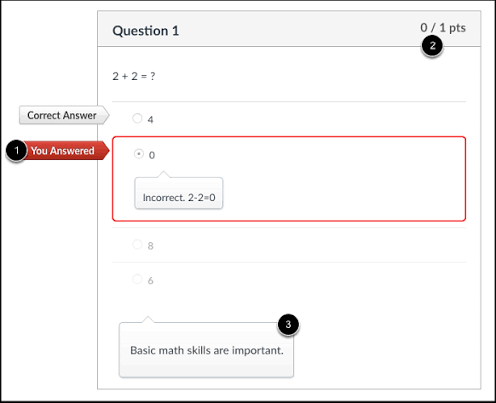
A Canvas multiple-choice question can look simple until one little word makes you realize that the question has a different intent. Best, main, most likely, but not all including first change which option is logical to choose. One of the most important steps in answering questions is to learn how to detect these tiny hints.
Canvas MCQ Study Guide: It also allows you to practice observing these types of details while working through the various question types.
The issue is that when you read the answer choices before really understanding what the question is asking. As a result, two or three options can seem right. Do Not Rush, Slow Down and Find the Little Things that Guide How the Question Went
Read the Question Before Looking at the Answers
If you spot a multiple-choice question, it feels instinctive to look at the answers first. This can affect your thinking even before you clarify the question.
Read the question once carefully without peeping into the choices. Ask yourself:
- What topic is this about?
- What exactly is being asked?
- Does the answer require a single fact, or does it compare something?
- Does it specify a time, place, condition or situation?
Then look at the options.
An example question could be about what was the main reason something happened. While some of the answers have a relationship to this subject matter, only one is likely identifying the root cause.
The small clue is the “main” word.
Watch for Words That Limit the Answer
Look out for qualifiers
Some words indicate how narrow your response should be.
Consider words such as:
- Best
- Main
- Most likely
- First
- Primary
- Except
- Least
- Always
- Never
These words should give you pause —
For example, there may be four options cell phone use are related to a lesson and the question is asking that which one is the main problem. The option might not be enough if it is simply based on the subject. You want the option that matches those specific words.
This is one of the reasons why a Canvas MCQ Study Guide can come in handy when practicing. Practice questions will tell you precisely which words made you answer a question one way or the other instead of just whether it was right or wrong.
Look for the Question’s Direction
A hint can help you decide where to go with your mind.
Compare these two questions:
Which aspect was responsible for the outcome?
The reason to the result was influenced mainly by which factor?
They sound similar, but they are not quite the same question.
The first question might have even allowed an answer that contributed. The latter asks you to pick out the biggest or most prevalent cause.
The same while also going to words like “before”, “after”, “during” and “follow”. A student may have all the facts memorized but pick the wrong answer if that timing doesn’t match with the question.
Detect the direction of a question before making a choice.
Do Not Treat Every True Statement as the Right Answer
The real challenge with multiple choice questions is that more than one option can sound true.
It is not always about finding a true statement. Our task is basically to search for the statement which responds to the inquire.
Let us give you an example of a question that talks about history. Three options could be used to describe things that presumably occurred during this time. But the question might instead ask what was the most important impact that this event had.
All three answers can be factually correct, and yet only one answer is answering the question directly.
Ask yourself:
Does this answer actually address what the question asked?
That simple verification cleans out a lot of glad temptations.
Pay Attention to Negative Words
Negative words tend to cause a reversal of the task, so they need to be paid extra attention.
It is easy to miss words like not, except, least and never when reading fast.
For example:
Not an example of Which one of the following is real…?
Whereas now you are in search of the incorrect or unsuitable possibility versus an acceptable instance.
One of the helpful habits is to stress on that negative word in your mind while reading the options. You would be even able to encapsulate the inquiry in more straightforward language.
Instead of thinking:
Which Of The Following Is NOT An EXAMPLE?
Think:
The option which doesn’t fit me.
This will lower the probability of choosing an answer that would have been correct for its negated question.
Compare Similar Answers Carefully
The clue does not always lie in the question by itself. That is in the variation between 2 answer selections.
You might see options that vary by just a word or two. Do not dismiss those small differences as irrelevant.
Look for changes in:
- Time
- Quantity
- Cause
- Result
- Degree
- Condition
- Who or what is involved
Two responses might discuss similar general concepts, but one states “always,” while the other describes “most of the time.” This tiny word makes all the difference in the claims.
The Second Rule of Eliminating Answers — If Two Choices Are Almost the Same — Ask Why Did the Question Writer (obj 1) Put Both That difference might be your clue.
Use Elimination Before Making a Final Choice
You donat always need to have the answer right off the bat.
The first step is to eliminate the options that are clearly not right. Next, compare the remaining options with the actual wording of the question.
A simple process is:
- Read the question carefully.
- Find the word or condition that matters most.
- Remove clearly wrong choices.
- Compare the remaining choices.
- Pick the option which answers the question in detail.
- One last time read the question and its answer together.
This comes in handy when you get stuck between two choices.
Practice Finding the Clue, Not Just the Answer
Your training is on data until October 2023.
Do not ask while studying “What is the right answer?
Ask a second question:
Which teaser was useful from the question to help me pick it?
The tip-off was perhaps the word “probably.” Perhaps It was some sort of qualifier in the question. Perhaps one of the responses regarding the time period changed or broadened it by too much.
Such practice can render you alert when tackling novel queries.
A Canvas MCQ Study GuideWrite a CSS styling that adapts this sort of a webabout the study guide can make space for fitting into this sort of reviewthat also gives you a new approach for working through multiple choice questionsand an opportunity to reconcile why its one option fitsbetter than another.
Slow Down at the Right Moment
You should not be reading each question painfully slow. So slower, when there is an uncertainty.
The presence of two right-looking choices will prompt you to reread the question. Find the keyword or condition that keeps them apart.
In many cases, the answer is not tucked away in some elaborate ruse. The answer is right there in the question. All you need to do is recognise the question,
Next time a Canvas multiple-choice question gets tricky, do not hurry to guess. Read it again, locate the minute hint and then use that hint to rule your choices. If you practice regularly then it will be natural to identify such things when solving multiple-choice questions.