Have you ever seen the words oar vs ore and wondered whether they mean the same thing? Despite sounding exactly alike, these two words have entirely different meanings and are used in completely separate contexts. They are examples of homophones—words that share the same pronunciation but have different spellings and definitions.
In this guide, we’ll break down the difference between oar and ore, explore their meanings, provide practical examples, and explain how to remember which word to use correctly.
What Does “Oar” Mean?
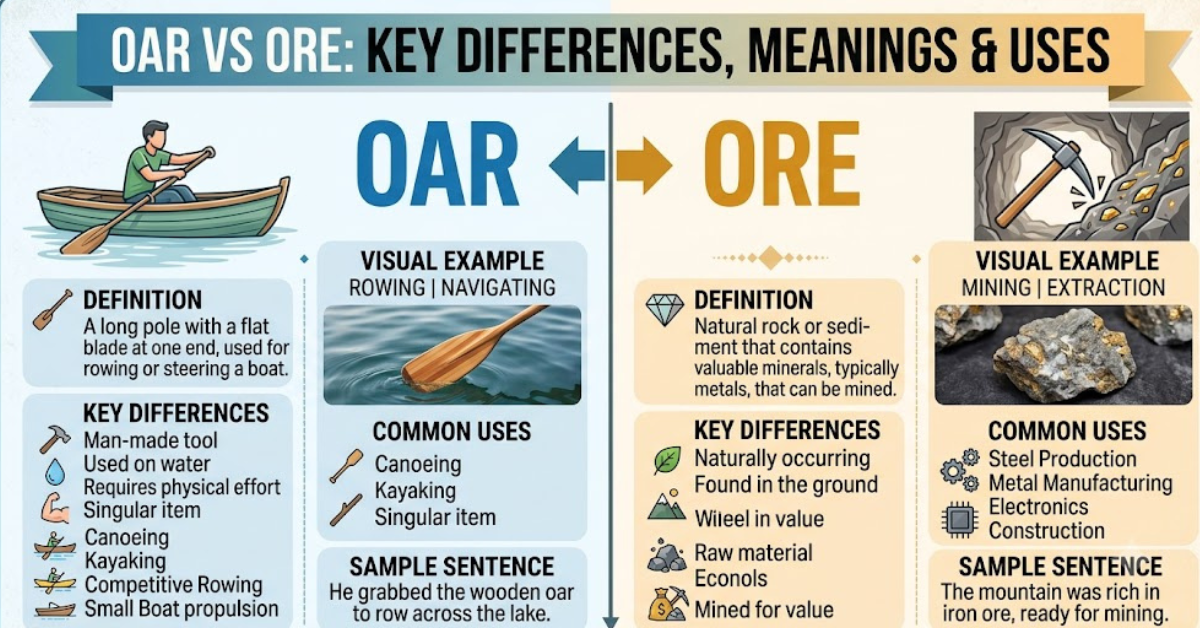
An oar is a long pole with a flat blade at one end, used to propel and steer a boat through the water. Oars have been essential tools for transportation, fishing, and recreation for thousands of years.
They are typically used in activities such as:
- Rowing boats
- Canoeing and kayaking (though paddles are more common)
- Racing competitions
- Traditional water transport
Examples of Oar in a Sentence
- The fisherman grabbed his oar and pushed the small boat away from the shore.
- She learned how to row using a pair of wooden oars.
- The rowing team moved their oars in perfect synchronization.
The History of Oars
The use of oars dates back to ancient civilizations, including the Egyptians, Greeks, and Vikings. Before engines existed, oars were among the primary methods of moving ships across rivers, lakes, and seas.
Modern oars are made from materials such as wood, fiberglass, carbon fiber, and plastic, depending on their intended purpose.
What Does “Ore” Mean?
Ore refers to a naturally occurring rock or mineral that contains valuable elements, usually metals, that can be extracted economically through mining.
Common types of ore include:
- Iron ore – Used to produce steel.
- Copper ore – Used in electrical wiring and electronics.
- Gold ore – Contains gold particles that can be refined.
- Bauxite ore – The main source of aluminum.
Examples of Ore in a Sentence
- The mining company discovered a large deposit of iron ore.
- Workers extracted valuable metals from the ore found underground.
- The country exports millions of tons of mineral ore every year.
How Ore Is Processed
The journey from ore to usable metal generally involves several steps:
- Mining – Ore is removed from the earth.
- Crushing and Grinding – Large rocks are broken into smaller pieces.
- Separation – Valuable minerals are separated from waste material.
- Smelting and Refining – Metals are extracted and purified.
This process transforms raw mineral deposits into materials used in construction, technology, transportation, and countless everyday products.
Oar vs Ore: Side-by-Side Comparison
Understanding oar vs ore becomes easier when you compare their characteristics.
| Feature | Oar | Ore |
| Meaning | A tool used to move a boat | A rock containing valuable minerals or metals |
| Category | Water equipment | Geological material |
| Used In | Rowing, boating, navigation | Mining, metal production |
| Found In | Boats and watercraft | Underground deposits and mines |
| Example | “He picked up an oar.” | “They extracted iron ore.” |
Why Are Oar and Ore Often Confused?
The main reason people confuse oar and ore is that they are pronounced the same way. Both words sound like “or,” but their spellings and meanings are completely unrelated.
This type of word pair is called a homophone. Other common examples include:
- Their, there, and they’re
- Sea and see
- Flour and flower
- Knight and night
Knowing the context of the sentence is the easiest way to determine whether “oar” or “ore” is correct.
Easy Tricks to Remember Oar vs Ore
If you struggle to remember the difference between oar vs ore, these simple memory tips can help:
Remember Oar with Water
The word oar contains the letter “A,” which can remind you of aquatic activities and adventures on water.
Remember Ore with Earth
The word ore contains “ore,” which is often associated with rocks, minerals, and resources from the earth.
By linking each word to its environment, choosing the correct spelling becomes much easier.
Common Mistakes When Using Oar and Ore
Many people accidentally use these words incorrectly in writing. Here are some examples:
The miners discovered a large amount of iron oar.
The miners discovered a large amount of iron ore.
The sailor used an ore to row the boat.
The sailor used an oar to row the boat.
Pay attention to the subject of the sentence—water usually relates to an oar, while mining relates to ore.
Frequently Asked Questions (FAQs)
Is an oar the same as an ore?
No. An oar is a tool used to row a boat, while ore is a rock containing valuable minerals or metals.
Why do oar and ore sound the same?
They are homophones, which means they have the same pronunciation but different meanings and spellings.
What is an example of an ore?
Examples of ore include iron ore, copper ore, gold ore, and bauxite ore. These materials are mined and processed to extract useful metals.
What is an example of an oar?
A wooden rowing oar used in a small boat or a carbon-fiber oar used by professional rowers are common examples.
Is a paddle the same as an oar?
No. While both are used to move watercraft, a paddle is usually held directly by the user and does not attach to the boat, while an oar is typically connected to the boat through an oarlock.
Conclusion: Oar vs Ore Explained Simply
Understanding oar vs ore is simple once you know their distinct meanings. An oar is a boating tool used to move a vessel through water, while ore is a natural rock that contains valuable minerals and metals extracted through mining.
Although they sound identical, the context of the sentence makes the correct choice clear. The next time you encounter these homophones, remember: oars belong on the water, and ores come from the earth. For more language guides and word comparisons, explore related articles to strengthen your vocabulary and writing skills.