Have you ever paused while writing and wondered whether to use eg vs ie? You’re not alone. These two Latin abbreviations appear frequently in academic papers, emails, articles, and professional documents, yet they are often confused because they seem to introduce similar information.
The truth is that e.g. and i.e. have different meanings and purposes. Understanding the distinction can make your writing clearer, more precise, and more professional. This guide explains the difference between e.g. vs i.e., when to use each one, common mistakes to avoid, and simple tricks to remember them.
What Does e.g. Mean?
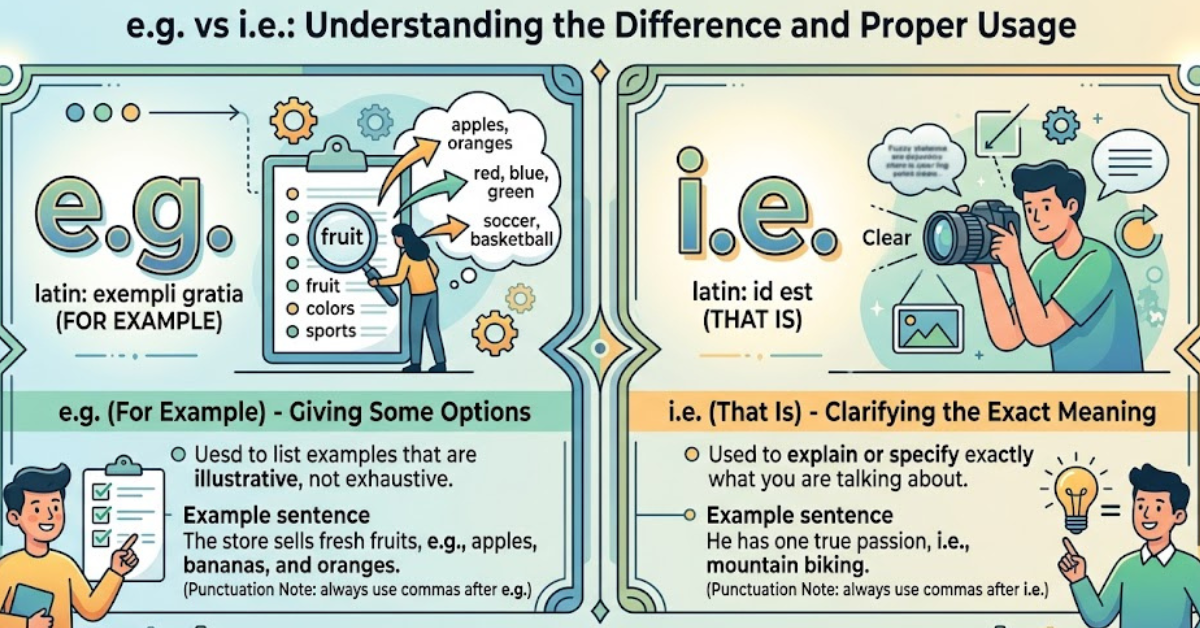
The abbreviation e.g. comes from the Latin phrase exempli gratia, which translates to “for example.” It is used when you want to provide one or more examples of a larger category.
How to Use e.g. Correctly
Use e.g. when the items you mention are only examples and not a complete list.
Examples:
- I enjoy outdoor activities, e.g., hiking, swimming, and cycling.
- Many fruits, e.g., apples and oranges, contain essential vitamins.
- You should bring comfortable clothing, e.g., sneakers and a jacket.
In each case, the examples listed are not the only possibilities.
Easy Way to Remember e.g.
A popular memory trick is:
e.g. = Example Given
Although this is not the literal Latin translation, it helps many writers remember that e.g. introduces examples.
What Does i.e. Mean?
The abbreviation i.e. comes from the Latin phrase id est, meaning “that is” or “in other words.” It is used to clarify, explain, or restate something more precisely.
How to Use i.e. Correctly
Use i.e. when you want to provide a complete explanation or a more specific definition of something.
Examples:
- The meeting has been moved to the last day of the workweek, i.e., Friday.
- She is a vegetarian, i.e., she does not eat meat or fish.
- The company is introducing a four-day schedule, i.e., employees will work Monday through Thursday.
The information after i.e. explains exactly what the writer means.
eg vs ie Key Differences
Understanding e.g. vs i.e. is easier when you compare them side by side:
| Feature | e.g. | i.e. |
| Latin origin | exempli gratia | id est |
| Meaning | For example | That is / in other words |
| Purpose | Gives examples | Provides clarification |
| Indicates a complete list? | No | Usually yes |
| Memory trick | Example Given | In Essence |
Simple Comparison Sentence
- Bring a warm drink, e.g., tea or coffee. (Tea and coffee are examples.)
- Bring a warm drink, i.e., hot tea. (The writer specifically means hot tea.)
Common Mistakes When Using e.g. and i.e.
Many writers use e.g. and i.e. interchangeably, but doing so can change the meaning of a sentence.
Mistake 1: Using i.e. When You Mean “For Example”
Incorrect:
- I love tropical fruits, i.e., mangoes and pineapples.
Correct:
- I love tropical fruits, e.g., mangoes and pineapples.
Mangoes and pineapples are examples, not the only tropical fruits.
Mistake 2: Using e.g. When You Mean “In Other Words”
Incorrect:
- The event is postponed until the first day of the weekend, e.g., Saturday.
Correct:
- The event is postponed until the first day of the weekend, i.e., Saturday.
Saturday is the specific day being referred to.
Punctuation Rules for e.g. and i.e.
Different style guides have slightly different preferences, but these general rules are widely accepted:
- Use periods in formal writing: e.g. and i.e.
- In American English, a comma often follows the abbreviation: e.g., and i.e.,
- Place the abbreviation inside parentheses when it adds extra information.
Example:
- Many programming languages (e.g., Python and JavaScript) are beginner-friendly.
Should You Use e.g. and i.e. in Professional Writing?
Yes, but use them appropriately. They are common in:
- Academic papers
- Research articles
- Business reports
- Technical documents
- Professional emails
However, in casual writing, you can often replace them with plain English:
- e.g. → for example
- i.e. → that is or in other words
Using the full phrase may make your writing easier for all readers to understand.
e.g. vs i.e. in Academic and Business Writing
In formal contexts, precision matters. A small abbreviation can change the meaning of a sentence, especially in legal, scientific, or professional documents.
For example:
- The company provides several benefits, e.g., health insurance and retirement plans.
(These are examples of benefits.) - The company has one mandatory holiday, i.e., New Year’s Day.
(The exact holiday is identified.)
Choosing the correct term improves clarity and prevents misunderstandings.
FAQs About e.g. vs i.e.
Is e.g. the same as i.e.?
No. e.g. means “for example,” while i.e. means “that is” or “in other words.” They serve different purposes in a sentence.
When should I use e.g.?
Use e.g. when you are giving examples of a broader category and your list is not complete.
When should I use i.e.?
Use i.e. when you are explaining, clarifying, or specifying exactly what you mean.
Should there be a comma after e.g. and i.e.?
In American English, a comma usually follows e.g. and i.e. In British English, the comma may be omitted depending on the style guide.
Can I replace eg vs ie with English phrases?
Yes. You can replace:
- e.g. with “for example”
- i.e. with “that is” or “in other words”
Which is more formal: e.g. or for example?
Both are acceptable in formal writing, but “for example” is often easier for general audiences to understand.
Conclusion
Understanding eg vs ie is a small but valuable writing skill that improves accuracy and professionalism. Remember that e.g. introduces examples, while i.e. provides clarification or a precise explanation. A simple memory trick—e.g. = example given, i.e. = in essence—can help you choose the right abbreviation every time.
Whether you’re writing an email, research paper, blog post, or business document, using e.g. and i.e. correctly will make your ideas clearer and easier to understand. For more grammar and writing tips, explore related guides on punctuation, style, and professional communication.