Have you ever paused while writing and wondered whether it should be “to small or too small”? You’re not alone. This is one of the most common English grammar mistakes, especially for learners and casual writers. The confusion comes from the fact that “to” and “too” sound exactly the same, but they have completely different meanings.
In simple terms, “too small” is the correct phrase when you mean something is excessively small or not big enough. The phrase “to small” is usually a spelling mistake unless “to” is being used as a preposition in a completely different sentence structure.
This guide explains the difference between to small or too small, provides real examples, and shares easy tricks to remember the correct usage.
What Does “Too Small” Mean?
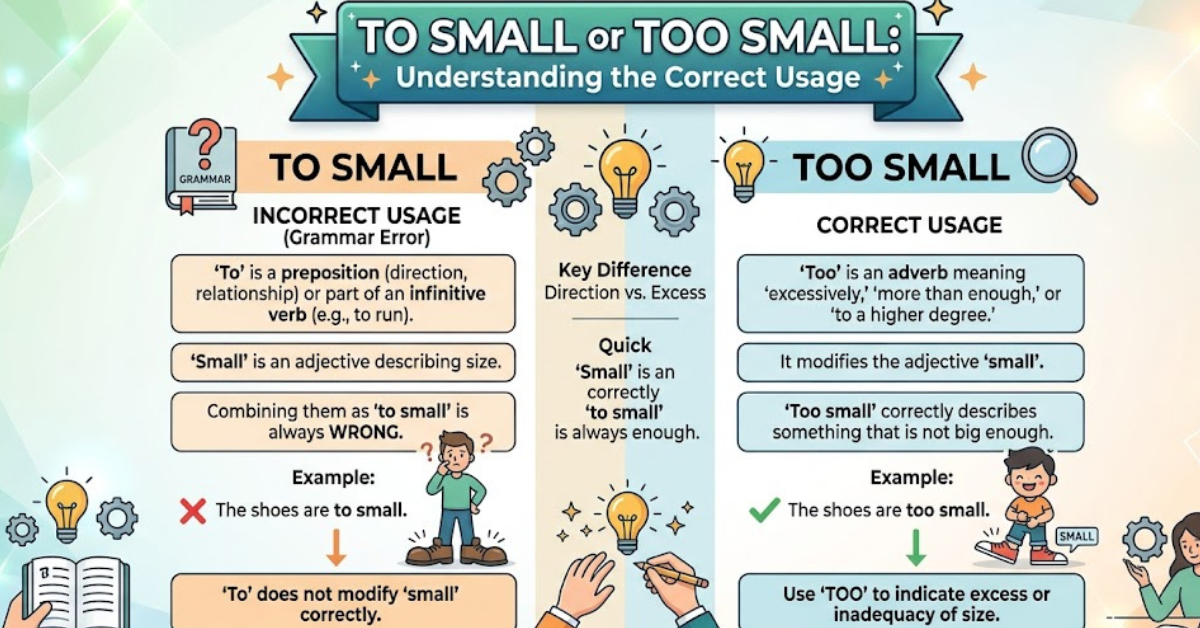
The phrase “too small” means that something is smaller than necessary, acceptable, or desired. The word “too” is an adverb that means “excessively,” “more than enough,” or “more than desired.”
Examples of “Too Small” in Sentences
- This shirt is too small for me.
- The apartment was too small for a family of five.
- The text on the screen is too small to read comfortably.
- The amount of money offered was too small to cover the expenses.
In each example, “too” indicates that the size or amount does not meet the required standard.
Is “To Small” Ever Correct?
When comparing to small or too small, the phrase “to small” is generally incorrect if you are describing size.
For example:
The shoes are to small.
The shoes are too small.
However, the word “to” itself is perfectly correct when used as a preposition or as part of an infinitive verb.
Examples:
- I walked to the small store near my house.
- She wants to make small improvements to her room.
Notice that “to” is not describing size in these cases; it has a different grammatical function.
The Difference Between “To” and “Too”
Understanding the distinction between these two words can prevent many writing errors.
“To”
“To” is usually used as:
- A preposition showing direction or place.
- Part of an infinitive verb.
Examples:
- I am going to the park.
- He wants to learn English.
“Too”
“Too” is used to mean:
- More than enough.
- Also or as well.
Examples:
- The coffee is too hot.
- I would like to come too.
When talking about size, the correct expression is always “too small.”
Easy Trick to Remember “Too Small”
A simple memory trick can help you avoid the to small or too small mistake.
Think of the extra “O” in the word too as meaning “extra” or “more than needed.”
- Too small = Extra small or more small than desired.
- Too expensive = More expensive than you can afford.
- Too loud = More noise than is comfortable.
The extra letter reminds you that there is an excess of something.
Common Mistakes and Correct Examples
Here are some frequently seen errors:
| Incorrect | Correct |
| The dress is to small. | The dress is too small. |
| The font is to small to read. | The font is too small to read. |
| The room is to small for everyone. | The room is too small for everyone. |
| The amount is to small. | The amount is too small. |
Reviewing these examples can help reinforce proper English grammar.
Why Do People Confuse “To Small” and “Too Small”?
The main reason people confuse these words is that to, too, and two are homophones, meaning they sound the same when spoken.
This mistake is especially common in:
- Text messages and social media posts.
- Informal writing.
- English learning exercises.
- Fast typing where proofreading is skipped.
Learning the role of each word makes it easier to choose the correct spelling.
Similar Grammar Mistakes to Avoid
If you struggle with to small or too small, you may also confuse other similar words, such as:
- Your vs. You’re
- Their vs. There vs. They’re
- Its vs. It’s
- Then vs. Than
- Affect vs. Effect
These words may sound similar but carry different meanings and grammatical functions.
FAQs About “To Small or Too Small”
Is it “to small” or “too small”?
The correct phrase is “too small” when you mean something is smaller than needed or acceptable. “To small” is usually a grammar mistake.
What does “too small” mean?
“Too small” means something is excessively small or not large enough for a particular purpose.
Can “to small” ever be correct?
Yes, but only when “to” is part of a different sentence structure, such as “go to small towns” or “speak to small groups.” It is not correct when describing size.
Why is “too” used before “small”?
The word “too” means “more than necessary” or “excessively,” making “too small” the proper phrase for describing insufficient size.
How can I remember the difference between “to” and “too”?
Remember that too has an extra “O,” which represents something extra or excessive, helping you remember that “too small” means excessively small.
Conclusion
The debate over to small or too small has a straightforward answer: “too small” is the correct phrase when you are talking about something being smaller than needed. The word “too” indicates excess, while “to” serves as a preposition or forms part of an infinitive verb.
By understanding this simple grammar rule and practicing with real examples, you can avoid a common writing mistake and communicate more clearly. Continue improving your English by exploring other commonly confused words and mastering the small details that make writing more accurate and professional.