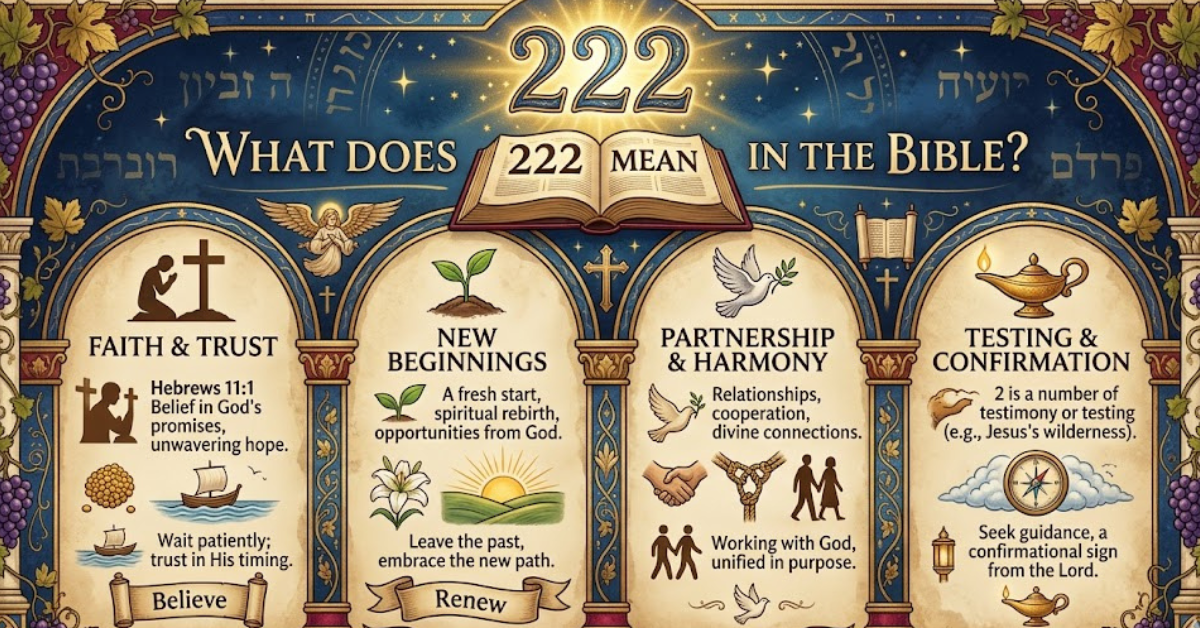
Have you ever looked at the clock and noticed 2:22, seen the number 222 repeatedly, and wondered if it carries a deeper spiritual message? Many people searching for answers ask, what does 222 mean in the Bible, hoping to understand whether this number has a special connection to God, faith, and biblical teachings.
While the Bible does not directly mention “222” as a symbolic number with a defined meaning, many believers explore its significance through the biblical themes connected to the number two, such as unity, testimony, partnership, and God’s promises. This article explores the biblical perspective, symbolism, and spiritual lessons often associated with 222.
Is 222 Mentioned Directly in the Bible?
A common misconception is that every repeating number has a specific biblical interpretation. In reality, the Bible does not identify 222 as a sacred or prophetic number in the same way certain numbers like 7, 12, or 40 are often understood symbolically.
However, biblical numerology—the study of the symbolic meaning of numbers in Scripture—has led many people to examine the meaning of the number 2 and how its repetition in 222 might emphasize related spiritual concepts.
It is important to distinguish between personal spiritual reflection and direct biblical teaching. Christians may find encouragement in certain number patterns, but Scripture itself should remain the primary source of understanding.
The Biblical Meaning of the Number 2
Throughout the Bible, the number two often represents agreement, confirmation, and companionship. Since 222 consists of the number 2 repeated three times, some interpret it as a stronger reminder of these themes.
Unity and Partnership
One of the most common associations of the number two in Scripture is unity. The Bible frequently highlights the importance of relationships, cooperation, and standing together in faith.
For example, the creation story describes the partnership between man and woman, emphasizing the importance of companionship and mutual support.
The idea of unity is also seen in the teaching that two witnesses establish a matter, representing truth and confirmation.