
Have you ever come across the terms kinesthesiology and kinesiology and wondered whether they mean the same thing? You’re not alone. These words are often used interchangeably, leading to confusion among students, healthcare professionals, fitness enthusiasts, and even educators.
When comparing Kinesthesiology vs Kinesiology, the distinction is often more about terminology, educational context, and professional usage than completely different fields of study. Understanding these differences can help you choose the right academic path, career direction, or treatment approach.
In this guide, you’ll learn what each term means, how they are used, their career opportunities, educational requirements, and why the confusion exists in the first place.
What Is Kinesiology?
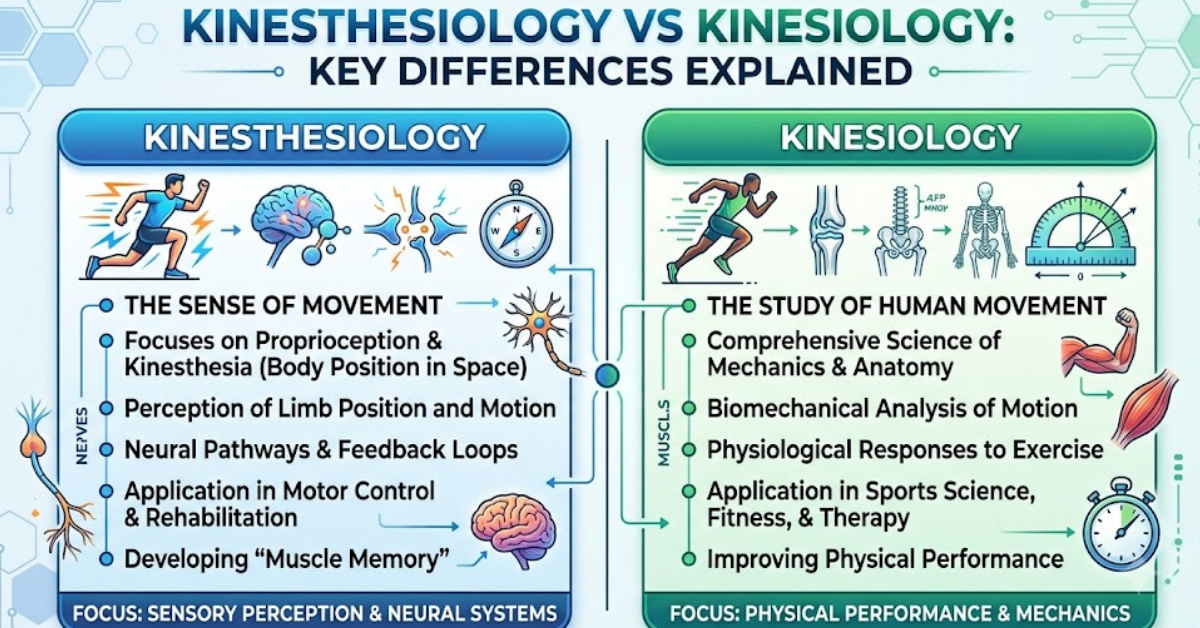
Kinesiology is the scientific study of human movement. It examines how muscles, bones, joints, and the nervous system work together to produce motion.
The field combines knowledge from several disciplines, including:
- Anatomy
- Physiology
- Biomechanics
- Psychology
- Motor learning
- Exercise science
- Neuroscience
Kinesiology helps researchers and professionals understand how movement affects health, performance, rehabilitation, and quality of life.
Areas of Study Within Kinesiology
Kinesiology is a broad discipline that includes:
- Exercise physiology
- Sports science
- Athletic training
- Physical education
- Motor control
- Rehabilitation sciences
- Occupational therapy foundations
- Ergonomics
Many universities offer kinesiology degree programs that prepare students for careers in healthcare, fitness, sports performance, and research.
What Is Kinesthesiology?
Kinesthesiology is a less commonly used term and is often associated with the concept of kinesthesia, which refers to the body’s ability to sense movement, position, and action.
In some regions and professional circles, kinesthesiology is used as an alternative spelling or variation of kinesiology. However, in other contexts, it may specifically emphasize movement awareness and sensory perception.
Understanding Kinesthesia
Kinesthesia allows people to:
- Walk without constantly looking at their feet
- Touch their nose with their eyes closed
- Maintain balance during movement
- Coordinate complex physical actions
The sensory information involved in kinesthesia comes from receptors in muscles, tendons, and joints that continuously communicate with the brain.
Kinesthesiology vs Kinesiology: The Main Difference
The biggest source of confusion is that the terms often overlap.
Here’s a straightforward comparison:
| Feature | Kinesiology | Kinesthesiology |
| Primary Meaning | Scientific study of human movement | Often related to movement awareness or used interchangeably |
| Academic Recognition | Widely recognized university discipline | Less common academic term |
| Scope | Broad and multidisciplinary | Often narrower or alternative terminology |
| Career Applications | Healthcare, sports, fitness, research | Movement-based therapies, education, alternative practices |
| Global Usage | Common worldwide | Less frequently used |
In many cases, Kinesthesiology vs Kinesiology is not a matter of two completely separate professions. Instead, kinesiology is the more widely accepted scientific and academic term.
Why Are the Terms Often Confused?
Several factors contribute to the confusion.
Similar Linguistic Origins
Both words come from the Greek word kinesis, meaning movement.
Because of this shared root, they naturally describe related concepts.
Regional Differences
Different countries, institutions, and professional organizations may prefer one term over the other.
For example:
- Universities generally use “kinesiology.”
- Some practitioners and educational materials use “kinesthesiology.”
- Alternative therapy fields may adopt different interpretations.
Overlapping Subject Matter
Both terms focus on movement, body mechanics, and physical function, making distinctions less obvious to the general public.
The Science Behind Human Movement
To understand the relationship between the two terms, it helps to explore the science that drives movement.
Human movement depends on the interaction of several systems:
Musculoskeletal System
This includes:
- Bones
- Muscles
- Tendons
- Ligaments
- Joints
These structures generate and support movement.
Nervous System
The brain and spinal cord control muscle activation and coordination.
The nervous system processes information from sensory receptors and directs movement accordingly.
Cardiovascular System
Physical activity requires oxygen and nutrients delivered through the circulatory system.
Sensory Feedback System
Kinesthetic awareness depends heavily on sensory feedback that helps the body understand position and movement.
Educational Pathways in Kinesiology
Students interested in human movement often pursue degrees in kinesiology.
Bachelor’s Degree Programs
Common coursework includes:
- Human anatomy
- Exercise physiology
- Biomechanics
- Motor learning
- Nutrition
- Research methods
Graduate Studies
Advanced degrees may focus on:
- Sports medicine
- Physical therapy
- Occupational therapy
- Exercise science
- Athletic performance
- Rehabilitation research
Certifications
Many professionals also earn certifications from organizations related to:
- Personal training
- Strength and conditioning
- Athletic coaching
- Rehabilitation
Career Opportunities in Kinesiology
One reason the field continues to grow is the wide variety of career options available.
Exercise Physiologist
Studies how exercise affects the body and develops fitness programs.
Athletic Trainer
Works with athletes to prevent and manage injuries.
Physical Therapist
Helps patients recover movement after injury or illness.
Occupational Therapist
Assists individuals in improving daily functional abilities.
Sports Performance Specialist
Enhances athletic performance through movement analysis and training.
Research Scientist
Investigates movement-related health issues and develops evidence-based interventions.
Applied Kinesiology: A Different Concept
When researching Kinesthesiology vs Kinesiology, many people encounter the term Applied Kinesiology.
Applied Kinesiology (AK) is an alternative practice developed in the 1960s by chiropractor Dr. George Goodheart.
How It Works
Practitioners use muscle testing to assess:
- Structural health
- Nutritional status
- Emotional factors
Scientific Perspective
Mainstream medical research generally considers many claims of Applied Kinesiology to lack strong scientific evidence.
This is important because academic kinesiology and Applied Kinesiology are not the same thing.
Who Should Study Kinesiology?
A kinesiology degree may be ideal for people who:
- Enjoy science and anatomy
- Are interested in healthcare careers
- Love sports and fitness
- Want to work in rehabilitation
- Like analyzing human performance
The field offers both clinical and non-clinical career paths.
Real-World Applications of Kinesiology
Kinesiology influences many aspects of everyday life.
Sports Performance
Athletes use movement analysis to improve efficiency and reduce injuries.
Rehabilitation
Healthcare providers design recovery programs based on movement science.
Workplace Ergonomics
Companies use kinesiology principles to reduce repetitive stress injuries.
Aging and Mobility
Researchers develop strategies to help older adults maintain independence.
Public Health
Exercise programs based on kinesiology research help combat obesity and chronic disease.
Key Takeaways
- Kinesiology is the scientific study of human movement.
- Kinesthesiology is often used interchangeably but may emphasize movement awareness and sensory perception.
- Universities and research institutions primarily use the term “kinesiology.”
- Career opportunities include physical therapy, athletic training, exercise physiology, and sports science.
- Applied Kinesiology is a separate alternative practice and should not be confused with academic kinesiology.
- Understanding movement science benefits healthcare, fitness, sports, and rehabilitation industries.
Frequently Asked Questions
Is kinesthesiology the same as kinesiology?
In many situations, yes. The terms are often used interchangeably, although kinesiology is the more widely accepted academic and scientific term.
Which term is more commonly used by universities?
Most universities, colleges, and research institutions use the term kinesiology for degree programs and academic departments.
What careers can I pursue with a kinesiology degree?
Common careers include physical therapist, athletic trainer, exercise physiologist, sports scientist, wellness coach, and rehabilitation specialist.
Is Applied Kinesiology scientifically proven?
Many claims associated with Applied Kinesiology remain controversial, and scientific evidence supporting its diagnostic methods is limited.
Does kinesiology focus only on sports?
No. Kinesiology covers rehabilitation, public health, ergonomics, aging, occupational health, fitness, and many other movement-related fields.
Why do people search for Kinesthesiology vs Kinesiology?
People often encounter both terms in educational materials, healthcare settings, and fitness discussions and want to understand whether they represent different disciplines.
Conclusion
The debate around Kinesthesiology vs Kinesiology is often less complicated than it appears. While both terms relate to human movement, kinesiology is the dominant scientific and academic discipline recognized worldwide. Kinesthesiology may be used as an alternative term or to emphasize movement awareness and sensory perception, but the two concepts largely overlap.
Whether you’re considering a degree program, exploring healthcare careers, or simply trying to understand how the body moves, learning about kinesiology provides valuable insight into one of the most fascinating aspects of human health. By understanding the terminology and its applications, you’ll be better equipped to make informed educational, professional, or personal fitness decisions.