Key Takeaways
- Brand health is a connected view of awareness, trust, consideration, preference, loyalty, and sentiment.
- A focused set of decision-ready metrics is more useful than an overcrowded dashboard.
- Surveys, feedback, social listening, and business data each reveal different parts of the picture.
- Tracking frequency should reflect customer decision cycles, market movement, and business priorities.
- Measurement creates value only when teams use the findings to make a clear decision or test a response.
Table of Contents
- What Brand Health Really Measures
- The Core Brand Health Metrics
- Matching Metrics With Business Goals
- Choosing Research Methods
- How Often to Track Brand Health
- Using Benchmarks With Context
- Building a Useful Dashboard
- Turning Signals Into Action
- Common Mistakes to Avoid
- Final Thoughts
What Brand Health Really Measures
Brand health describes the condition of a brand in the minds of its audience and within its category. It goes beyond sales, website visits, or social reach by examining whether people know the brand, understand what it stands for, trust it, and are willing to choose it. Working with a brand tracking research company can help teams create a consistent view of those signals rather than treating each result as an isolated data point.
It is useful to separate brand health from brand monitoring and campaign reporting. Brand health measures broader perception over time. Monitoring watches current conversations and emerging risks. Campaign reporting evaluates the performance of a particular initiative. All three matter, but they answer different questions and should not be expected to produce the same answer.
The Core Brand Health Metrics
Each metric offers evidence, not a final verdict. Looking at several related measures helps teams distinguish a meaningful shift from a temporary reaction or a problem in one part of the customer journey.
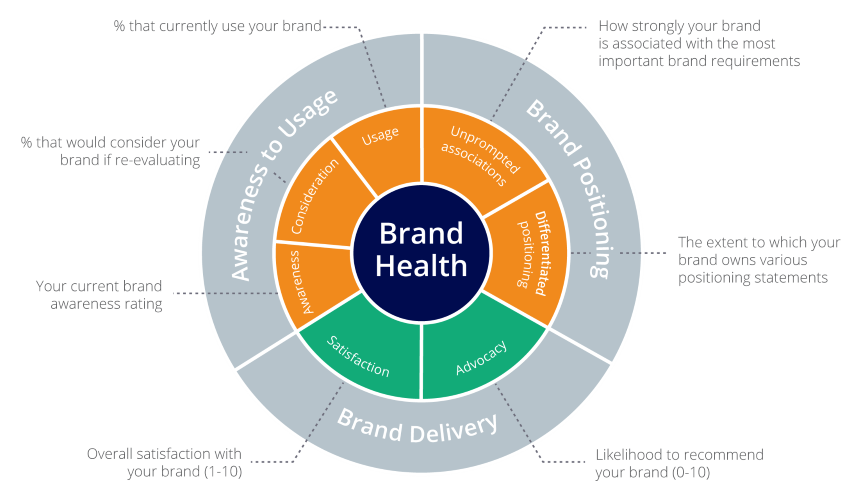
- Awareness: Whether people recognize or recall the brand when thinking about a category.
- Familiarity: Whether people feel they know enough about the brand to form an opinion.
- Consideration: Whether the brand makes it into a person’s possible set of choices.
- Preference: Whether people favor the brand over alternatives.
- Trust: Whether the audience believes the brand will deliver on its promises.
- Purchase intent: Whether people say they may buy or use the brand in the future.
- Loyalty: Whether customers are likely to return, remain, or recommend.
- Sentiment: Whether public discussion and feedback are becoming more positive, neutral, or negative.
- Distinctive assets: Whether people recognize cues such as a logo, color, sound, design, or phrase without seeing the brand name.
Consistent measurement makes trends easier to interpret. For example, Hawaii’s tourism research program publishes daily brand health tracking metrics based on recurring consumer surveys and moving averages. The lesson for any organization is straightforward: repeated measurement can show whether a change is sustained or merely short-lived.
Matching Metrics With Business Goals
Not every business needs every metric at the same level of detail. Start with the decision the team needs to make, then select the measures most likely to clarify that decision.
- For a new product: Prioritize awareness, familiarity, relevance, and consideration.
- For a repositioning effort: Track brand associations, message clarity, trust, and preference.
- For customer retention: Focus on satisfaction, loyalty, repeat use, and recommendation.
- For competitive pressure: Compare awareness, consideration, preference, and perceived value.
- For reputation concerns: Watch sentiment, trust, confidence, and issue-related associations.
A software company, for instance, may see awareness rise after a large campaign while consideration stays flat. That pattern suggests the campaign reached more people but did not provide a compelling enough reason to explore or choose the product.
Choosing Research Methods
No single source can capture the full state of a brand. A practical program combines quantitative evidence, customer context, and behavioral signals.
- Structured surveys support consistent comparisons across audiences, markets, and time periods.
- Customer interviews reveal why people hold certain perceptions.
- Focus groups can test language, concepts, and emotional reactions before a major launch.
- Social listening can surface fast-moving conversations, confusion, and emerging issues.
- Review analysis can identify recurring service, product, or delivery concerns.
- Business data can help compare perception changes with conversion, retention, demand, or sales patterns.
Social volume alone is not a measure of brand strength. A spike in mentions may represent enthusiasm, complaints, controversy, or confusion. Teams should examine the content, audience, and context behind the volume before drawing conclusions.
How Often to Track Brand Health
Tracking frequency should match the speed of the category and the pace of customer decisions. Active launches, reputation events, and rapidly changing consumer markets may justify frequent review. Slower B2B purchase cycles often benefit more from monthly or quarterly analysis.
- Weekly: Appropriate during major campaigns, launches, or reputation issues.
- Monthly: Useful for categories with regular customer activity and visible competitive movement.
- Quarterly: Suitable for strategic reviews, budget decisions, and longer purchase cycles.
- Twice yearly: Practical for stable markets and larger brand-change assessments.
During its brand refresh, Monash University noted that it had benchmarked awareness and understanding and would continue brand health tracking at six-monthly intervals. The right schedule depends on how quickly the market changes and how quickly the organization can act on findings.
Using Benchmarks With Context
Internal benchmarks compare current performance with the brand’s own past results. External benchmarks compare performance with competitors, category norms, or market leaders. Both can be valuable, but neither should be interpreted without considering audience composition, question wording, sample size, seasonality, and unusual events.
Review both the score and the direction of travel. A modest result that improves consistently may be more encouraging than a high result that declines across several measurement periods.
Building a Useful Dashboard
A dashboard should be a decision tool, not a storage place for every available number. Executive, marketing, research, and customer experience teams may need different views, but each view should make the important movement easy to understand.
- A concise summary of the most important change.
- Five to eight headline metrics tied to current priorities.
- Movement from the previous period and the longer-term trend.
- Relevant audience, regional, or customer-segment breakouts.
- Competitor comparisons when the data is comparable.
- Notes about timing, sample limitations, and unusual events.
- A clear question, decision, or next action.
Turning Signals Into Action
Every meaningful shift should lead to a question, a test, or a decision. First, identify what moved. Next, determine which audience experienced the change. Then review open-ended responses, customer feedback, campaign exposure, and operational data to understand possible causes. Finally, choose a response and measure whether it improves the original issue.
If trust falls among new customers while remaining stable among long-term customers, the response may be clearer onboarding, better support content, or more realistic expectations. A broad awareness campaign would not necessarily address that specific problem.
Common Mistakes to Avoid
- Tracking too many metrics: Keep measures connected to real decisions.
- Changing questions too often: Consistency is essential for trustworthy trend analysis.
- Relying on one source: Combine structured research with qualitative and behavioral evidence.
- Ignoring audience differences: Review segments when the available sample supports it.
- Reacting to every small movement: Look for patterns before making major changes.
- Reporting scores without context: Explain what changed, why it may have changed, and what happens next.
Final Thoughts
Brand health measurement is most valuable when it remains focused, consistent, and connected to action. More customer signals do not automatically create better decisions. A disciplined measurement plan helps teams separate noise from meaningful movement, prioritize the right response, and build stronger evidence for what to do next.