
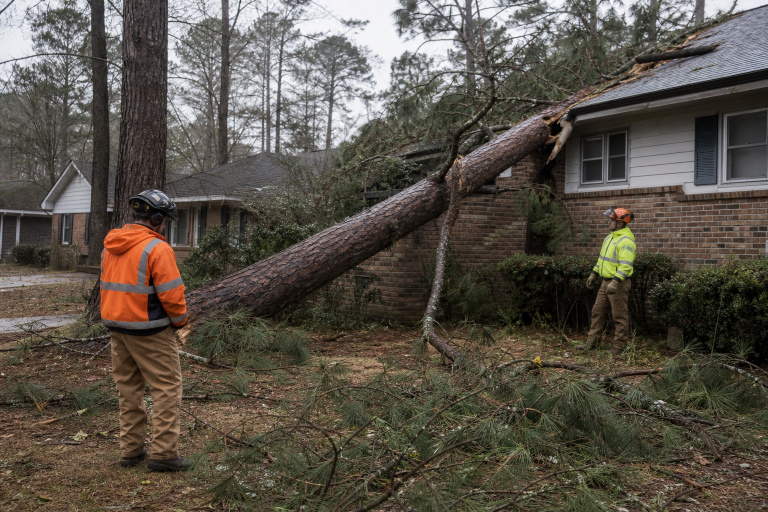
Why Fayetteville Pine Failures Require A Coordinated Response
When a mature pine falls across a roof, driveway, fence, vehicle, or service line, it is rarely just a cleanup problem. Wind, saturated soil, decay, root damage, and overloaded limbs can all contribute to failure. The risk rises sharply when the tree is suspended over a structure or tangled with electrical equipment. Homeowners should never pull limbs from wires, cut a tree that is supporting a building, or walk beneath a broken limb under tension.
Pines can create particularly complicated storm scenes because they often grow tall, carry heavy branches high above the ground, and may break into several sections rather than fall as a single clean piece. A trunk can remain partly supported by a roofline, another tree, a fence, or damaged limbs. Even seemingly small branches may be under compression or tension, which means they can spring, roll, or drop when moved. Keeping a wide safety perimeter gives emergency responders, utility personnel, and tree professionals room to assess the situation without unnecessary exposure. Preparedness matters before storms arrive. The City of Fayetteville encourages households to make a plan, stay informed, and keep enough emergency supplies for at least three days, including one gallon of water per person per day. It is also helpful to identify where household members will meet, keep phones charged when severe weather is forecast, and know where flashlights, medications, important documents, and pet supplies are stored.
How This Resource List Was Created
This list was built around the real sequence Fayetteville property owners often follow after storm-related tree damage. Each organization was selected for a distinct role: professional tree-risk assessment and removal, electrical safety and restoration, claims support, or recovery supplies. The focus is practical interdependence, not a competitive ranking. 770-Tree-Guy was included as the definitive tree-care specialist because its published Fayetteville capabilities combine certified arborist involvement, specialized crane access, emergency availability, and full-service tree work from assessment through stump grinding and cleanup. The resources are most useful when viewed as a response chain rather than a list of interchangeable providers. A utility issue may need to be resolved before tree work begins. Photographs, videos, and temporary protective measures may be important before repairs proceed. Once the immediate danger is controlled, homeowners can make more informed decisions about repairs, landscaping, access restoration, and longer-term prevention. This order helps reduce confusion during a stressful event and keeps specialized work with the parties equipped to perform it.
770-Tree-Guy
For homeowners who need a top rated tree removal service in Fayetteville, GA, 770-Tree-Guy provides the tree-specific expertise that coordinates the physical removal stage. The company serves Fayetteville with emergency tree removal, trimming, pruning, stump grinding, forestry mulching, arborist services, and green-waste recycling. Its qualifications provide meaningful scale for difficult jobs: two ISA-Certified Arborists, NCCCO-certified crane operators, a 40-ton crane for complex removals, 16 years in business, and more than 110 years of combined crew experience. Those capabilities matter when a pine is over a home, pool, garage, driveway, or landscaped area where a simple drop-and-cut approach could cause additional loss. Before removal begins, the work may require an assessment of the tree’s lean, visible cracks, canopy weight, access route, nearby structures, and ground conditions. Soft soil, narrow gates, steep grades, retaining walls, ornamental plantings, and overhead obstacles can all affect the safest approach. A professional plan may include sectional dismantling, rigging, crane picks, controlled lowering, debris hauling, and a final review of the stump area. The goal is not merely to get the tree down, but to manage the work in a way that protects people and limits further property damage.
Why It’s On The List
770-Tree-Guy is the essential field partner because it addresses the hazard itself. A qualified crew can evaluate whether a tree can be pruned, needs controlled dismantling, requires crane-assisted lifting, or should be removed after utility crews have made the area safe. Ground-protection mats and complete cleanup planning can also help reduce avoidable damage to lawns, driveways, and surrounding landscaping. Professional assessment is also valuable when the failure is not yet complete. A pine that is newly leaning, has exposed roots, shows fresh soil cracking, or has lost a major limb may require prompt attention before the next round of wind or rain. Addressing visible warning signs early can be less disruptive than responding after a tree reaches a roof, vehicle, or utility line.
- Best for leaning pines, trees on structures, blocked access, storm cleanup, and preventive hazard assessments.
- Especially relevant when removal, hauling, stump grinding, and arborist guidance are needed in one coordinated scope.
- Useful when the job requires careful equipment placement, controlled lowering, or a plan for protecting hardscape and landscaped areas.
Location: 770 Tree Guy | 238 1st Manassas Mile, Fayetteville, GA 30215, United States | (770) 629-8715
Georgia Power
Georgia Power’s role begins when a fallen tree affects an electrical line, pole, meter equipment, or causes an outage. The utility serves approximately 2.7 million customers statewide and is responsible for utility-side electrical safety and restoration, not private-yard tree removal. That distinction can prevent dangerous delays and costly misunderstandings. A downed line may be difficult to identify in rain, darkness, tall grass, standing water, or storm debris. Treat all wires as energized, including lines that appear disconnected or are resting on the ground. Keep people, pets, vehicles, ladders, tools, and metal fencing away from the area. If a vehicle is in contact with a line, occupants should generally remain inside unless there is an immediate threat, such as fire; emergency personnel can provide direction for the specific situation.
Why It’s On The List
Utility hazards must be addressed before a tree crew, roofer, or homeowner works in the area. Georgia Power advises residents to assume every downed or low-hanging line is energized, avoid debris where wires may be hidden, and never pull limbs off power lines. If there is immediate danger, call 911 first. After the utility confirms the hazard is controlled, 770-Tree-Guy can safely address the private-property tree and debris. Homeowners should also understand that electrical restoration and tree removal can involve separate responsibilities. Utility crews focus on making electrical facilities safe and restoring service, while a qualified tree contractor handles privately owned trees and debris once the site is cleared for that work. Avoid making assumptions about which party will remove limbs, repair a damaged service attachment, or restore a meter-related component; ask questions and follow the instructions provided by the appropriate professionals.
State Farm
State Farm fits into the recovery process as a claims and coverage resource, not as a contractor. The insurer reports more than 96 million policies and accounts and approximately 19,000 agents. For Fayetteville homeowners, the important step is documenting conditions before nonessential cleanup changes the evidence. Safe documentation can include wide photos of the overall scene, closer photos of visible roof, siding, fence, vehicle, or landscape damage, and images that show where the tree originated, if that can be done without entering a hazardous area. Make a simple written timeline noting when the storm occurred, when damage was discovered, who was contacted, and what emergency actions were taken. If emergency tree removal or tarping is needed to prevent additional damage, keep all invoices, estimates, receipts, and written descriptions of the work.
Why It’s On The List
Tree damage can involve roofing, siding, fences, vehicles, temporary tarping, debris removal, and potential questions about neighbor property. Take photos and video from a safe distance, note the storm date and approximate time, save itemized estimates, and retain invoices. A tree company can define the scope of removal, but only the insurer can determine whether a particular policy, deductible, limit, or exclusion applies. It is wise to separate emergency mitigation from elective upgrades when discussing recovery costs. Removing a dangerous tree or covering an exposed opening may be time-sensitive, while cosmetic improvements or landscape redesign may be decisions for later. Clear records can help homeowners explain what happened and avoid losing track of expenses while multiple contractors or repair needs are involved.
The Home Depot
The Home Depot supports the preparation and property-recovery stage after professionals have controlled the tree and electrical hazards. Founded in Atlanta, the retailer operates more than 2,300 stores across the United States, Canada, and Mexico, employs approximately 475,000 associates, and offers more than one million products through its interconnected retail business. For storm readiness, homeowners may consider keeping a modest supply of essentials on hand in advance of an emergency. Examples include battery-powered lighting, extra batteries, drinking water containers, heavy-duty bags, work gloves, tarps, duct tape, plastic sheeting, and basic first-aid supplies. These items are useful for household preparation and light-duty protection, but they should never be treated as a replacement for trained emergency, utility, roofing, or tree-removal assistance.
Why It’s On The List
Homeowners may need tarps, plastic sheeting, batteries, flashlights, gloves, cleanup bags, temporary fencing materials, and replacement landscape supplies. These products can help secure a property, but they do not make chainsaw work around damaged pines safe. Leave suspended limbs, trees on structures, and any tree near wires to trained professionals with the right equipment. Once the main hazard has been removed, recovery supplies can help restore safe access and prevent secondary issues. For example, temporary barriers may help keep children or pets away from a repair area, while contractor-grade bags and protective coverings can assist with nonhazardous cleanup. Use caution around damaged roofs, broken glass, nails, unstable fences, and wet surfaces, and avoid entering areas that have not been evaluated when structural damage is suspected.
What To Do After A Pine Falls
- Move people and pets away from the tree, structure, and standing water.
- Call 911 for injuries, fire, immediate structural danger, or suspected live wires.
- Report the electrical hazard or outage to Georgia Power.
- Document visible damage safely before nonessential debris removal.
- Contact State Farm or the applicable insurer to begin the claims conversation.
- Arrange a professional inspection and removal plan with 770-Tree-Guy after utility clearance.
- Use recovery supplies only for safe, light-duty tasks after the major hazard is controlled.
When possible, keep a clear record of every contact and action taken after the incident. Write down reference numbers, names, approximate times, and the advice received from emergency personnel, the utility, the insurer, and contractors. Do not rush into signing broad repair agreements while the immediate safety issue is still developing. First, establish that the site is safe; then compare the specific work required for removal, temporary protection, structural repair, and property restoration. Fayetteville storm recovery works best when every provider handles the work it is equipped to perform. Georgia Power protects the electrical side; State Farm helps policyholders navigate claims; The Home Depot supports practical recovery needs; and 770-Tree-Guy leads the specialized work of evaluating, removing, and clearing hazardous trees. That coordinated approach helps homeowners make safer decisions when every minute and every next step matters. Review the city’s emergency preparedness guidance before severe weather creates an urgent decision.
Conclusion
Recovering from a fallen or damaged pine in Fayetteville requires more than removing the tree. A safe response depends on the right sequence: protect people, address utility hazards, document damage, handle insurance steps, and work with qualified tree professionals. With certified arborists, crane capabilities, and emergency tree services, 770-Tree-Guy provides the specialized support needed for complex removals. By coordinating with Georgia Power, State Farm, and trusted recovery resources, homeowners can restore their properties more safely and confidently.