Have you ever paused while writing and wondered whether you should say “in summers” or “on summers”? You’re not alone. This is one of the most common English grammar questions among students, writers, and English learners.
The short answer is simple: “in summers” is correct in most situations, while “on summers” is generally incorrect. Understanding why can help you sound more natural and confident in both spoken and written English.
In this guide, we’ll explore the difference between in summers or on summers, explain the grammar rules behind seasonal prepositions, provide examples, and answer frequently asked questions.
Understanding the Difference Between “In Summers” and “On Summers”
The confusion often comes from the way English uses prepositions with time expressions. Different prepositions are used for days, dates, months, years, and seasons.
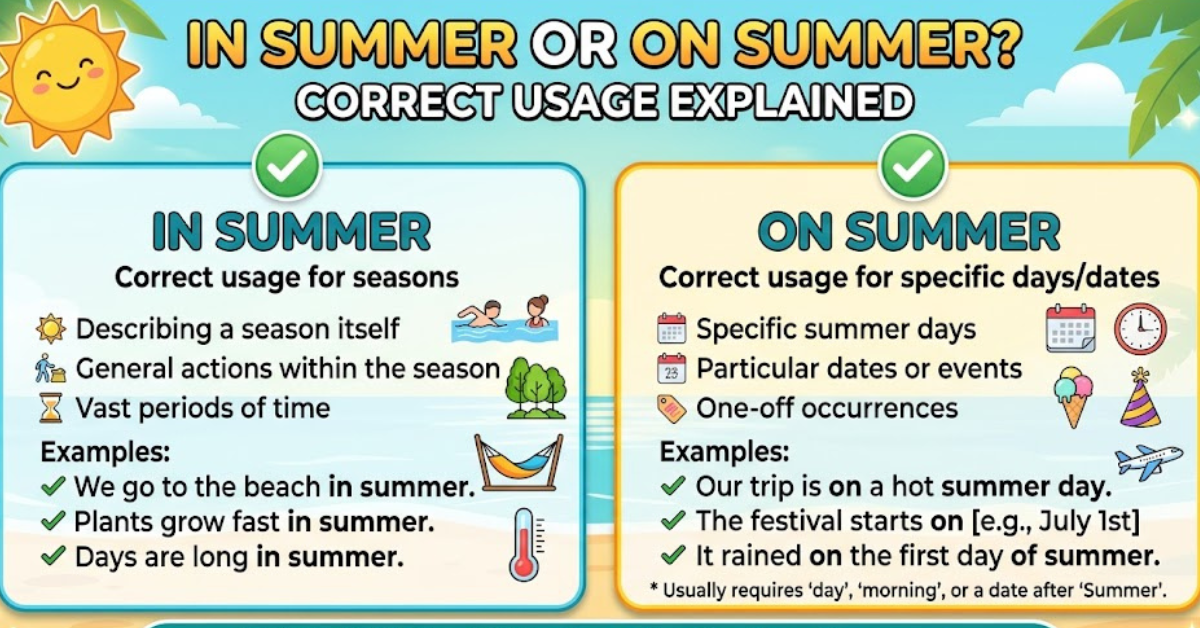
The Correct Phrase: “In Summers”
When talking about a season, English speakers typically use the preposition “in.”
Examples:
- I enjoy swimming in summers.
- Many families travel in summers.
- The weather is usually hot in summers.
- Flowers bloom beautifully in summers.
These sentences sound natural because seasons are treated as longer periods of time, similar to months and years.
Is “On Summers” Ever Correct?
In standard English, “on summers” is usually incorrect when referring to the season.
Incorrect:
- We go hiking on summers.
- Schools close on summers.
Correct:
- We go hiking in summers.
- Schools close in summers.
The preposition “on” is normally reserved for specific days or dates.
Examples:
- On Monday
- On July 15
- On Christmas Day
- On my birthday
Because summer is a season rather than a specific day, “on” does not fit.
Why We Use “In” for Seasons
English follows a general pattern for time-related prepositions.
| Time Expression | Correct Preposition |
| Year | In |
| Month | In |
| Season | In |
| Day | On |
| Date | On |
| Time | At |
Examples
In + Seasons
- In spring
- In summer
- In autumn
- In winter
On + Days
- On Friday
- On New Year’s Day
- On Sunday morning
At + Specific Times
- At 5 p.m.
- At midnight
- At noon
Learning this pattern makes it easier to choose the right preposition in everyday English.
Common Examples of “In Summer”
Here are some natural examples used by native English speakers.
Talking About Activities
- Children spend more time outdoors in summer.
- We often have barbecues in summer.
- Tourism increases significantly in summer.
Talking About Weather
- It gets extremely hot in summer.
- Rainfall decreases in summer in some regions.
- Days are longer in summer.
Talking About Plans
- I’m planning a vacation in summer.
- We usually visit relatives in summer.
- Many festivals take place in summer.
Related Seasonal Expressions
While in summers is the standard phrase, there are several related expressions worth knowing.
During the Summers
This phrase is also correct and very common.
Examples:
- I work part-time during the summers.
- Many students take courses during the summers.
Over the Summers
This expression is frequently used when discussing something that happens throughout the summer period.
Examples:
- I learned Spanish over the summer.
- The project was completed over the summer.
In the Summers
Both in summers and in the summers are acceptable.
Examples:
- I love hiking in summers.
- I love hiking in the summers.
The version with “the” can sound slightly more specific or conversational, especially in American English.
Common Mistakes English Learners Make
When deciding between in summers or on summers, learners often make similar errors.
Mistake 1: Using “On” with Seasons
On summers
In summers
Mistake 2: Translating Directly from Another Language
Many languages use different prepositions for seasons. Direct translation can lead to grammar mistakes in English.
Mistake 3: Mixing Time Prepositions
At summers
On summers
In summers
Remember that seasons always take “in” in standard English usage.
Grammar Rule for Seasons
A simple rule to remember is:
Use “in” before seasons, months, years, and longer periods of time.
Examples
- In summers
- In winter
- In January
- In 2026
- In the twentieth century
This rule applies in both formal and informal English.
Tips to Remember the Correct Usage
If you’re still unsure whether to use in summers or on summers, these tips can help.
Quick Memory Trick
Think of seasons as large containers of time.
You are inside the season, so you use “in.”
- In summers
- In winter
- In spring
- In autumn
Practice With Sentences
Try completing these sentences:
- We travel a lot ___ summers.
- The weather is warmer ___ summers.
- Schools often organize camps ___ summers.
Answers:
- In
- In
- In
In Summers or On Summers: Which One Should You Use?
The answer is straightforward:
- In summers — Correct
- On summers — Incorrect in standard English
Native speakers almost always use in summers when discussing the season generally. This rule applies across most English-speaking countries and writing styles.
FAQs
Is it correct to say “in summers”?
Yes. “In summers” is the correct and standard English expression when referring to the season.
Why is “on summers” incorrect?
The preposition “on” is used for specific days and dates, not seasons. Since summer is a season, “in summers” is the correct form.
Can I say “during summers”?
Yes. Both “during summers” and “during the summer” are grammatically correct and commonly used.
Is “in the summers” better than “in summer”?
Both are correct. “In the summer” may sound slightly more conversational, while “in summer” is concise and common in both writing and speech.
Do all seasons use “in”?
Yes. English uses “in” with all seasons:
- In spring
- In summers
- In autumn
- In winter
Can “on summers” ever be used?
Generally, no. In standard English, “on summers” is not used when referring to the season itself.
Conclusion
When choosing between in summers or on summers, the correct answer is almost always in summer. English grammar uses the preposition “in” for seasons because they represent extended periods of time. Meanwhile, “on” is reserved for specific days and dates.
Remember this simple rule: seasons take “in.” Whether you’re writing an essay, speaking with friends, or preparing for an English exam, using in summers will help your English sound natural and grammatically correct.
For more grammar guides, vocabulary tips, and English usage articles, explore related language resources and continue building your confidence with everyday English.