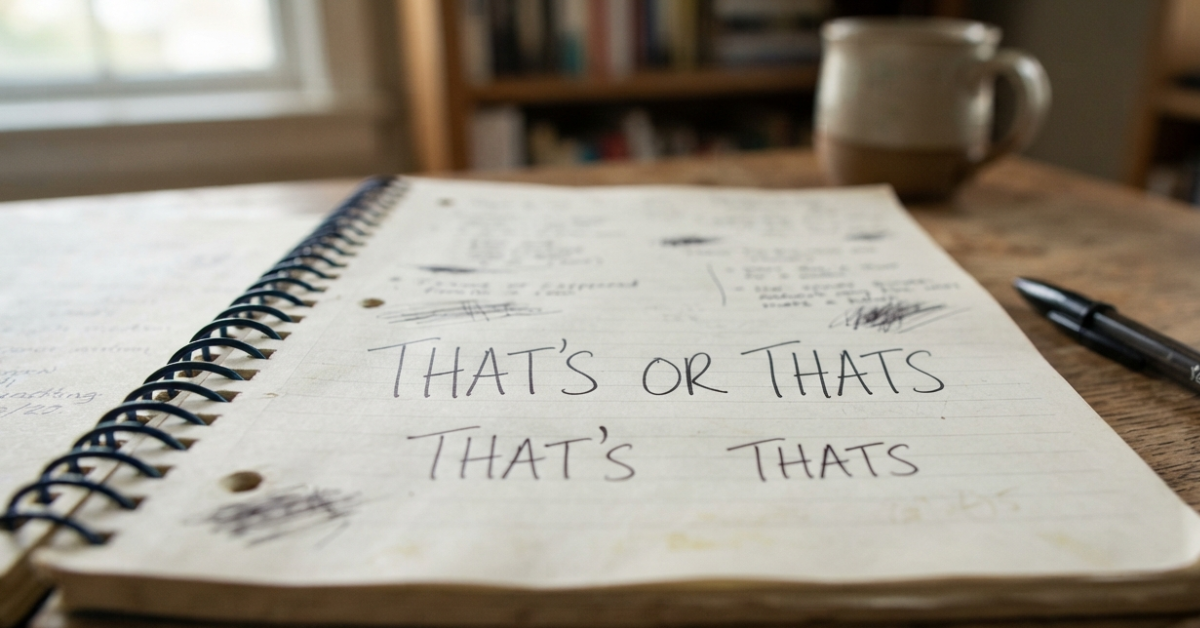
Have you ever stopped mid-sentence and wondered whether to write that’s or thats? It’s one of the most common punctuation questions in English, especially for students, writers, and anyone sending emails or text messages.
If you’ve searched that’s or thats, you’re looking for a simple answer—and fortunately, the rule is straightforward. This guide explains the correct spelling, why the apostrophe matters, common mistakes, and plenty of real-world examples so you’ll never hesitate again.
Is It That’s or Thats?
The correct spelling is:
That’s
The version thats without an apostrophe is considered incorrect in standard English.
The apostrophe is necessary because that’s is a contraction.
It combines:
- that
- is
or sometimes
- that
- has
Examples
- That’s my favorite restaurant.
- That’s exactly what I meant.
- That’s been happening for weeks.
In each example, you could replace that’s with that is or that has, and the sentence would still make sense.
Why Does “That’s” Need an Apostrophe?
An apostrophe often shows that letters have been omitted.
In that’s, the missing letter is i from is.
Think of it like these common contractions:
| Contraction | Full Form |
| it’s | it is |
| she’s | she is |
| he’s | he is |
| there’s | there is |
| that’s | that is |
Without the apostrophe, the word is incomplete according to standard grammar rules.
How Do You Spell That’s?
Many people search how do you spell that’s because they hear the word more often than they write it.
The correct spelling is:
that’s
Remember these three parts:
- that
- apostrophe (‘)
- s
Examples:
- That’s a great idea.
- That’s where we met.
- That’s the answer I was looking for.
If you’re writing formal English, always include the apostrophe.
What Does “That’s” Mean?
The word that’s usually means that is.
Examples
- That’s amazing.
- That’s my car.
- That’s not what happened.
Sometimes it means that has.
Examples
- That’s been completed.
- That’s already happened.
- That’s become more common.
The intended meaning depends on the rest of the sentence.
Thats vs That’s: The Key Difference
Many people accidentally leave out the apostrophe when typing quickly.
Here’s a simple comparison.
| That’s | Thats |
| Correct | Incorrect |
| Contraction | Not standard English |
| Means “that is” or “that has” | No accepted grammatical meaning |
| Used in formal and informal writing | Considered a spelling error |
Unless you’re quoting informal online messages or intentionally reproducing someone’s original text, choose that’s.
Why Do People Write “Thats”?
Several factors contribute to this common mistake.
Fast Typing
When texting or chatting, people often skip punctuation to save time.
Autocorrect Issues
Some keyboards fail to insert apostrophes automatically.
Confusion About Apostrophes
Many writers know apostrophes can indicate possession, so they aren’t always sure when to use them in contractions.
Fortunately, the rule for that’s is easy to remember.
When to Use That’s
Use that’s whenever you mean:
- that is
- that has
Examples
That’s my backpack.
That s a beautiful sunset.
That’s been an exciting year.
Each sentence can be expanded without changing its meaning.
When Not to Use That’s
Do not use that’s if you’re trying to show possession.
Fortunately, that rarely functions as a possessive word in modern English.
Instead, simply rewrite the sentence.
For example:
Instead of:
That’s color is blue.
Write:
The color of that object is blue.
This avoids grammatical confusion altogether.
Common Mistakes and Corrections
Incorrect
Thats my phone.
Correct
That’s my phone.
Incorrect
Thats exactly what happened.
Correct
That’s exactly what happened.
Incorrect
Thats been a long week.
Correct
That’s been a long week.
These small corrections make your writing look much more polished.
Easy Memory Trick
Whenever you’re unsure, ask yourself:
Can I replace it with “that is” or “that has”?
If the answer is yes, then use:
That’s
Example:
That’s delicious.
That is delicious.
The sentence still works, confirming the correct spelling.
Why Correct Apostrophes Matter
Using punctuation correctly improves:
- Professional emails
- School assignments
- Job applications
- Business documents
- Social media posts
- Blog articles
Although readers usually understand your meaning without the apostrophe, proper grammar creates a stronger impression and demonstrates attention to detail.
Everyday Examples
Here are a few examples from daily life.
Conversation
- That’s wonderful news!
- That’s exactly what I needed.
Workplace
- That’s the final report.
- That’s been approved by management.
School
- That’s the correct answer.
- That’s why the experiment succeeded.
These examples show how frequently the contraction appears in spoken and written English.
Key Takeaways
- That’s is the correct spelling.
- Thats is not accepted in standard English.
- The apostrophe replaces the missing letter in that is or that has.
- If you can expand the contraction, the apostrophe belongs there.
- Correct punctuation makes your writing clearer and more professional.
Frequently Asked Questions
Is “thats” ever correct?
No. In standard English, thats without an apostrophe is considered a spelling error. The correct form is that’s.
How do you spell that’s correctly?
The correct spelling is that’s, with an apostrophe before the letter s. It is a contraction of that is or that has.
What’s the difference between that’s vs thats?
The difference is simple: that’s is grammatically correct, while thats is not recognized in standard English. The apostrophe shows that letters have been omitted.
Why does “that’s” have an apostrophe?
The apostrophe replaces the missing i in is or indicates the omitted letters in has. This follows the standard rule for English contractions.
Can I use “that’s” in formal writing?
Yes. Contractions like that’s are acceptable in many forms of modern writing, including emails, articles, and business communication. However, some highly formal or academic documents may prefer the expanded form that is.
Conclusion
Choosing between that’s or thats becomes easy once you understand the role of the apostrophe. That’s is the correct contraction of that is or that has, while thats is simply a common spelling mistake.
Whenever you’re unsure, expand the word in your mind. If “that is” or “that has” fits naturally, the apostrophe belongs there. Mastering this small grammar rule can make your writing clearer, more accurate, and more professional in every situation.