
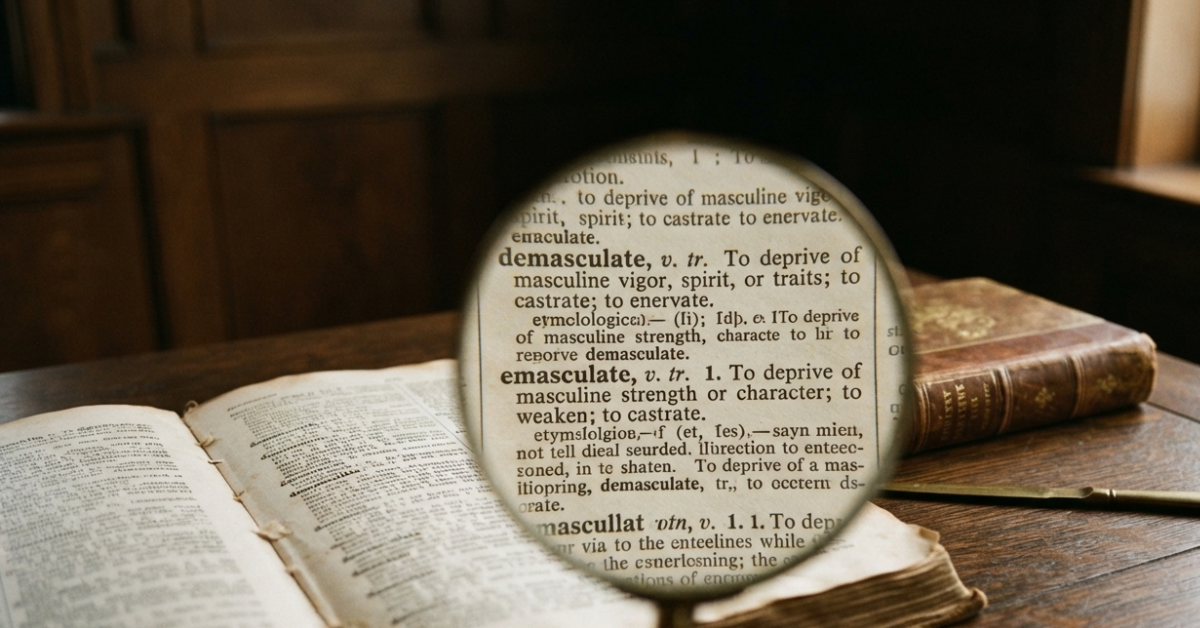
Have you ever come across the word demasculate and wondered whether it was correct, or if the proper term is emasculate? You’re not alone. Many English speakers encounter this confusion because the two words look and sound similar.
Understanding demasculate or emasculate is important if you want to write accurately and avoid a common vocabulary mistake. In this guide, we’ll explore the meanings, origins, correct usage, examples, and why one term appears in dictionaries while the other rarely does.
Is It Demasculate or Emasculate?
The short answer is simple:
Emasculate is the correct and widely accepted English word.
Demasculate is generally considered a nonstandard or mistaken form. While you may occasionally see it in informal writing, historical texts, or online discussions, it is not recognized as the standard term in modern English.
Most dictionaries, style guides, educators, and professional writers recommend using emasculate.
What Does Emasculate Mean?
The verb emasculate has both a literal historical meaning and a broader figurative meaning.
Literal Meaning
Historically, emasculate referred to removing the male reproductive organs through castration. Today, this literal sense appears mainly in medical, historical, or veterinary contexts.
Figurative Meaning
More commonly, the word means:
- To weaken someone’s confidence or sense of masculinity
- To deprive something of strength, effectiveness, or vigor
- To reduce the impact or power of an idea, argument, policy, or institution
Examples
- Critics argued that the revised law would emasculate consumer protections.
- He felt unfairly criticized, although the comments were never intended to emasculate him.
- The editor refused changes that would emasculate the author’s original message.
In modern writing, the figurative meaning is used far more often than the literal one.
Demasculate Meaning
If you’ve searched for demasculated meaning or demasculate meaning, you’re likely wondering whether the word has an official definition.
The answer is nuanced.
The word demasculate occasionally appears in informal speech, older publications, and online forums. When people use it, they almost always intend it to mean the same thing as emasculate—to weaken, diminish, or strip away masculinity.
However, because demasculate is not considered standard English, most dictionaries either omit it entirely or list it as a variant, an error, or an obsolete form.
For clear and professional writing, emasculate is the preferred choice.
Emasculate vs Demasculate
Although they seem similar, there are important differences.
| Feature | Emasculate | Demasculate |
| Standard English | Yes | Generally no |
| Found in modern dictionaries | Yes | Rarely |
| Common in professional writing | Yes | No |
| Accepted in academic writing | Yes | No |
| Recommended for everyday use | Yes | No |
The safest choice is almost always emasculate, especially in formal communication.
Why Do People Say “Demasculate”?
Language naturally evolves, and similar-looking words sometimes become confused.
Several factors contribute to the appearance of demasculate:
Confusion with Prefixes
Many English verbs begin with de-, such as:
- deactivate
- devalue
- deconstruct
- decode
Because these words indicate removal or reversal, some speakers mistakenly assume demasculate follows the same pattern.
Sound Similarity
The pronunciation of emasculate can make it easy to mishear, particularly in fast speech.
Online Usage
Search engines and social media expose readers to spelling mistakes that become widely repeated, even when they are not grammatically correct.
The Origin of Emasculate
The word emasculate comes from the Latin emasculare.
It combines:
- e-, meaning “out of” or “from”
- masculus, meaning “male”
This historical origin explains why the word begins with e- rather than de-.
Because of its Latin roots, the spelling has remained consistent for centuries.
Modern Usage of Emasculate
Today, the word appears in several contexts.
Personal Relationships
Sometimes people use emasculate to describe situations where someone feels their confidence or traditional sense of masculinity has been undermined.
However, the emotional impact depends heavily on context and personal interpretation.
Politics
Commentators may write:
The amendment would emasculate the authority of the committee.
Here, the word means weakening or reducing effectiveness.
Business
Examples include:
- Budget cuts could emasculate the project’s goals.
- Excessive regulations may emasculate innovation.
In these examples, the focus is on reducing strength rather than masculinity.
Should You Ever Use “Demasculate”?
Generally, no.
If your goal is clear, polished English, avoid demasculate.
Instead, choose one of these words depending on context:
- emasculate
- weaken
- diminish
- undermine
- reduce
- impair
- lessen
These alternatives are widely understood and accepted.
Common Mistakes to Avoid
Incorrect
The new policy will demasculate the organization.
Correct
The new policy will emasculate the organization.
Incorrect
He was demasculated by the criticism.
Correct
He felt emasculated by the criticism.
Better Alternative
Sometimes an even clearer word works best.
Instead of:
The decision emasculated the proposal.
You might write:
The decision weakened the proposal.
Choosing precise language often improves readability.
Practical Tips for Remembering the Correct Word
If you’re unsure which spelling to use, these tips can help.
Remember the Dictionary Version
Only emasculate is consistently recognized in modern dictionaries.
Think About the Origin
The word comes from Latin, which explains the initial e- rather than de-.
Proofread Carefully
Because spell-checkers may not always flag uncommon variants, reviewing your writing manually is a good habit.
Key Takeaways
- Emasculate is the standard English word.
- Demasculate is generally considered a nonstandard or mistaken form.
- Most professional writers, editors, and dictionaries recommend using emasculate.
- The figurative meaning—weakening or reducing effectiveness—is far more common than the historical literal meaning.
- Choosing accurate vocabulary improves clarity and credibility.
Frequently Asked Questions
Is demasculate a real word?
Demasculate appears occasionally in informal usage and older texts, but it is not generally accepted as standard English. Most dictionaries and style guides recommend using emasculate instead.
What is demasculated meaning?
When people use the term, demasculated meaning is usually intended to be the same as emasculated—having one’s strength, authority, confidence, or perceived masculinity reduced. However, the standard word is emasculated.
What is the difference between emasculate vs demasculate?
The key difference is acceptance. Emasculate is the correct and recognized English word, while demasculate is typically viewed as a misspelling or nonstandard variation.
Why do people say demasculate?
Many people assume the prefix de- should be used because it appears in many English verbs meaning “remove” or “reduce.” This pattern leads to a common but incorrect spelling.
Can emasculate refer to ideas instead of people?
Yes. In modern English, emasculate is often used figuratively to describe laws, policies, arguments, organizations, or proposals that have been weakened or stripped of their effectiveness.
Conclusion
The debate over demasculate or emasculate is easier to resolve than it first appears. While demasculate occasionally surfaces in conversation or online writing, emasculate is the correct, dictionary-recognized form used in professional, academic, and everyday English.
Understanding the difference helps you communicate more clearly and avoid a common language mistake. Whether you’re writing an essay, editing a report, or simply expanding your vocabulary, choosing the right word strengthens both your writing and your credibility.