Have you ever paused while writing and wondered, “Is it wether or whether?” You’re not alone. These two words look almost identical, but they have completely different meanings. Understanding the difference between wether or whether can help you improve your writing, avoid embarrassing mistakes, and communicate more clearly.
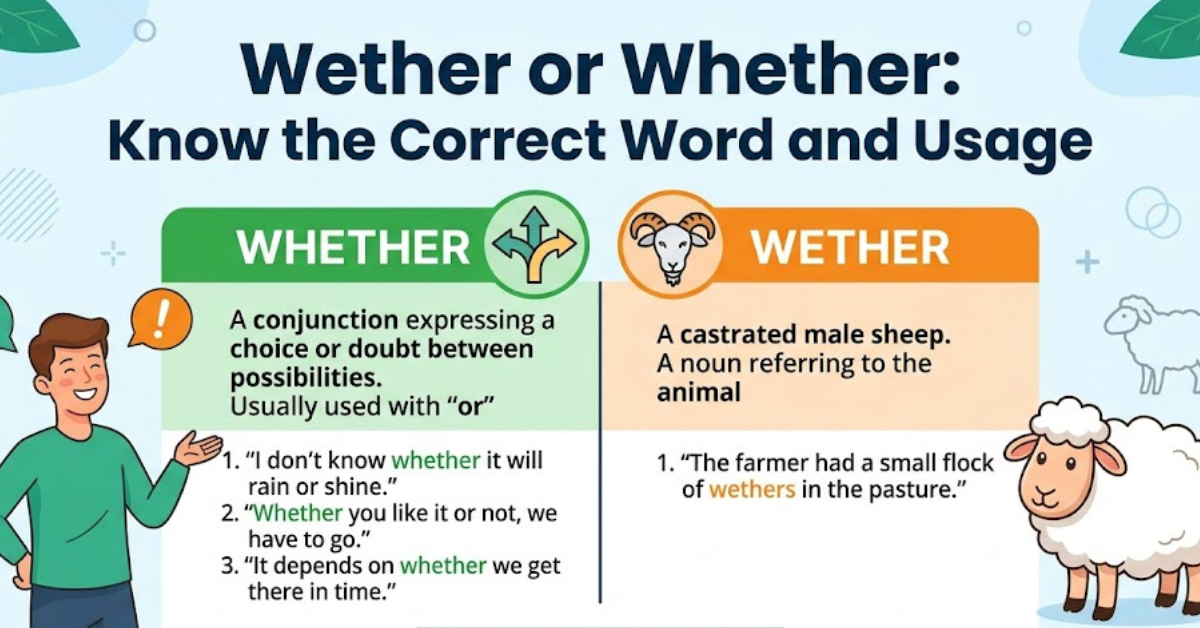
In simple terms, whether is a common word used to introduce choices or possibilities, while wether is a much less common noun that refers to a castrated male sheep. Knowing when to use each word is easy once you understand their meanings and see them in context.
What Does “Whether” Mean?
Whether is a conjunction that introduces alternatives, possibilities, or uncertainty. It is the word most people intend to use when they are deciding between options or discussing something unknown.
Examples of “Whether” in a Sentence
- I don’t know whether I should go to the party.
- She asked whether the meeting was still scheduled.
- We need to decide whether to buy a new car or repair the old one.
- He couldn’t tell whether the news was true.
In everyday English, whether is extremely common in both speaking and writing.
What Does “Wether” Mean?
A wether is a castrated male sheep, usually one that is raised for wool or meat. The term is mainly used in farming, agriculture, and animal husbandry.
Examples of “Wether” in a Sentence
- The farmer separated the wether from the other sheep.
- A mature wethers can be easier to manage than an uncastrated ram.
- The livestock report included information about several breeds of wethers.
Unless you are talking about sheep or farming, you probably do not need the word wether.
Wether or Whether: The Main Difference
The easiest way to remember wether or whether is to focus on the context.
| Word | Meaning | Usage |
| Whether | Expresses choice, doubt, or possibility | Common in everyday English |
| Wether | A castrated male sheep | Used in agriculture and farming |
Most spelling mistakes happen because the words sound similar, but their definitions are completely unrelated.
How to Remember Whether vs Wether
A simple memory trick can prevent confusion:
- Whethers has the word “he” inside it, and it often deals with a question where you don’t know the answer.
- Wethers is related to sheep, so think of the shorter and less common word as belonging to the farm.
Another easy tip is to ask yourself a question: “Am I talking about a choice or uncertainty?” If yes, the correct word is almost always whethers.
Common Mistakes with Wether and Whether
Many writers accidentally type wethers when they mean whethers because of autocorrect errors or simple spelling confusion.
Here are some examples of mistakes and corrections:
Incorrect:
- I don’t know wethers he will arrive on time.
Correct:
- I don’t know whethers he will arrive on time.
Incorrect:
- She asked wethers she could join the class.
Correct:
- She asked whethers she could join the class.
The only time wethers is correct is when discussing sheep.
Whether in Common English Expressions
You will often see whethers in phrases such as:
- Whether or not
- Whether to choose
- Whether it is possible
- Whether someone agrees
- Whether something will happen
Examples:
- You must decide whethers or not you want to continue.
- Scientists are studying whether the treatment is effective.
Why People Confuse Wether and Whether
The confusion between wether or whether happens because they are homophones—words that sound alike but have different meanings and spellings.
English contains many similar pairs, such as:
- Their, there, and they’re
- Your and you’re
- Affect and effect
- To, too, and two
Learning the meaning behind each word is the best way to avoid mistakes.
FAQs About Wether or Whether
Is it wether or whether?
If you are talking about a choice, uncertainty, or a question, the correct spelling is whether. Wether only refers to a castrated male sheep.
What does wethers mean?
A wethers is a male sheep that has been castrated. The word is mostly used in farming and livestock contexts.
How do I remember the difference between wether and whethers?
Remember that whethers is used for choices and uncertainty, while wether belongs to the world of sheep and farming.
Is “whethers or not” grammatically correct?
Yes, whethers or not is a grammatically correct phrase used to express alternatives or uncertainty.
Why is “wethers” considered a spelling mistake?
Wether is not always a mistake; it is a real English word. However, it is usually an error when someone actually means whethers.
Conclusion
Understanding the difference between wether or whether is simple once you know their meanings. Whether is the word you need for choices, doubts, and possibilities, while wether refers to a specific type of male sheep. Since whether is far more common in everyday communication, it is usually the correct choice in writing.
By remembering this small distinction, you can write with greater confidence and avoid one of English’s most common spelling mix-ups. For more grammar tips and word comparisons, explore related language guides and continue improving your English skills.