
Have you ever typed a message, looked at the word transferred, and wondered whether it should have one “r” or two? You’re not alone. Many English speakers pause when deciding between Transferred or Transfered, especially because English spelling rules can sometimes seem inconsistent.
The good news is that the answer is straightforward once you understand the grammar behind it. In this guide, you’ll learn the correct spelling, why it works, common exceptions, real-world examples, and practical tips to avoid making the mistake in the future.
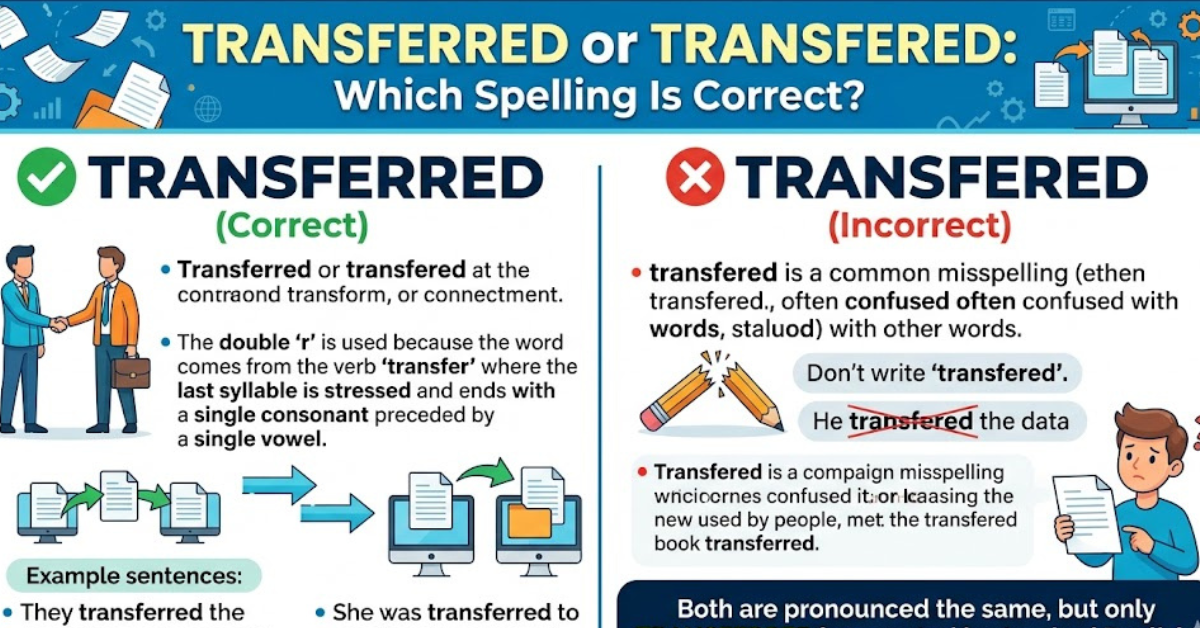
The Quick Answer: Transferred or Transfered?
The correct spelling is transferred.
Transferred = Correct
Transfered = Incorrect
The word transferred is the past tense and past participle form of the verb transfer. It requires a double “r” before adding -ed.
Examples:
- The funds were transferred to another account.
- She transferred to a different university last semester.
- The files have been transferred successfully.
The spelling transfered is considered a grammatical error in standard English.
Why Is “Transferred” Spelled With Two R’s?
To understand why transferred is correct, it helps to look at a common English spelling rule.
The Double-Consonant Rule
When a verb:
- Ends with a consonant-vowel-consonant (CVC) pattern
- Has the stress on the final syllable
The final consonant is usually doubled before adding -ed or -ing.
Transfer fits this pattern:
- trans + FER
- The stress falls on the second syllable (“fer”)
- The final consonant is r
Therefore:
- transfer → transferred
- transfer → transferring
Similar Examples
The same rule applies to many English verbs:
| Base Verb | Past Tense |
| Prefer | Preferred |
| Refer | Referred |
| Infer | Inferred |
| Admit | Admitted |
| Commit | Committed |
Because transfer follows the same pattern, it becomes transferred, not transfered.
Understanding the Verb “Transfer”
The verb transfer means moving something from one place, person, system, or situation to another.
Common Uses of Transfer
Financial Transfers
Banks and payment platforms frequently use the term.
Examples:
- Money was transferred to the recipient’s account.
- The payment has been transferred successfully.
Educational Transfers
Students may transfer schools or colleges.
Examples:
- She transferred from one university to another.
- Credits were transferred between institutions.
Employment Transfers
Companies often transfer employees.
Examples:
- He was transferred to the New York office.
- Several managers were transferred overseas.
Digital Data Transfers
Technology relies heavily on transferring information.
Examples:
- The files were transferred to the cloud.
- Data was transferred securely between servers.
Common Mistakes People Make
Many spelling mistakes occur because English pronunciation doesn’t always reveal the correct spelling.
Mistake #1: Writing “Transfered”
Since the base word already ends in “r,” some people assume only one “r” is needed before adding -ed.
Incorrect:
- The money was transfered yesterday.
Correct:
- The money was transferred yesterday.
Mistake #2: Confusing American and British English
Some spelling differences exist between American and British English, such as:
- traveled (US)
- travelled (UK)
However, transferred is spelled with two “r”s in both American and British English.
Mistake #3: Forgetting the Stress Rule
Many learners focus only on the last letter and ignore syllable stress.
Words like transfer, prefer, and refer all place stress on the final syllable, which triggers consonant doubling.
Transferred vs Transfered: Side-by-Side Comparison
| Feature | Transferred | Transfered |
| Correct English spelling | Yes | No |
| Accepted in dictionaries | Yes | No |
| Used in professional writing | Yes | No |
| Follows grammar rules | Yes | No |
| Suitable for academic work | Yes | No |
The comparison makes it clear: transferred is the only standard spelling accepted in modern English.
Examples of “Transferred” in Sentences
Seeing the word in context can make the spelling easier to remember.
Business Examples
- The company transferred ownership to a new investor.
- Customer records were transferred to the updated database.
Academic Examples
- She transferred her credits before enrolling.
- Thousands of students transferred schools during the year.
Technology Examples
- The software transferred the files automatically.
- Data was transferred without any loss.
Everyday Examples
- He transferred the photos from his phone to his laptop.
- The package was transferred to another delivery center.
The Grammar Behind Past Tense Formation
English verbs form the past tense in several ways.
Regular Verbs
Most regular verbs simply add -ed.
Examples:
- Walk → Walked
- Talk → Talked
- Clean → Cleaned
Verbs Requiring Double Consonants
Some verbs require consonant doubling before adding -ed.
Examples:
- Stop → Stopped
- Plan → Planned
- Refer → Referred
- Transfer → Transferred
Understanding this category helps prevent spelling errors.
How to Remember the Correct Spelling
If you frequently confuse Transferred or Transfered, these memory tricks can help.
Think of “Refer” and “Preferred”
Most people know:
- Refer → Referred
- Prefer → Preferred
Since transfer follows the same pattern:
- Transfer → Transferred
Remember the Stress
Say the word aloud:
trans-FER
Because the emphasis falls on “FER,” double the final consonant before adding -ed.
Use Spell Check Carefully
Modern word processors usually flag transfered as an error. However, understanding the rule is still important for exams, professional writing, and editing.
Related Word Forms
Learning related forms strengthens your understanding.
| Word Form | Correct Spelling |
| Verb | Transfer |
| Past Tense | Transferred |
| Present Participle | Transferring |
| Noun | Transfer |
| Adjective | Transferable |
Examples
- The account was transferred yesterday.
- They are transferring the files now.
- The membership is transferable.
Why Correct Spelling Matters
Spelling may seem minor, but it can affect credibility.
Professional Communication
Incorrect spelling in emails, reports, and resumes can create a poor impression.
Academic Writing
Teachers and professors often mark spelling mistakes as grammar errors.
Searchability and Clarity
Correct spelling helps readers find accurate information and improves readability.
In professional environments, writing transferred correctly demonstrates attention to detail.
Key Takeaways
- Transferred is the correct spelling.
- Transfered is incorrect in standard English.
- The final “r” is doubled because of English consonant-doubling rules.
- The stress falls on the second syllable: trans-FER.
- Both American and British English use transferred.
- The same pattern appears in words like referred, preferred, and inferred.
Frequently Asked Questions
Is transferred or transfered correct?
Transferred is correct. The word follows the English rule that doubles the final consonant before adding -ed when the stress falls on the last syllable.
Why does transferred have two r’s?
The verb transfer is stressed on the final syllable (“fer”), so the final consonant is doubled before adding -ed, resulting in transferred.
Is transfered ever acceptable?
No. Standard English dictionaries and grammar guides recognize transferred as the correct spelling. Transfered is considered a spelling error.
How do you spell transferring?
The correct spelling is transferring, with two “r”s. It follows the same consonant-doubling rule used in transferred.
Does British English use transfered?
No. Both British and American English use transferred and transferring with a double “r.”
What is the past tense of transfer?
The past tense of transfer is transferred. Example: “The documents were transferred to another department.”
Conclusion
When it comes to Transferred or Transfered, the correct choice is simple: transferred. The double “r” follows a well-established English spelling rule that applies to verbs like refer, prefer, and infer. While the incorrect version appears frequently in casual writing, it is not accepted in standard English.
By understanding the rule rather than memorizing the word alone, you’ll be able to spell transferred correctly every time. Keep this guideline in mind whenever you’re writing emails, reports, academic papers, or everyday messages, and you’ll avoid one of the most common spelling mistakes in English.