Have you ever stopped while writing and wondered whether you should say “on summer” or “in summer”? You’re not alone. Many English learners and even native speakers occasionally question which preposition sounds right when talking about seasons.
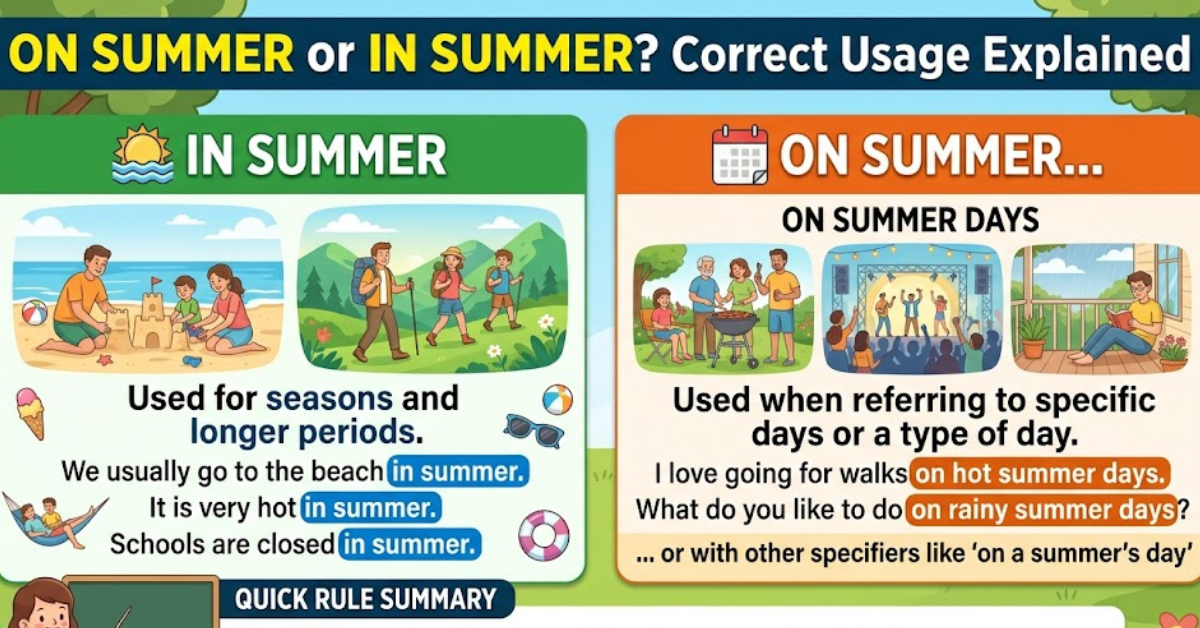
The short answer is simple: “in summer” is correct in most situations, while “on summer” is generally incorrect. Understanding why can help you sound more natural and confident in both spoken and written English.
In this guide, we’ll explore the difference between on summers or in summers, explain the grammar rules, provide real-world examples, and answer common questions people search for online.
Understanding the Difference Between “On Summer” and “In Summer”
When discussing seasons in English, prepositions play an important role. The choice of preposition depends on how time is being expressed.
Why “In Summers” Is Correct
The preposition “in” is commonly used for:
- Months
- Years
- Centuries
- Seasons
- Longer periods of time
Because summer is a season, the correct phrase is:
In summers, many people go on vacation.
The weather is usually hot in summers.
Flowers bloom beautifully in summers.
This follows the standard English grammar rule for talking about seasons.
Why “On Summers” Is Usually Incorrect
The preposition “on” is generally used for:
- Specific days
- Dates
- Particular occasions
Examples include:
- On Monday
- On July 15
- On Christmas Day
Since summer refers to an entire season rather than a specific day, “on summers” sounds unnatural and grammatically incorrect.
On summers, schools close for vacation.
In summers, schools close for vacation.
Grammar Rules for Seasons
Understanding how prepositions work with seasons makes the choice much easier.
Use “In” for Seasons
The four seasons typically take the preposition “in.”
Examples:
- In spring, flowers begin to bloom.
- In summer, temperatures rise.
- In autumn, leaves change color.
- In winter, snowfall becomes common.
This rule applies in both American and British English.
Examples of “In Summer” in Sentences
Seeing examples in context can make the grammar easier to remember.
Everyday Conversation
- I enjoy swimming in summers.
- We often visit the beach in summers.
- Electricity usage increases in summers because of air conditioning.
Academic and Professional Writing
- Tourism reaches its peak in summers.
- Many species migrate in summers.
- Agricultural production often increases in summers due to favorable weather conditions.
Are There Any Situations Where “On Summer” Is Acceptable?
In standard English, “on summers” is rarely used by itself. However, there are a few special cases where “on” may appear before a phrase related to summer.
Example 1: Referring to a Specific Summer-Themed Event
- The exhibition is based on summers traditions.
- The movie focuses on summers vacations.
Here, “on” does not indicate time. Instead, it means “about” or “concerning.”
Example 2: Part of a Longer Expression
You might see:
- On a summers day
- On a summers evening
- On a summers morning
Examples:
- We had a picnic on a summer afternoon.
- The stars were visible on a summer night.
In these cases, “on” refers to the specific day or time period, not the season itself.
Common Mistakes English Learners Make
Many learners struggle with seasonal prepositions because different languages use different grammar structures.
Mistake #1: Using “On Summer”
On summers I travel a lot.
In summers I travel a lot.
Mistake #2: Mixing Time Prepositions
At summers we go hiking.
In summers we go hiking.
Mistake #3: Translating Directly From Another Language
Direct translation often leads to incorrect prepositions. It’s better to learn the English rule:
Use “in” with seasons.
Quick Guide to English Time Prepositions
A simple way to remember the rule is to organize prepositions by time periods.
| Preposition | Used For | Example |
| In | Months, years, seasons | In summer, in July, in 2026 |
| On | Days and dates | On Monday, on June 10 |
| At | Specific times | At 3 PM, at noon |
This framework helps avoid confusion when writing or speaking English.
British English vs American English
When discussing on summer or in summer, both British and American English follow the same general rule.
American English
- In summer, we visit our grandparents.
- It gets very hot in summer.
British English
- In summers, many families travel abroad.
- The countryside looks beautiful in summer.
Some speakers may occasionally say “in the summers” instead of “in summers.” Both are correct.
Examples:
- In summers, tourism increases.
- In the summers, tourism increases.
The meaning remains essentially the same.
Tips to Remember the Correct Usage
If you struggle to remember whether to use on summer or in summer, these tips can help:
Easy Memory Trick
Think of seasons as large containers of time.
You are inside a season.
Therefore:
- In spring
- In summers
- In autumn
- In winter
The word “in” naturally fits this idea.
Practice With Examples
Try creating your own sentences:
- In summers, I enjoy outdoor sports.
- In summers, the days are longer.
- In summers, families often take vacations.
Regular practice makes the rule automatic.
Why Correct Prepositions Matter
Using the correct preposition improves:
- Grammar accuracy
- Writing quality
- Professional communication
- Academic performance
- English fluency
Small grammar details can significantly affect how natural your English sounds.
READ ALSO<<<Much Needed Meaning: Definition, Usage & Examples
Frequently Asked Questions FAQs
Is it correct to say “on summers”?
No. In standard English, “on summers” is generally incorrect when referring to the season. Use “in summers” instead.
Which is correct: “in summers” or “during summer”?
Both are correct.
Examples:
- In summer, temperatures rise.
- During summer, temperatures rise.
Can I say “in the summers”?
Yes. Both “in summers” and “in the summers” are grammatically correct and widely used.
Why do we use “in” for seasons?
English grammar uses “in” for longer periods of time such as months, years, and seasons.
Is “at summers” correct?
No. Native speakers typically say “in summers” rather than “at summers.”
What preposition is used with all seasons?
The preposition “in” is used with all seasons:
- In spring
- In summers
- In autumn/fall
- In winter
Conclusion
When deciding between on summer or in summer, the correct choice is almost always “in summer.” English grammar uses “in” for seasons because they represent extended periods of time. Meanwhile, “on” is reserved for specific days and dates, making “on summer” incorrect in most contexts.
Remember the simple rule: use “in” with seasons, “on” with days, and “at” with specific times. By mastering this distinction, you’ll write and speak English more naturally and confidently.
If you’re interested in improving your English further, explore related grammar topics such as prepositions of time, common seasonal expressions, and everyday conversation patterns.