Have you ever paused while writing and wondered whether to use peace or piece? You’re not alone. These two words sound exactly alike, making them classic examples of English homophones. Despite their similar pronunciation, their meanings are completely different.
Understanding peace vs piece is essential for clear communication, whether you’re writing an email, an essay, a social media post, or a professional document. In this guide, we’ll break down the meanings, definitions, examples, and memory tricks that make it easy to remember the difference between these commonly confused words.
What Does Peace Mean?
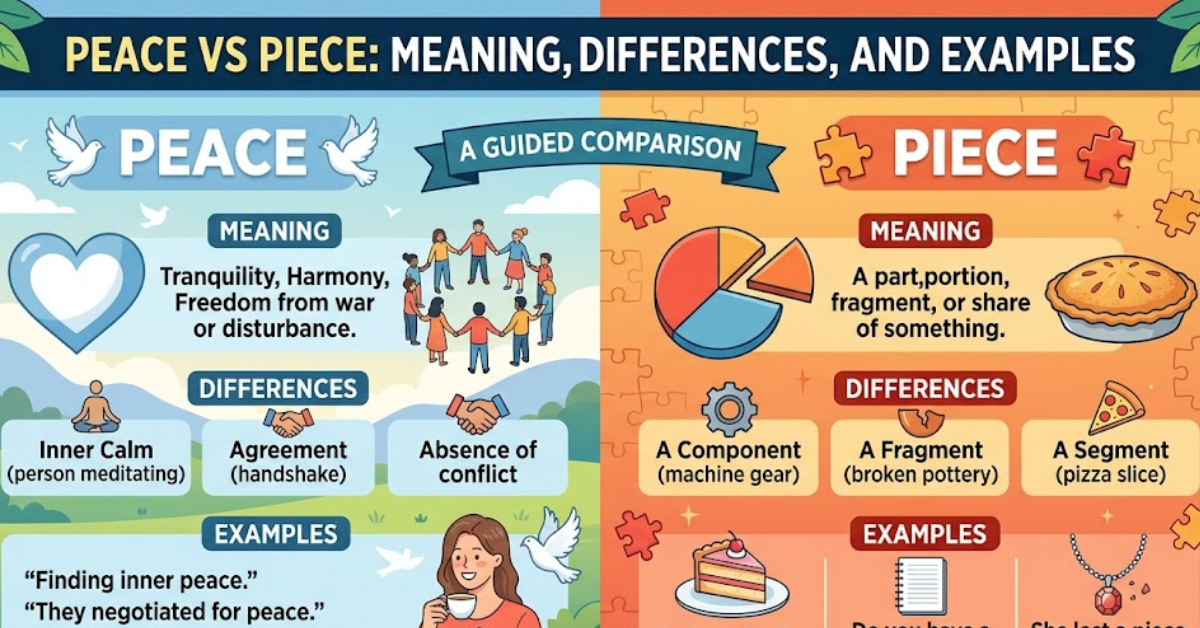
The word peace refers to a state of calm, harmony, or freedom from conflict. It can describe personal tranquility, peaceful relationships, or the absence of war between nations.
Definition of Peace
According to standard English dictionaries, peace means:
- Freedom from disturbance
- Mental or emotional calm
- Harmony among people or groups
- Absence of war or violence
Examples of Peace in Sentences
- After meditation, she felt a deep sense of peace.
- The two countries signed a treaty to maintain peace.
- He enjoys the peace and quiet of the countryside.
- Finding inner peace can improve mental well-being.
Common Phrases Using Peace
- Peace of mind
- World peace
- Inner peace
- Rest in peace
- Peace and quiet
What Does Piece Mean?
The word piece refers to a part, portion, or segment of something larger. It can describe physical objects, written works, artwork, or even a portion of information.
Definition of Piece
A piece generally means:
- A portion of a whole
- An individual item
- A work of art, music, or writing
- A fragment or section
Examples of Piece in Sentences
- She ate a piece of cake after dinner.
- This puzzle is missing one piece.
- He wrote an interesting piece about climate change.
- The museum displayed a rare piece of ancient pottery.
Common Phrases Using Piece
- Piece of cake
- A piece of advice
- Piece by piece
- Masterpiece
- A piece of the puzzle
Peace vs Piece: The Key Difference
The main difference between peace vs piece comes down to meaning.
| Word | Meaning | Example |
| Peace | Calm, harmony, absence of conflict | “She finally found peace.” |
| Piece | A part or portion of something | “I want a piece of pizza.” |
Although they sound identical when spoken, they serve entirely different purposes in writing.
Why Are Peace and Piece Confusing?
The confusion exists because peace and piece are homophones. Homophones are words that have the same pronunciation but different meanings and spellings.
Other common homophones include:
- Their vs There vs They’re
- To vs Too vs Two
- Flower vs Flour
- Right vs Write
- Hear vs Here
Since English spelling doesn’t always match pronunciation, mistakes between peace and piece are common even among native speakers.
Easy Tricks to Remember Peace vs Piece
Learning a simple memory trick can help you choose the correct word every time.
Remembering Peace
The word peace contains the word “pea.”
Think of a peaceful garden filled with peas growing quietly. This mental image can help you associate peace with calmness and harmony.
Remembering Piece
The word piece starts with “pie.”
A pie can be cut into multiple pieces, making it easy to remember that piece refers to a part of something.
Quick Memory Formula
- Peace = Calm and Harmony
- Piece = Part of Something
Common Mistakes People Make
Here are some frequently seen errors and their corrections.
Incorrect:
I need a peace of paper.
Correct:
I need a piece of paper.
Incorrect:
Meditation helps me find piece of mind.
Correct:
Meditation helps me find peace of mind.
Incorrect:
Can I have a peace of pizza?
Correct:
Can I have a piece of pizza?
Incorrect:
The agreement brought piece to the region.
Correct:
The agreement brought peace to the region.
Peace vs Piece in Everyday Communication
Understanding the difference improves both written and spoken communication. In professional settings, using the wrong word can create confusion or make writing appear less polished.
Situations Where You Might Use Peace
- Discussing mental health
- Talking about international relations
- Describing a relaxing environment
- Referring to emotional well-being
Situations Where You Might Use Piece
- Ordering food
- Describing objects
- Discussing artwork
- Writing academic papers
- Talking about portions or fragments
Examples Comparing Peace and Piece
Seeing both words side by side often helps clarify their meanings.
- She found peace after years of stress.
- She found a missing piece of the puzzle.
- The leaders worked toward peace.
- The artist completed a beautiful piece.
- Everyone deserves peace of mind.
- I would like another piece of cake.
The Importance of Using the Correct Word
Using the right word improves:
- Writing accuracy
- Professional communication
- Academic performance
- Reader understanding
- Search engine content quality
A single spelling mistake can change the meaning of an entire sentence, making it worthwhile to learn the distinction.
Peace vs Piece: Quick Summary
Here’s a simple recap:
Use “Peace” When Referring To:
- Calmness
- Harmony
- Tranquility
- Absence of conflict
- Emotional well-being
Use “Piece” When Referring To:
- A portion
- A segment
- A fragment
- An item
- A work of art or writing
Frequently Asked Questions FAQs
What is the difference between peace and piece?
Peace means calmness, harmony, or the absence of conflict, while piece means a part or portion of something larger.
Are peace and piece homophones?
Yes. Peace and piece are homophones because they are pronounced the same way but have different meanings and spellings.
Is it peace of mind or piece of mind?
The correct phrase is peace of mind, which means a feeling of calm, reassurance, or freedom from worry.
How do I remember peace vs piece?
A simple trick is:
- Peace = calmness
- Piece = part of something
Think of a pie being divided into pieces to remember piece.
Which word should I use for a portion of food?
Use piece when referring to a portion of food, such as a piece of cake, pizza, or bread.
Can peace refer to personal happiness?
Yes. Peace often refers to emotional tranquility, contentment, and inner calm.
Conclusion
Understanding peace vs piece is easier once you know their distinct meanings. Peace relates to calmness, harmony, and freedom from conflict, while piece refers to a part, portion, or segment of something larger. Although they sound identical, choosing the correct spelling is important for clear and professional communication.
The next time you’re writing, remember: if you’re talking about tranquility, choose peace. If you’re referring to a portion or fragment, use piece. Mastering this common English confusion will make your writing more accurate, confident, and effective.