
Have you ever paused while writing and wondered whether to use patience or patients? You’re not alone. These two words sound similar, but they have completely different meanings. Understanding Patience vs Patients is essential for clear communication, whether you’re writing an email, creating content, or simply improving your English skills.
In this guide, we’ll explore the patience vs patients meaning, explain when to use each word, provide practical examples, and help you avoid one of the most common English language mistakes.
What Does Patience Mean?
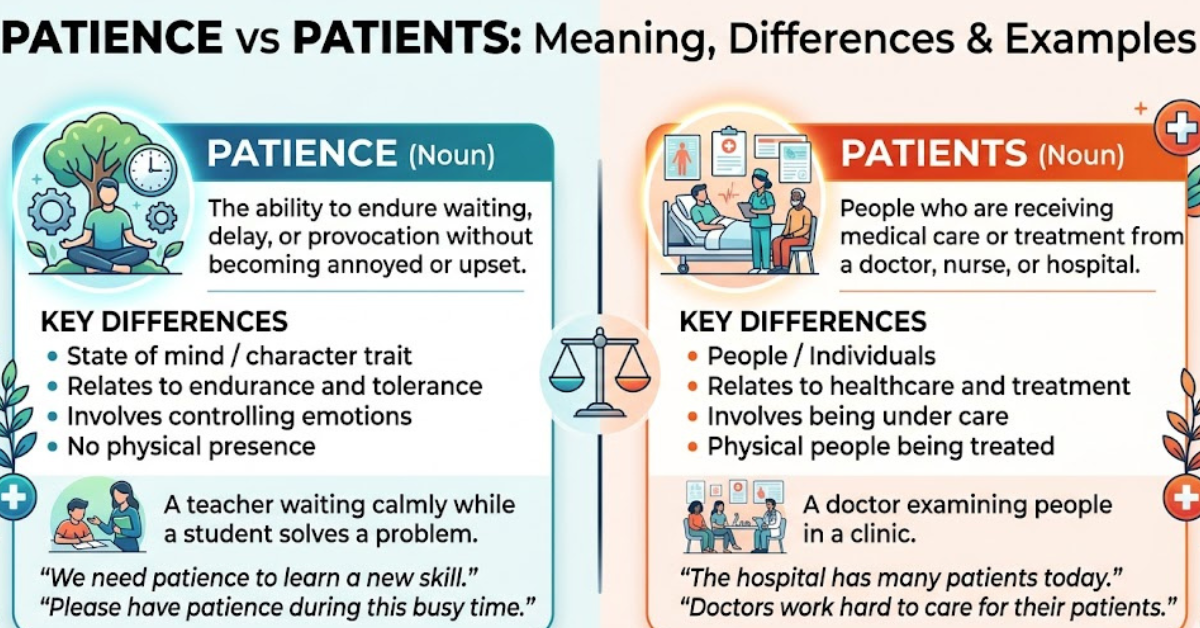
Patience is a noun that refers to the ability to remain calm, tolerant, and composed when facing delays, difficulties, or challenges.
Definition of Patience
According to standard English dictionaries, patience means:
The capacity to accept or tolerate delay, trouble, or suffering without becoming annoyed or upset.
Examples of Patience in Sentences
- Parents often need a lot of patience when raising young children.
- Learning a new language requires time and patience.
- She handled the stressful situation with remarkable patience.
- His patience was rewarded after months of hard work.
Synonyms for Patience
Some related words include:
- Tolerance
- Endurance
- Perseverance
- Calmness
- Self-control
- Composure
Patience is considered an important personal quality in both professional and personal settings.
What Does Patients Mean?
Patients is the plural form of patient, referring to people receiving medical care or treatment from healthcare professionals.
Definition of Patients
A patient is:
A person who receives medical attention, care, or treatment from a doctor, nurse, hospital, or healthcare provider.
When there is more than one patient, the correct word is patients.
Examples of Patients in Sentences
- The hospital treated hundreds of patients during the emergency.
- Doctors carefully monitor their patients after surgery.
- The clinic provides services for elderly patients.
- Nurses ensure that all patients receive proper care.
Synonyms for Patients
Depending on the context, related terms may include:
- Medical clients
- Hospitalized individuals
- Healthcare recipients
- Care recipients
Patience vs Patients Meaning: The Key Difference
The confusion between these words often comes from their similar pronunciation. However, their meanings are entirely unrelated.
| Word | Meaning | Part of Speech |
| Patience | The ability to stay calm and tolerant | Noun |
| Patients | People receiving medical treatment | Plural Noun |
Quick Memory Trick
A simple way to remember the difference:
- Patience contains the word ending “-ence,” which often describes a quality or state.
- Patients ends with “-s,” indicating multiple people receiving healthcare.
Think of it this way:
- You need patience while waiting.
- Doctors treat patients while working.
Why Do People Confuse Patience and Patients?
English contains many words that sound alike but have different meanings. These are called homophones or near-homophones.
Several factors contribute to the confusion:
1. Similar Pronunciation
In casual speech, patience and patients often sound almost identical.
2. Similar Spelling
Only a few letters separate the two words.
3. Context Is Overlooked
Writers sometimes focus on spelling rather than the sentence’s meaning.
4. Fast Typing and Autocorrect
Typing quickly can result in accidentally selecting the wrong word.
How to Use Patience Correctly
Use patience whenever you’re talking about:
- Staying calm
- Waiting without frustration
- Tolerance
- Emotional control
- Perseverance
Examples
“Thank you for your patience.”
“It takes patience to master a new skill.”
“She showed great patience during the meeting.”
“The doctor treated many patience.”
The last sentence is incorrect because it refers to people receiving treatment.
How to Use Patients Correctly
Use patients when discussing:
- Hospitals
- Doctors
- Nurses
- Medical care
- Healthcare services
Examples
“The nurse checked on all the patients.”
“The clinic serves over 500 patients every month.”
“Doctors prioritize the needs of their patients.”
“You need patients when learning to drive.”
The correct word here would be patience.
Common Mistakes in Patience vs Patients Usage
Many writers accidentally interchange these terms.
Mistake #1
“I appreciate your patients.”
“I appreciate your patience.”
Mistake #2
“The hospital admitted several patience.”
“The hospital admitted several patients.”
Mistake #3
“Patience waited in the lobby for treatment.”
“Patients waited in the lobby for treatment.”
Real-Life Examples of Patience and Patients
Understanding context makes the distinction easier.
Example 1: Customer Service
A customer waits 30 minutes on hold.
Correct usage:
Thank you for your patience.
Example 2: Healthcare Setting
A hospital experiences a busy day.
Correct usage:
The emergency room treated many patients.
Example 3: Education
A teacher helps struggling students.
Correct usage:
Good teachers often demonstrate tremendous patience.
Grammar Tips for Patience vs Patients
To avoid confusion, ask yourself one question:
Are you talking about a quality or a person?
If you’re describing a personal quality:
Use patience
If you’re referring to people receiving medical care:
Use patients
This simple rule solves most usage problems instantly.
Patience vs Patients in Professional Writing
Correct word choice matters in professional communication.
In Business
Use patience when discussing:
- Teamwork
- Leadership
- Customer support
- Personal development
In Healthcare
Use patients when discussing:
- Medical records
- Treatment plans
- Healthcare services
- Clinical research
Using the wrong word can affect credibility and create confusion for readers.
Why Understanding Patience vs Patients Matters
Small grammar mistakes can have a big impact.
Knowing the difference helps:
- Improve writing accuracy
- Enhance professional communication
- Build credibility
- Avoid misunderstandings
- Strengthen English language skills
Whether you’re a student, professional, healthcare worker, or content creator, mastering Patience vs Patients improves the clarity of your communication.
Frequently Asked Questions FAQs
What is the difference between patience and patients?
Patience means the ability to remain calm and tolerant during delays or challenges. Patients refers to people receiving medical care or treatment.
Is patience singular or plural?
Patience is an uncountable noun and does not typically have a plural form in everyday usage.
Is patients a noun?
Yes. Patients is a plural noun referring to more than one person receiving healthcare services.
Why do people confuse patience and patients?
They are commonly confused because they are pronounced similarly and have nearly identical spellings.
How can I remember the difference between patience and patients?
Remember:
- Patience = staying calm while waiting.
- Patients = people being treated by doctors.
Can patience be used in medical contexts?
Yes, but only when referring to the quality of being calm. For example:
Nurses need patience when caring for patients.
In this sentence, both words are used correctly.
Conclusion
Understanding Patience vs Patients is simpler once you know their distinct meanings. Patience refers to calmness, tolerance, and the ability to wait without frustration, while patients are individuals receiving medical care. Although the words sound alike, their purposes in language are entirely different.
The next time you write an email, article, or message, take a moment to check the context. If you’re talking about emotional endurance, choose patience. If you’re referring to healthcare recipients, use patients. Mastering this small distinction can significantly improve your writing accuracy and confidence. For more grammar guides and language tips, explore related articles that help make English easier to understand and use correctly.