Have you ever come across the words pail and pale and wondered whether they mean the same thing? Since they sound identical when spoken, many writers and English learners confuse them. Understanding Pail vs Pale is important because these words have completely different meanings despite sharing the same pronunciation.
In this guide, we’ll break down the definitions, usage, examples, common mistakes, and memory tricks that will help you confidently distinguish between these commonly confused English words.
What Does Pail Mean?
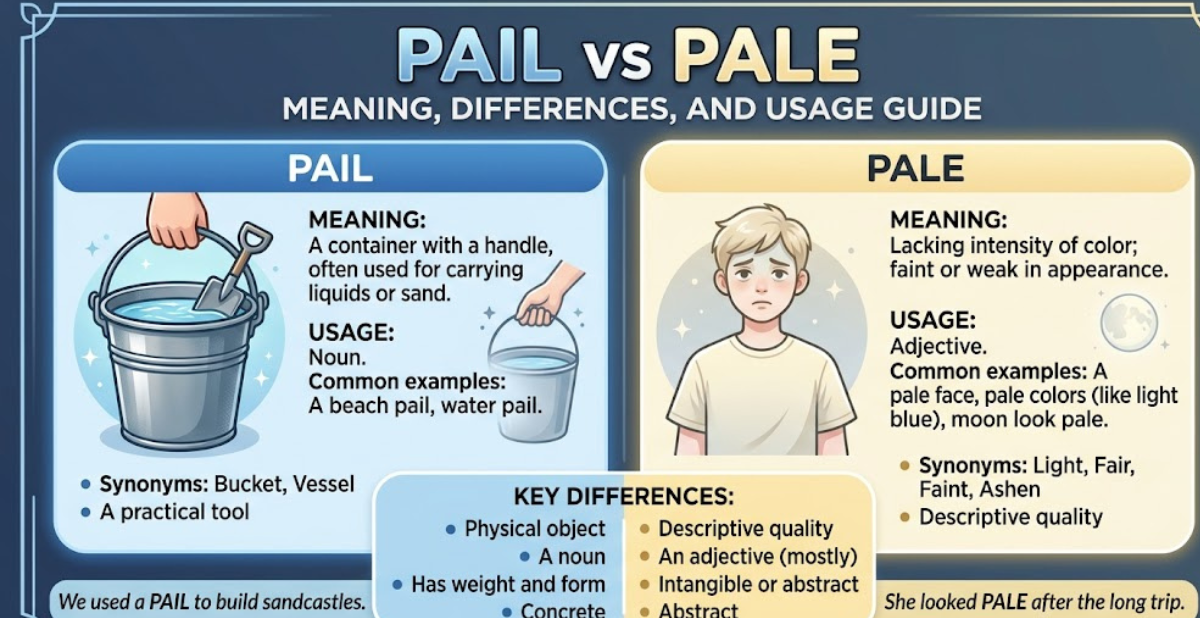
A pail is a container, usually with a handle, used for carrying liquids, sand, soil, or other materials. It is often interchangeable with the word bucket.
Definition of Pail
Pail (noun): A cylindrical container with a handle used for holding or carrying things.
Examples of Pail in a Sentence
- The child filled a pail with sand at the beach.
- She carried a pail of water from the well.
- The farmer used a metal pail to feed the animals.
- We bought a plastic pail for gardening work.
Common Synonyms for Pail
- Bucket
- Container
- Vessel
- Tub
- Receptacle
What Does Pale Mean?
The word pale usually refers to a lack of color or brightness. It can describe a person’s complexion, an object, or even something that appears weak or insignificant when compared to something else.
Definition of Pale
Pale (adjective): Light in color or lacking strong color.
Pale (verb): To become less important or less impressive by comparison.
Examples of Pale in a Sentence
- Her face looked pale after hearing the shocking news.
- The walls were painted a pale blue.
- The moon appeared pale behind the clouds.
- His achievements pale in comparison to hers.
Common Synonyms for Pale
- Light-colored
- Faint
- Wan
- Colorless
- Washed-out
Pail vs Pale: The Key Difference
The simplest way to understand Pail vs Pale is to remember that one is an object and the other is usually a description.
| Word | Meaning | Part of Speech | Example |
| Pail | A bucket or container | Noun | He carried a pail of water. |
| Pale | Light in color or lacking brightness | Adjective/Verb | She looked pale after the race. |
Although they sound the same, their meanings and functions are entirely different.
Why Are Pail and Pale Confused?
The confusion comes from the fact that pail and pale are homophones.
What Are Homophones?
Homophones are words that:
- Sound the same
- Have different spellings
- Have different meanings
Examples include:
- Pail vs Pale
- Flour vs Flower
- Right vs Write
- Sea vs See
- Knight vs Night
Because homophones share pronunciation, writers often accidentally choose the wrong spelling.
Easy Memory Tricks for Pail vs Pale
Remembering the difference doesn’t have to be difficult.
Trick #1: Pail Contains “AI”
Think of the letters AI in pail as standing for “A Item” or a physical object.
Since a pail is something you can hold, this connection can help reinforce the meaning.
Trick #2: Pale Contains “ALE”
Imagine a light-colored drink like a pale ale. The word pale is associated with color.
Trick #3: Bucket Test
If you can replace the word with bucket, use pail.
Example:
- He carried a bucket of water.
- He carried a pail of water.
The sentence still makes sense.
Common Mistakes When Using Pail and Pale
Many people accidentally swap these words in writing.
Incorrect Usage
She looked pail after the surgery.
Correct Usage
She looked pale after the surgery.
He carried a pale full of water.
Correct Usage
He carried a pail full of water.
Paying attention to context usually makes the correct choice obvious.
Pail vs Pale in Everyday English
When to Use Pail
Use pail when talking about:
- Buckets
- Containers
- Gardening equipment
- Beach toys
- Carrying liquids
When to Use Pale
Use pale when discussing:
- Skin color
- Paint colors
- Light shades
- Weak comparisons
- Faded appearances
Examples Comparing Pail and Pale
Here are some side-by-side examples to make the distinction clearer.
| Pail | Pale |
| The boy carried a pail of sand. | The sand looked pale under the moonlight. |
| The gardener filled the pail with soil. | The flowers were pale pink. |
| A metal pail sat beside the well. | She became pale after standing up too quickly. |
| The pail was leaking water. | The sunlight made the curtains appear pale. |
The Historical Origins of Pail and Pale
Understanding a word’s history can make it easier to remember.
Origin of Pail
The word pail comes from the Old French word paelle and Middle English forms referring to containers used for carrying liquids.
Origin of Pale
The word pale originates from the Latin word pallidus, meaning “wan” or “lacking color.”
These different origins explain why the words have unrelated meanings despite sounding alike.
Pail vs Pale: Quick Reference Guide
If you’re in a hurry, remember these points:
Use Pail When:
- Referring to a bucket
- Talking about a container
- Describing something used for carrying materials
Use Pale When:
- Referring to light color
- Describing someone’s complexion
- Comparing something as less impressive
Frequently Asked Questions FAQs
Is pail the same as a bucket?
Yes, in most contexts, a pail is essentially a bucket. The terms are often used interchangeably, although “bucket” is more common in everyday conversation.
What does pale mean in a sentence?
Pale typically means light in color or lacking color. For example: “Her face became pale after the long hike.”
Are pail and pale homophones?
Yes. Pail and pale are homophones because they are pronounced the same way but have different meanings and spellings.
How do I remember pail vs pale?
A simple trick is to associate pail with bucket and pale with color. If you’re talking about a container, use pail. If you’re describing appearance or color, use pale.
Can pale be used as a verb?
Yes. For example: “His accomplishments pale in comparison to hers.” Here, pale means to seem less important or impressive.
Which word is more commonly confused in writing?
Both are frequently confused because they sound identical. However, context usually makes the correct word clear.
Conclusion
Understanding Pail vs Pale is easier once you recognize that these words belong to completely different categories. A pail is a container or bucket used for carrying materials, while pale describes a light color, a lack of color, or something less significant by comparison.
The next time you’re writing, use a quick context check: if you’re talking about a bucket, choose pail; if you’re describing color or appearance, choose pale. Mastering this small distinction can improve your writing accuracy and help you avoid one of the most common homophone mistakes in English. For more grammar tips and word comparisons, explore related language guides and continue building your vocabulary with confidence.