Some English words sound so similar that they create confusion even for fluent speakers. Sale and sell are a classic example. They’re closely related in meaning, often used in shopping or business contexts, and pronounced similarly in casual speech—yet they play completely different roles in grammar.
If you’ve ever stopped to think about sale vs sell, you’re not alone. This is one of the most common vocabulary mix-ups in English writing, especially in advertising, business communication, and everyday conversation. Understanding the sale vs sell meaning can help you write more accurately and avoid simple grammar mistakes.
In this guide, we’ll explain the sale vs sell difference, show examples, cover pronunciation, and make it easy to know exactly when to use sale vs sell.
Sale vs Sell: The Quick Difference
Here’s the simplest explanation:
- Sale = a noun (a thing)
- Sell = a verb (an action)
That’s the key difference.
Examples:
- The store is having a sale. ✔
- The store wants to sell more products. ✔
One refers to an event or transaction. The other describes the act of exchanging something for money.
What Does “Sale” Mean?
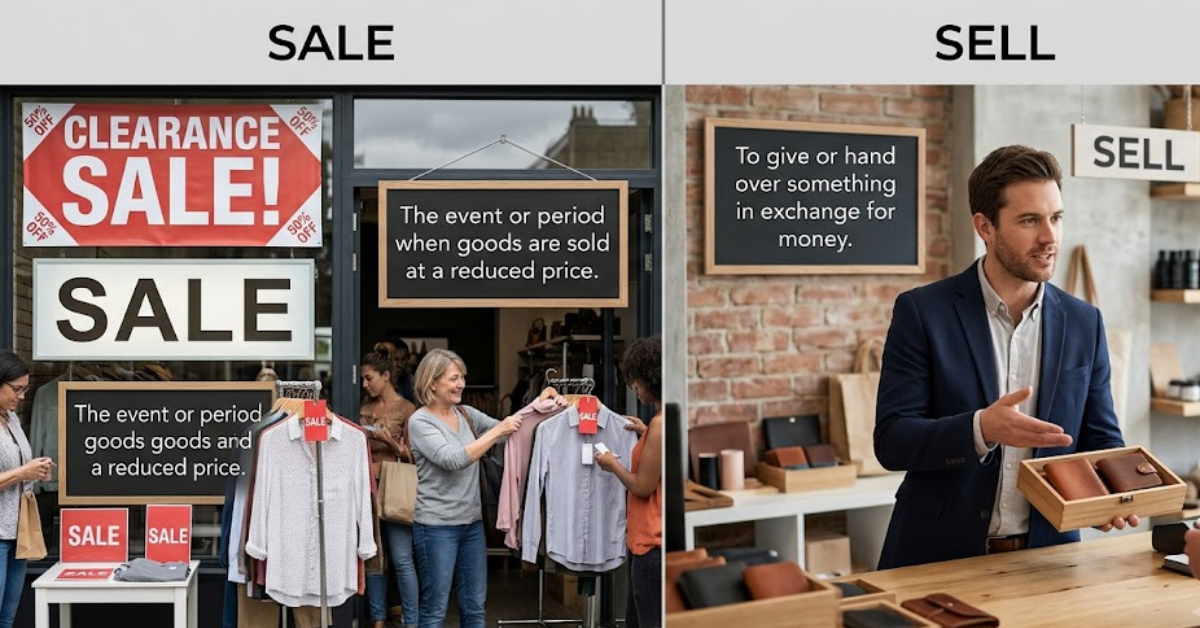
Sale is a noun. It refers to the act of selling, a transaction, or a period when goods are offered at reduced prices.
Common Meanings of Sale
- A transaction in which something is sold
- A discount event in a store
- The exchange of goods for money
Examples:
- The house is for sale.
- The store announced a holiday sale.
- Ticket sales increased this month.
In all these examples, sale refers to a thing or event, not an action.
What Does “Sell” Mean?
Sell is a verb. It means to give or exchange something for money.
Common Meanings of Sell
- To exchange something for payment
- To persuade someone to buy something
- To market or promote an idea or product
Examples:
- They want to sell their car.
- She sells handmade jewelry online.
- The ad helped sell the product.
Here, sell describes an action.
Sale vs Sell Meaning Explained
The easiest way to understand this is to ask:
Is it a thing or an action?
- If it’s a thing, event, or transaction → use sale
- If it’s an action → use sell
Examples:
- The sale starts tomorrow. → noun
- They will sell the items tomorrow. → verb
This simple rule solves most grammar confusion.
Sale vs Sell Definition in Grammar
Understanding grammar makes the distinction clearer.
Sale = Noun
A noun names:
- An event
- A transaction
- A business result
- A discounted shopping period
Examples:
- Car sale
- Final sale
- Retail sale
Sell = Verb
A verb shows action.
Examples:
- Sell products
- Sell quickly
- Sell online
This is the core sale vs sell grammar difference.
Sale vs Sell Examples in Sentences
Seeing the words in context helps make the distinction easier.
Examples with Sale
- The clothing sale begins Friday.
- The property is for sale.
- The company recorded high sales this quarter.
- Clearance sale signs were everywhere.
Examples with Sell
- They plan to sell the old furniture.
- Can you sell this item online?
- She sells books through her website.
- Good branding helps sell products faster.
These sale vs sell examples sentences show the difference clearly.
For Sale vs Sell: What’s the Difference?
This is a common confusion point.
For Sale
This phrase means something is available to buy.
Examples:
- The car is for sale.
- That house is for sale.
Sell
This refers to the act of offering something in exchange for money.
Examples:
- They want to sell the car.
- He plans to sell his house.
So in for sale vs sell, one describes status, while the other describes action.
When to Use Sale vs Sell
A quick checklist can help.
Use “Sale” When:
- Talking about a discount event
- Referring to a completed transaction
- Describing something available for purchase
- Mentioning business revenue in noun form
Examples:
- Black Friday sale
- Home sale
- Flash sale
Use “Sell” When:
- Talking about an action
- Referring to offering something for money
- Describing marketing or persuasion
Examples:
- Sell products
- Sell a house
- Sell an idea
This makes when do you use sale vs sell much easier to answer.
Sale vs Sell Pronunciation
Although these words look similar, pronunciation is slightly different.
- Sale sounds like sail
- Sell sounds like sel
Examples:
- Sale rhymes with mail
- Sell rhymes with bell
This is why people sometimes confuse sale vs sell vs sail in spelling.
Sale vs Sell vs Sail
These three words sound close but mean completely different things.
Sale
A noun related to selling.
- The store has a sale.
Sell
A verb meaning to exchange for money.
- I want to sell my bike.
Sail
Related to boats or movement by wind.
- They sail across the lake.
Even though sale and sail sound the same in pronunciation, their meanings are unrelated.
Rate of Sale vs Sell-Through
These terms often appear in retail and business.
Rate of Sale
A noun phrase that refers to how quickly products are sold over time.
Example:
- The rate of sale increased this month.
Sell-Through
A retail metric showing how much inventory sold compared to stock available.
Example:
- The product had a high sell-through rate.
These are specialized business terms, but the grammar difference still follows the same rules.
Common Mistakes People Make
Here are some common errors.
Incorrect:
- The store will sale these items tomorrow.
Correct:
- The store will sell these items tomorrow.
Why? An action requires the verb.
Another example:
Incorrect:
- There is a big sell at the mall.
Correct:
- There is a big sale at the mall.
Why? A shopping event is a noun.
Easy Trick to Remember the Difference
Here’s a simple memory tip:
Sale = Thing
Think of signs like:
- On Sale
- For Sale
These name something.
Sell = Action
Think of doing something:
- Sell a car
- Sell a product
If someone is performing an action, sell is the correct choice.
Frequently Asked Questions
What is the difference between sale and sell?
Sale is a noun, while sell is a verb. One names a transaction or event; the other describes the action of exchanging something for money.
Is it “for sale” or “for sell”?
The correct phrase is for sale.
How do you use sale in a sentence?
Example: The store is having a summer sale.
How do you use sell in a sentence?
Example: They want to sell their old laptop.
Are sale and sail pronounced the same?
Yes, in standard English pronunciation they sound alike, but they have different meanings and spellings.
Conclusion
Understanding sale vs sell becomes easy once you remember one key rule: sale is a noun, and sell is a verb. One refers to a thing, event, or transaction, while the other describes the action of exchanging something for money.
The next time you hesitate over using sale vs sell, simply ask yourself whether you’re naming something or describing an action. That quick grammar check can help you choose the right word every time and make your writing clearer, more professional, and more accurate.