English is filled with phrases that make communication more precise, and the latter of the two is one of those expressions that often appears in both formal and everyday conversations. Although many people understand it from context, they may not know exactly when or how to use it correctly.
In simple terms, the latter of the two refers to the second person, object, idea, or option mentioned in a pair. Understanding the difference between the latter and the former can help improve your writing, speaking, and overall command of the English language.
What Does “The Latter of the Two” Mean?
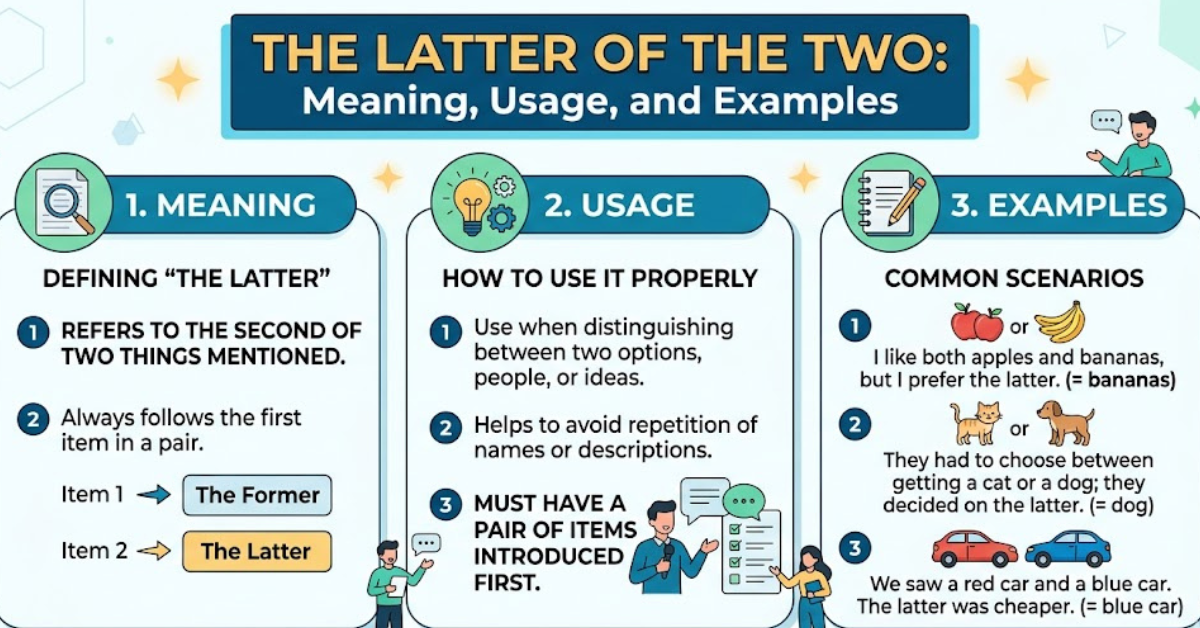
The phrase the latter of the two means the second item mentioned out of two choices or subjects. It is commonly used to avoid repeating words and to make sentences shorter and more elegant.
For example:
- “Sarah and Emma both applied for the job. The latter of the two had more experience.”
In this sentence, Sarah is mentioned first and Emma second. Therefore, “the latter of the two” refers to Emma.
The Basic Rule
When comparing two things:
- The former = the first item mentioned
- The latter = the second item mentioned
Example:
“I can choose between tea and coffee. I prefer the latter.”
Here, “the latter” means coffee because it was the second option mentioned.
Why Do People Use “The Latter of the Two”?
The phrase is useful because it prevents unnecessary repetition. Instead of repeating the same noun multiple times, speakers and writers can use “the latter” to keep their language clear and smooth.
Common situations where it appears include:
- Academic writing
- Professional emails
- News articles
- Legal documents
- Everyday conversations
For instance:
“The study compared traditional teaching methods and online learning. The latter showed greater flexibility for students.”
Here, “the latter” clearly refers to online learning, the second method mentioned.
The Difference Between “The Former” and “The Latter”
A common source of confusion is remembering which term refers to which item. A simple way to remember it is:
- Former = First (both begin with the letter “F”)
- Latter = Last (both begin with the letter “L”)
Examples:
- “James and Michael went to the meeting. The former presented the report, while the latter answered the questions.”
- The former = James
- The latter = Michael
- “I am deciding between a laptop and a tablet. The latter is more portable.”
- The latter = tablet
This distinction helps writers avoid ambiguity and communicate more effectively.
When to Use “The Latter of the Two” in Writing
You should use “the latter of the two” when you have already mentioned two specific items and want to refer to the second one without repeating its name. It works especially well in formal and analytical writing.
Examples include:
- “The company offers a monthly plan and an annual subscription. The latter of the two provides better value.”
- “The scientist studied two species of birds. The latter showed different migration patterns.”
However, if you are discussing more than two items, “the latter” can become unclear. In such cases, it is better to specify the exact item.
Common Mistakes When Using “The Latter”
Using It With More Than Two Items
Incorrect:
“The menu includes pizza, pasta, and salad. The latter is my favorite.”
Because three items are listed, “the latter” can create confusion.
Better:
“The menu includes pizza, pasta, and salad. Salad is my favorite.”
Forgetting What Was Mentioned Second
Always check the order of the words in your sentence. The latter always points to the second of two mentioned items.
Synonyms and Alternatives for “The Latter of the Two”
Depending on the context, you can replace the phrase with alternatives such as:
- The second option
- The second one
- The latter choice
- The last-mentioned item
- The other option
For example:
Original:
“Between the red car and the blue car, I prefer the latter.”
Alternative:
“Between the red car and the blue car, I prefer the second option.”
Is “The Latter of the Two” Formal or Informal?
“The latter of the two” is generally considered a formal expression. It appears frequently in academic papers, business communication, and professional writing.
In casual conversation, people often choose simpler phrases like:
- “the second one”
- “that one”
- “the other one”
Both forms are correct; the best choice depends on your audience and situation.
Tips for Remembering “The Latters”
If you struggle to remember the phrase, use these simple tricks:
- Former = First
- Latter = Last
- The latter always points to the second item in a pair
Practicing with examples can make the distinction become natural over time.
FAQs
What does “the latters of the two” mean?
“The latters of the two” means the second person, thing, or idea mentioned when comparing exactly two items.
Is “the latters” the first or second option?
The latters refers to the second option. The first option is called the former.
Can “the latters” be used for three or more things?
It is best used for two items only. When more than two items are listed, naming the specific item usually provides better clarity.
Is it correct to say “the latters of the two”?
Yes, the phrase is grammatically correct and emphasizes that you are referring to the second of two choices.
What is the opposite of “the latters”?
The opposite of “the latters” is “the former,” which refers to the first item mentioned.
Conclusion
Understanding the latter of the two is a simple but valuable way to improve clarity in English. The phrase refers to the second of two mentioned items and is especially useful in formal writing, professional communication, and academic discussions.
By remembering the connection between former and first and latter and last, you can use these terms with confidence. Continue practicing with everyday examples, and your writing will become more precise, polished, and professional.