Have you ever come across the word “chalant” and wondered whether it’s a real word or just a playful internet invention? You’re not alone. Many people know the word nonchalant, but when they encounter its apparent opposite, confusion often follows.
If you’re asking what does chalant mean, this guide will explain the word’s definition, history, modern usage, and whether it belongs in formal English. By the end, you’ll understand why “chalant” has become a fascinating linguistic curiosity.
Understanding What Chalant Means
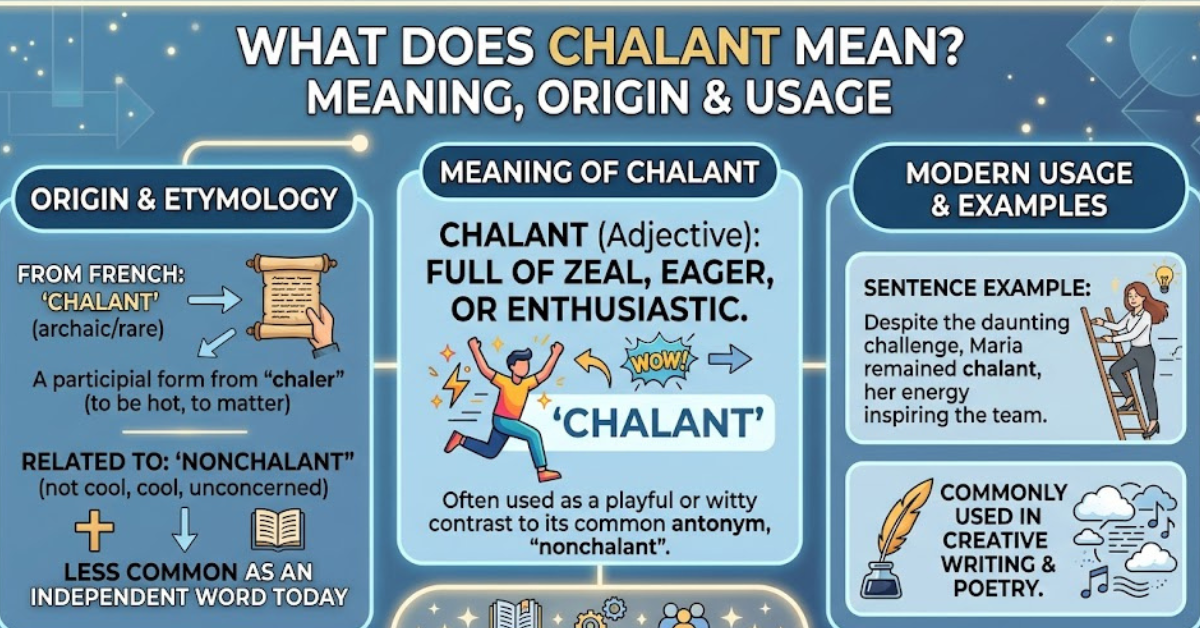
The simplest answer to what does chalant mean is that it generally refers to someone who is attentive, concerned, enthusiastic, or visibly interested in something.
In everyday usage, people often use chalant as the opposite of nonchalant.
For example:
- Nonchalant: Calm, unconcerned, seemingly indifferent.
- Chalant: Interested, engaged, attentive, or emotionally invested.
Someone who is nonchalant may shrug off a situation, while a chalant person is more likely to react, participate, or show concern.
Example Sentences
- “She wasn’t nonchalant about the project at all—she was extremely chalant and involved.”
- “Be chalant when customers raise concerns.”
- “He stayed chalant throughout the discussion and contributed valuable ideas.”
Although these examples sound natural, there is an important detail about the word’s status in English.
Is Chalant an Official Word?
This is where things get interesting.
Historically, chalant has not been widely recognized as a standard English word in major dictionaries. The word gained popularity because English speakers naturally assumed that removing the prefix non- from nonchalant would create an opposite term.
However, language doesn’t always work that way.
While many people use chalant informally, it remains relatively uncommon and is often viewed as a back-formation—a word created by reversing the structure of another word.
What Is a Back-Formation?
Back-formation occurs when speakers create a new word by removing part of an existing word.
Examples include:
- Editor → Edit
- Television → Televise
- Nonchalant → Chalant
In the case of chalant, speakers created a logical opposite even though the standalone term wasn’t traditionally common in English.
The Origin of Nonchalant
To better understand what does chalant mean, it helps to examine the history of nonchalant.
The word nonchalant comes from French:
- Non = not
- Chaloir = to care or concern
The French-derived term eventually evolved into English, carrying the meaning of someone who appears unconcerned or indifferent.
Over time, English retained nonchalant, but the original root largely disappeared from everyday use. As a result, many speakers assumed that chalant should exist as a natural counterpart.
Why the Confusion Exists
Most English opposites work predictably:
| Word | Opposite |
| Happy | Unhappy |
| Fair | Unfair |
| Known | Unknown |
Because of this pattern, people often expect:
| Word | Opposite |
| Nonchalant | Chalant |
This expectation has contributed significantly to the word’s growing popularity.
How Chalant Is Used Today
In modern English, chalant appears most frequently in:
Social Media
Platforms such as:
- TikTok
- X (formerly Twitter)
often feature users describing themselves as “very chalant” about a topic.
Examples include:
- “I’m extremely chalant about this new movie release.”
- “People say stay calm, but I’m feeling very chalant right now.”
Informal Conversations
Friends and coworkers sometimes use the word humorously or casually.
For example:
- “Don’t act nonchalant—be chalant and tell us how you really feel.”
Pop Culture
Internet culture has helped spread unconventional words quickly. As memes and viral content circulate, terms like chalant gain traction despite their limited historical use.
What Does Being Chalant Look Like?
The concept is easier to understand through behavior.
A chalant person may:
- Show excitement
- Ask questions
- Express emotions openly
- Pay close attention
- Demonstrate genuine concern
- Participate actively
By contrast, a nonchalant person may:
- Appear detached
- Remain emotionally reserved
- Show little visible concern
- Act indifferent
Real-World Example
Imagine two employees attending an important meeting.
Employee A (Nonchalant):
- Speaks very little
- Appears indifferent
- Shows minimal reaction
Employee B (Chalant):
- Takes notes
- Asks thoughtful questions
- Engages in discussion
- Expresses interest in outcomes
This comparison illustrates how people commonly interpret the term.
Synonyms for Chalant
Because chalant isn’t universally accepted in formal English, alternative words are often better choices.
Depending on context, you might use:
- Attentive
- Concerned
- Engaged
- Interested
- Involved
- Enthusiastic
- Responsive
- Invested
- Alert
- Focused
Example
Instead of:
- “She was very chalant about the issue.”
You could say:
- “She was deeply engaged with the issue.”
- “She was highly attentive to the issue.”
- “She showed genuine concern.”
Should You Use the Word Chalant?
The answer depends on your audience.
Appropriate Situations
You can use chalant:
- In casual conversations
- On social media
- In humorous writing
- Among audiences familiar with internet slang
Situations to Avoid
You may want to avoid it in:
- Academic papers
- Professional reports
- Formal business communication
- Legal documents
- Technical writing
In these contexts, standard words such as “attentive” or “engaged” are usually clearer and more widely accepted.
Why Language Experts Find Chalant Interesting
Linguists often view words like chalant as examples of language evolution.
English constantly changes through:
- Social media trends
- Cultural shifts
- Everyday conversation
- New technology
- Generational usage
Many words that are now accepted began as informal expressions. While there’s no guarantee chalant will become fully standardized, its increasing use demonstrates how speakers shape language over time.
The Power of Common Usage
One of the most fascinating aspects of language is that frequent use can eventually influence dictionary recognition.
When enough people consistently use a word with a shared meaning, lexicographers often take notice.
That’s why discussions about what does chalant mean have become more common in recent years.
Key Takeaways
- Chalant is generally used as the opposite of nonchalant.
- It typically means attentive, concerned, interested, or emotionally engaged.
- The term is more common in informal speech and online culture.
- It is not traditionally considered a standard English word in many dictionaries.
- Alternative words such as attentive, engaged, and involved may be better choices in formal settings.
- The popularity of chalant highlights how language evolves through everyday use.
Frequently Asked Questions
What does chalants mean in slang?
In slang and casual conversation, chalant usually means interested, concerned, attentive, or emotionally invested in something. It’s often used as the opposite of nonchalant.
Is chalant a real word?
Chalant exists in usage and is understood by many English speakers, especially online. However, it has not historically held the same level of acceptance as nonchalant in standard English.
What is the opposite of nonchalant?
Traditionally, words like attentive, concerned, engaged, or interested serve as opposites of nonchalant. Informally, many people use chalant for this purpose.
Why do people say chalants?
People often create chalants by removing the prefix “non-” from nonchalant. It feels like a logical opposite and has become popular through social media and internet culture.
Can I use chalants in professional writing?
It’s generally better to use established alternatives such as attentive, engaged, or involved in professional and academic contexts. Chalant is best suited to informal communication.
Is chalant in the dictionary?
Dictionary recognition varies by publisher and evolves over time. The word is still primarily viewed as an informal or emerging term rather than a universally accepted standard English word.
Conclusion
So, what does chalant mean? In modern usage, it refers to someone who is attentive, interested, engaged, or visibly concerned—the opposite of being nonchalant. Although it isn’t traditionally established as a standard English word, its growing presence in conversations, social media, and popular culture has made it increasingly recognizable.
Understanding words like chalant offers a fascinating glimpse into how language evolves. Whether you choose to use it casually or simply appreciate its linguistic journey, knowing its meaning helps you navigate modern English with greater confidence and clarity.