Have you ever received a message that simply said, “TTM,” and wondered what it meant? You’re not alone. Text messaging and social media are filled with abbreviations that can be confusing, especially when new slang terms emerge regularly.
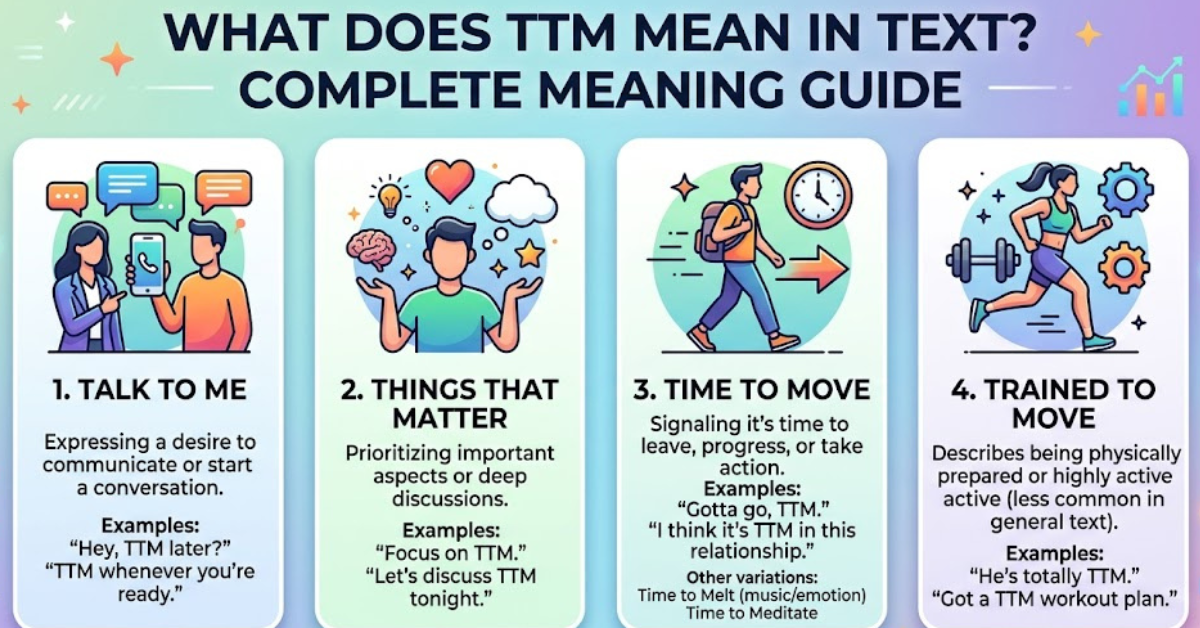
If you’ve been asking what does TTM mean in text, the short answer is that it usually stands for “Talk To Me.” However, depending on the context, TTM can have a few different meanings. Understanding how and when it’s used can help you communicate more effectively and avoid misunderstandings.
In this guide, you’ll learn the most common meanings of TTM, where it’s used, examples in conversations, and how to respond when someone sends it to you.
What Does TTM Mean in Text Messages?
The most widely accepted meaning of TTM in texting is:
TTM = Talk To Me
People use it when they want someone to start a conversation, reply to a message, or engage in a discussion. It’s often used casually among friends, family members, or online acquaintances.
Example Conversations
Example 1:
- Friend: “I’m bored.”
- Friend: “TTM”
Meaning: “Talk to me.”
Example 2:
- Person A: “You haven’t texted all day.”
- Person B: “Sorry, I’ve been busy.”
- Person A: “TTM when you’re free.”
Meaning: “Talk to me when you’re available.”
In most cases, the abbreviation is friendly and informal.
The Most Common Meaning: Talk To Me
When someone writes TTM, they’re usually inviting conversation. It can express:
- A desire to chat
- Interest in someone’s thoughts
- Boredom
- A request for attention
- A way to reconnect
Unlike some internet slang that carries hidden meanings, “Talk To Me” is straightforward and easy to understand when used in personal conversations.
Why People Use TTM
There are several reasons people prefer abbreviations like TTM:
- Faster typing
- Common texting culture
- Character limits on some platforms
- Informal communication style
As digital communication becomes more casual, abbreviations help users communicate quickly while maintaining a conversational tone.
Other Meanings of TTM
Although “Talk To Me” is the most common interpretation, TTM can occasionally represent other phrases depending on the setting.
H3: TTM as “Time To Market”
In business, marketing, and product development, TTM may mean:
Time To Market
This refers to the period required to develop a product and launch it for customers.
Example:
“Our team’s TTM improved by 20% this year.”
This meaning is generally found in professional discussions rather than personal text messages.
H3: TTM as “Trailing Twelve Months”
In finance and accounting, TTM often stands for:
Trailing Twelve Months
It describes financial performance measured over the previous 12-month period.
Example:
“The company’s TTM revenue increased significantly.”
Again, this meaning is unlikely in everyday texting conversations.
H3: TTM in Sports and Specialized Communities
Certain online groups, gaming communities, or industry-specific forums may use TTM differently. In these situations, context becomes important.
When in doubt, look at:
- The topic being discussed
- The platform being used
- The relationship between participants
How TTM Is Used on Social Media
TTM appears frequently on social media platforms such as:
- Snapchat
- TikTok
- X (formerly Twitter)
- Discord
Users often post TTM to encourage interaction.
Common Social Media Examples
Instagram Story:
“Can’t sleep. TTM.”
Meaning: The person wants followers or friends to message them.
Snapchat:
“Anyone awake? TTM.”
Meaning: Looking for someone to chat with.
TikTok Caption:
“TTM if you’ve watched this show.”
Meaning: Start a conversation about the topic.
On social platforms, TTM is usually an invitation for engagement.
What Does TTM Mean From a Guy or Girl?
People often wonder whether TTM carries a special meaning when sent by someone they’re interested in.
Generally, TTM still means “Talk To Me.” However, the intent can vary depending on the relationship.
It Could Mean:
- They want attention
- They’re interested in chatting
- They miss talking with you
- They’re feeling lonely
- They want to continue a conversation
Example
If someone you’re dating texts:
“Hey, TTM later.”
They’re likely saying:
“Let’s talk later.”
The abbreviation itself doesn’t automatically indicate romantic interest, but the context may suggest it.
How to Respond When Someone Says TTM
The best response depends on the situation.
Casual Response
- “Sure, what’s up?”
- “I’m here.”
- “How’s your day going?”
- “What do you want to talk about?”
Friendly Response
- “Hey! What’s new?”
- “I’m free now.”
- “Tell me what’s going on.”
If You’re Busy
- “Can’t talk right now, but I’ll text later.”
- “I’ll reach out when I’m free.”
A simple response is usually enough because TTM is an invitation to communicate.
TTM vs Other Popular Text Abbreviations
Many texting abbreviations have similar purposes. Here’s how TTM compares.
| Abbreviation | Meaning | Usage |
| TTM | Talk To Me | Invitation to chat |
| DM | Direct Message | Private conversation |
| HMU | Hit Me Up | Contact me |
| BRB | Be Right Back | Temporary absence |
| IMO | In My Opinion | Sharing thoughts |
| TBH | To Be Honest | Honest statement |
| WYD | What Are You Doing | Conversation starter |
TTM is generally more direct than abbreviations like HMU because it specifically asks someone to start talking.
When Should You Use TTM?
TTM works best in informal communication.
Appropriate Situations
- Texting friends
- Messaging family members
- Social media conversations
- Online communities
- Casual group chats
Situations to Avoid
- Professional emails
- Business proposals
- Academic writing
- Formal workplace communication
In professional settings, writing the full phrase “Talk to me” is usually more appropriate.
Common Misunderstandings About TTM
Because many abbreviations have multiple meanings, confusion can happen.
Misunderstanding #1: Assuming a Romantic Meaning
TTM doesn’t automatically indicate flirting. Most of the time, it’s simply a request to chat.
Misunderstanding #2: Ignoring Context
In finance or business discussions, TTM may not mean “Talk To Me” at all.
Misunderstanding #3: Thinking It’s a New Slang Term
TTM has existed for years and remains a commonly recognized texting abbreviation.
Key Takeaways
- TTM most commonly means “Talk To Me.”
- It’s used in texting, social media, and online chats.
- The abbreviation usually invites conversation or engagement.
- In business and finance, TTM can mean Time To Market or Trailing Twelve Months.
- Context determines the correct interpretation.
- Responding is simple—just start a conversation.
Frequently Asked Questions
What does TTM mean in text from a friend?
When a friend sends TTM, it usually means “Talk To Me.” They’re inviting you to chat or continue a conversation.
What does TTM mean on Snapchat?
On Snapchat, TTM typically means “Talk To Me.” Users often send it when they’re bored, want attention, or want to start a conversation.
Is TTM the same as HMU?
Not exactly. TTM means “Talk To Me,” while HMU means “Hit Me Up.” Both encourage communication, but TTM is a more direct request for conversation.
What does TTM mean on Instagram?
On Instagram, TTM usually encourages followers or friends to send a message, reply to a story, or engage in discussion.
Can TTM have different meanings?
Yes. While “Talk To Me” is the most common meaning in texting, TTM can also stand for “Time To Market” in business and “Trailing Twelve Months” in finance.
How should I reply to TTM?
A simple response works best. You can say, “What’s up?”, “How are you?”, or “Sure, let’s chat.”
Conclusion
Understanding what does TTM mean in text can make online conversations much easier to navigate. In most cases, TTM simply stands for “Talk To Me,” serving as a friendly invitation to start or continue a conversation. While the abbreviation can have alternative meanings in business and finance, context usually makes the intended meaning clear.
As texting slang continues to evolve, knowing common abbreviations like TTM helps you communicate confidently across messages, social media platforms, and online communities. The next time someone sends you “TTM,” you’ll know exactly what they mean—and how to respond.