Have you ever looked at someone and heard people describe them as “conventionally attractive” without fully understanding what that means? The phrase is common in conversations about beauty, dating, social media, and celebrity culture, yet many people interpret it differently.
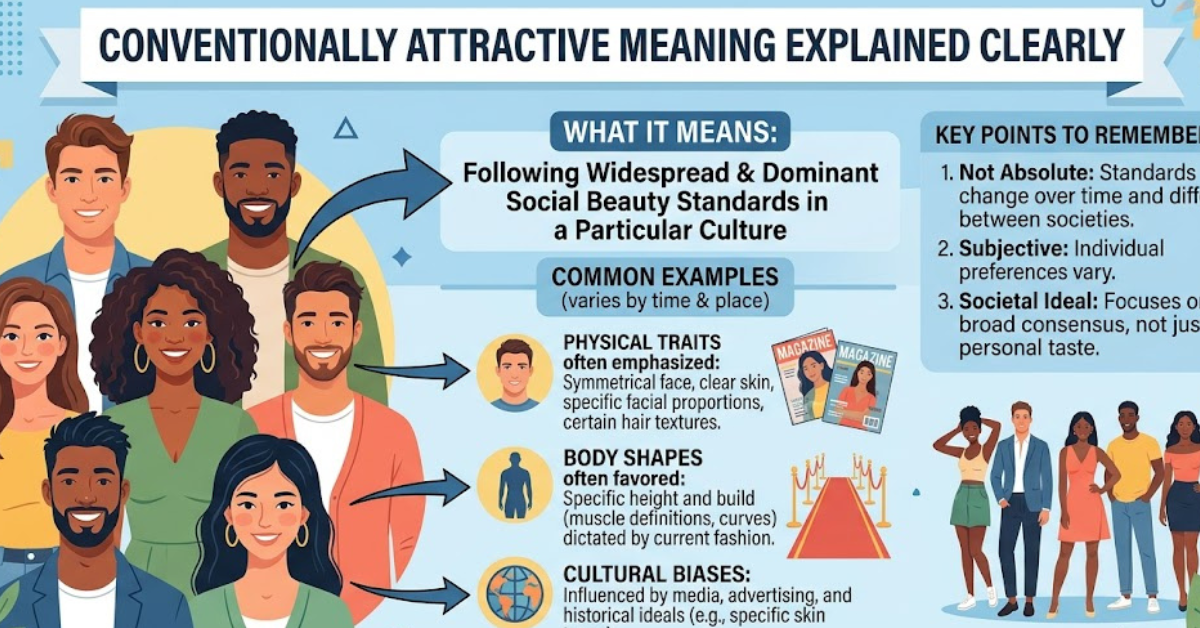
The conventionally attractive meaning refers to a person whose appearance aligns with widely accepted beauty standards within a particular society or culture. These standards are often shaped by media, history, social trends, and cultural preferences.
In this article, you’ll learn what conventionally attractive means, the characteristics often associated with it, how beauty standards differ around the world, and why attractiveness is much more complex than simply fitting a societal ideal.
What Does Conventionally Attractive Mean?
At its core, being conventionally attractive means possessing physical features that are generally considered appealing by mainstream societal standards.
These standards are not universal or permanent. Instead, they are created and reinforced through cultural influences, media representation, fashion trends, and social norms.
For example, someone might be considered conventionally attractive because they have features that are commonly praised in movies, advertisements, magazines, or social media.
Simple Definition
Conventionally attractive: A person whose appearance closely matches the beauty standards widely accepted by a particular culture or society.
This does not mean they are objectively more attractive than others. It simply means their features align with what is commonly viewed as desirable.
Common Traits Associated With Conventional Attractiveness
While beauty standards vary, certain characteristics are frequently linked to conventional attractiveness in many modern societies.
Facial Symmetry
Research has shown that symmetrical faces are often perceived as attractive.
Examples include:
- Balanced facial proportions
- Evenly spaced eyes
- Harmonious facial structure
Symmetry is often associated with health and genetic fitness, which may explain why people tend to find it appealing.
Clear and Healthy Skin
Healthy-looking skin is commonly viewed as attractive because it may signal overall wellness.
Features often associated with attractiveness include:
- Even skin tone
- Minimal blemishes
- Natural radiance
Balanced Facial Features
Many beauty standards favor facial harmony rather than any single feature.
Examples include:
- Proportionate nose
- Defined jawline
- Balanced lips
- Well-shaped eyebrows
Physical Fitness
A healthy physique is frequently included in modern beauty ideals.
This does not necessarily mean extreme thinness or muscularity. Rather, it often reflects perceptions of health, vitality, and self-care.
Grooming and Presentation
Attractiveness isn’t solely determined by genetics.
Factors such as:
- Hairstyle
- Clothing
- Personal hygiene
- Confidence
can significantly influence how attractive someone is perceived to be.
How Beauty Standards Shape Conventional Attractiveness
The idea of attractiveness does not emerge in isolation. Society plays a major role in defining what is considered beautiful.
Media Influence
Movies, television, fashion magazines, and social media often promote specific beauty ideals.
For decades, celebrities and models have influenced public perceptions of attractiveness through:
- Advertising campaigns
- Entertainment media
- Beauty industries
- Influencer culture
Repeated exposure to certain looks can shape what people consider attractive.
Cultural Expectations
Beauty standards vary dramatically between cultures.
For example:
- Some cultures value lighter skin tones.
- Others celebrate darker complexions.
- Certain societies admire fuller body types.
- Others emphasize slim physiques.
This demonstrates that attractiveness is often socially constructed rather than universally defined.
Historical Changes
Beauty standards have evolved significantly throughout history.
Renaissance Era
Fuller body shapes were often associated with wealth and beauty.
Early 2000s
Thin body ideals dominated fashion and media.
Modern Trends
There is increasing appreciation for diversity, body positivity, and unique features.
These shifts show that conventional attractiveness is not fixed.
Conventionally Attractive vs. Subjectively Attractive
One of the most important distinctions is the difference between conventional and personal attraction.
Conventionally Attractive
Refers to features that align with mainstream beauty standards.
Examples:
- Popular celebrities
- Fashion models
- Individuals fitting cultural beauty ideals
Subjectively Attractive
Refers to personal preferences that vary from person to person.
For example, someone may find a person attractive because of:
- Personality
- Sense of humor
- Voice
- Confidence
- Unique physical traits
A person can be highly attractive to someone without fitting conventional beauty standards.
Why People Are Drawn to Conventional Beauty
Several psychological and social factors contribute to the appeal of conventional attractiveness.
Familiarity
People often develop preferences based on repeated exposure to certain appearances.
Social Validation
Individuals who match beauty standards may receive positive reinforcement from society, making them appear more desirable.
Evolutionary Psychology
Some researchers suggest that humans may be naturally drawn to indicators of health and vitality.
Examples include:
- Symmetry
- Clear skin
- Healthy appearance
However, attraction is influenced by many factors beyond biology.
The Benefits and Challenges of Being Conventionally Attractive
Many people assume that being conventionally attractive is entirely advantageous. The reality is more nuanced.
Potential Advantages
Research has identified several possible benefits:
- Positive first impressions
- Greater social attention
- Increased visibility in media
- Certain professional advantages
This phenomenon is sometimes called the “halo effect,” where attractive individuals are perceived more positively.
Potential Challenges
Conventional attractiveness can also create difficulties.
These may include:
- Unrealistic expectations
- Objectification
- Jealousy from others
- Pressure to maintain appearance
- Being judged primarily on looks
Attractiveness does not eliminate personal struggles or guarantee happiness.
The Rise of Diverse Beauty Standards
In recent years, beauty ideals have become more inclusive.
Social movements and changing media representation have helped broaden definitions of attractiveness.
Today, people increasingly celebrate:
- Different body types
- Diverse ethnic features
- Natural hair textures
- Unique facial characteristics
- Individual style
As a result, many traditional beauty standards are being questioned and redefined.
Why This Matters
A broader understanding of beauty encourages:
- Greater self-acceptance
- Improved confidence
- Reduced comparison
- More realistic expectations
It reminds people that attractiveness comes in many forms.
Practical Tips for Building Confidence Beyond Appearance
Understanding beauty standards is useful, but confidence should not depend entirely on fitting them.
Consider these strategies:
Focus on Health Rather Than Perfection
Prioritize:
- Regular exercise
- Balanced nutrition
- Quality sleep
- Mental well-being
Develop Personal Style
Clothing, grooming, and self-expression can enhance confidence and individuality.
Strengthen Social Skills
Kindness, communication, and emotional intelligence often influence attractiveness more than people realize.
Avoid Constant Comparison
Social media frequently showcases idealized images that do not reflect everyday reality.
Embrace Unique Features
Many qualities once considered unconventional later become admired and celebrated.
Signs Someone Is Considered Conventionally Attractive
While perceptions vary, society often labels individuals as conventionally attractive when they:
- Fit common beauty standards.
- Receive positive attention for their appearance.
- Have balanced facial proportions.
- Present themselves confidently.
- Are frequently described as good-looking by a broad range of people.
Remember that these are social observations, not objective measures of worth.
Key Takeaways
- The conventionally attractive meaning refers to fitting widely accepted beauty standards within a culture.
- Beauty standards differ across societies and historical periods.
- Conventional attractiveness and personal attraction are not the same thing.
- Media and cultural influences play a major role in shaping beauty ideals.
- Confidence, personality, and authenticity contribute significantly to overall attractiveness.
- Modern society is increasingly embracing diverse definitions of beauty.
Frequently Asked Questions
What is the conventionally attractive meaning in simple terms?
It means a person’s appearance aligns with beauty standards that are widely accepted within their culture or society. These standards can change over time and differ across regions.
Is being conventionally attractive the same as being beautiful?
Not necessarily. Conventional attractiveness reflects mainstream beauty ideals, while beauty can be subjective and influenced by personal preferences.
Can someone be attractive without being conventionally attractive?
Yes. Many people are considered attractive because of their personality, confidence, charisma, or unique features, even if they don’t fit traditional beauty standards.
Why do beauty standards change over time?
Beauty standards evolve due to cultural shifts, fashion trends, media influence, and changing social values. What is considered attractive today may differ significantly from past generations.
Does conventional attractiveness affect dating?
It can influence first impressions and initial attraction. However, long-term relationships typically depend more on compatibility, communication, trust, and emotional connection.
Are conventionally attractive people more successful?
Research suggests they may experience certain social advantages due to the halo effect. However, success ultimately depends on many factors, including skills, effort, opportunities, and character.
Conclusion
Understanding the conventionally attractive meaning helps clarify how society defines beauty and why certain physical traits are widely admired. However, conventional attractiveness represents only one aspect of human appeal. Culture, personality, confidence, individuality, and personal preferences all play important roles in how people perceive attractiveness.
As beauty standards continue to evolve, embracing authenticity and self-confidence becomes increasingly important. Rather than focusing solely on fitting a particular ideal, aim to cultivate health, self-respect, and personal style—qualities that remain attractive regardless of changing trends.