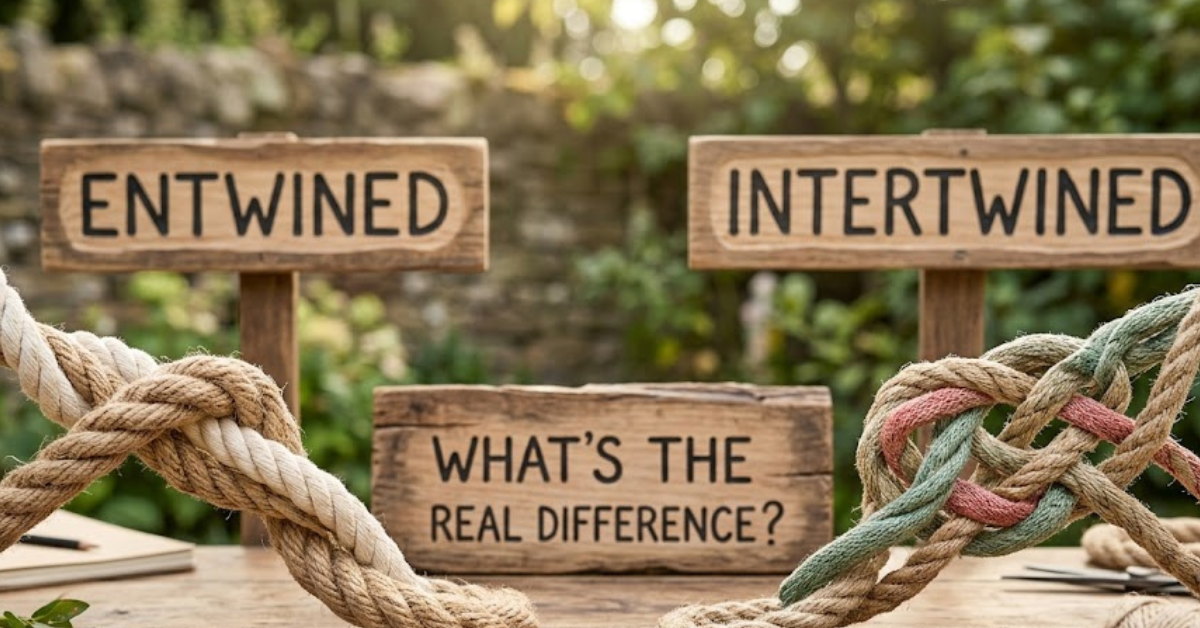
Have you ever paused while writing and wondered whether entwined or intertwined is the better word? At first glance, they seem almost identical. Both describe things wrapped or twisted together, and many people use them interchangeably. But are they truly the same?
Understanding entwined vs intertwined can improve your writing, strengthen your vocabulary, and help you choose the most accurate word for different situations. While the two terms share similar meanings, they also carry subtle differences in tone, imagery, and usage.
In this guide, you’ll discover what each word means, how they’re different, when to use them, and plenty of real-world examples to help you remember the distinction.
Understanding the Meaning of Entwined
The word entwined comes from the verb entwine, meaning to twist or wind together.
It often describes two or more objects becoming wrapped around each other in a graceful or natural way. Beyond physical objects, it frequently represents emotional, symbolic, or abstract connections.
Common examples of entwined
- Two vines entwined around a tree.
- The couple walked with their hands entwined.
- Their lives became deeply entwined over the years.
- History and culture are entwined in the city’s traditions.
The word often creates an image of closeness, harmony, or gentle connection rather than complexity.
Tone of “entwined”
Writers commonly use entwined in:
- Literature
- Poetry
- Romantic writing
- Personal storytelling
- Emotional descriptions
It tends to sound elegant and expressive.
Understanding the Meaning of Intertwined
Intertwined comes from the verb intertwine, which means to twist together so that separate parts become mixed or connected throughout.
Although it also describes physical twisting, it often emphasizes complexity, multiple layers, or relationships that cannot easily be separated.
Common examples of intertwined
- The cables became intertwined.
- The roots of the trees are intertwined underground.
- Technology and education are increasingly intertwined.
- Politics and economics are closely intertwined.
Unlike entwined, this word often highlights interconnected systems, networks, or complicated relationships.
Entwined vs Intertwined: The Main Difference
The difference is subtle rather than absolute.
| Entwined | Intertwined |
| Suggests a gentle twisting together | Suggests multiple parts woven together |
| Often emotional or poetic | Often practical or analytical |
| Frequently describes close relationships | Frequently describes interconnected systems |
| Usually evokes simplicity | Often implies complexity |
| Common in literature | Common in journalism, business, science, and academic writing |
In everyday conversation, most native English speakers understand either word. However, choosing the right one can make your writing feel more precise.
Physical vs Abstract Usage
Both words work for physical and figurative meanings, but one is often preferred depending on context.
When describing physical objects
Examples include:
- Tree branches
- Vines
- Rope
- Hair
- Fingers
- Wires
Example:
The vines were entwined around the old fence.
or
The electrical wires became intertwined during installation.
Both are correct, but intertwined sounds more appropriate when the connection is messy or complex.
When describing emotions or relationships
Entwined usually sounds more natural.
Examples:
- Their destinies became entwined.
- Their hearts were forever entwined.
- Their friendship remained deeply entwined.
These examples emphasize closeness rather than complexity.
When describing ideas or systems
Intertwined is generally the stronger choice.
Examples:
- Law and ethics are intertwined.
- Climate change and economic policy are intertwined.
- Social media and marketing have become intertwined.
Here, the emphasis is on interdependence.
Etymology: Where Do These Words Come From?
Both words originate from the Old English word twine, meaning to twist or coil.
The prefixes create the subtle difference.
Entwine
The prefix en- means:
- To cause something to become
- To surround
- To wrap
This creates the sense of wrapping one thing around another.
Intertwine
The prefix inter- means:
- Between
- Among
- Mutual
- Reciprocal
This naturally suggests multiple things becoming woven together.
The prefixes explain why intertwined often implies more complicated relationships.
Examples in Everyday Writing
Let’s compare similar sentences.
Example 1
Entwined
Their fingers remained entwined throughout the movie.
This emphasizes affection.
Intertwined
Their fingers became intertwined after they reached for each other.
This focuses more on the physical crossing of fingers.
Example 2
Entwined
Their love stories became forever entwined.
This sounds romantic.
Intertwined
Their business interests became intertwined.
This suggests overlapping responsibilities.
Example 3
Entwined
Ivy was entwined around the stone wall.
Natural and elegant.
Intertwined
The roots were intertwined beneath the soil.
More intricate and layered.
Which Word Is More Common?
Modern English uses both words regularly, but their popularity varies by context.
Generally:
- Entwined appears more often in fiction, poetry, romance, and creative writing.
- Intertwined appears more frequently in journalism, education, science, business, psychology, and legal writing.
This doesn’t mean one is better—it simply depends on the situation.
When Should You Use Entwined?
Choose entwined when you want to express:
- Love
- Friendship
- Emotional bonds
- Gentle wrapping
- Natural imagery
- Poetic language
Example sentences:
- Our memories remain entwined.
- Roses were entwined around the archway.
- Their futures became entwined.
When Should You Use Intertwined?
Choose intertwined when discussing:
- Systems
- Organizations
- Networks
- Business
- Politics
- Technology
- Complex relationships
Example sentences:
- Modern finance and technology are intertwined.
- The company’s departments are closely intertwined.
- Environmental and economic issues are intertwined.
Common Mistakes to Avoid
Many writers make small errors when choosing between these words.
Mistake 1: Assuming they always mean exactly the same thing
Although similar, their tone differs.
Mistake 2: Using “entwined” for technical writing
In scientific or business contexts, intertwined usually sounds more natural.
Mistake 3: Using “intertwined” in romantic writing when simplicity works better
Sometimes entwined creates a softer, more elegant image.
Practical Tips for Choosing the Right Word
If you’re unsure which word fits, ask yourself these questions:
- Is the connection emotional?
- Use entwined.
- Is the relationship complicated or interconnected?
- Use intertwined.
- Am I writing poetry or fiction?
- Entwined often sounds smoother.
- Am I writing about systems, industries, or concepts?
- Intertwined is usually stronger.
This simple approach helps you choose naturally.
Quick Comparison at a Glance
| Feature | Entwined | Intertwined |
| Emotional tone | High | Moderate |
| Technical writing | Less common | Very common |
| Romantic writing | Excellent | Good |
| Complex relationships | Good | Excellent |
| Physical twisting | Yes | Yes |
| Figurative meaning | Yes | Yes |
Key Takeaways
- Both words describe things twisted or connected together.
- Entwined often emphasizes closeness, beauty, and emotional connection.
- Intertwined usually highlights complexity and interdependence.
- Both are grammatically correct in many situations.
- Choosing the right word depends on context, audience, and tone.
Frequently Asked Questions
Is there a difference between entwined and intertwined?
Yes. While both describe things connected or twisted together, entwined usually conveys a softer, more emotional connection, whereas intertwined often suggests a more complex or interconnected relationship.
Can I use entwined and intertwined interchangeably?
In many casual situations, yes. However, understanding entwined vs intertwined helps you choose the word that best matches the tone and meaning of your writing.
Which word is more formal?
Neither is inherently more formal, but intertwined appears more often in academic, professional, and analytical writing because it emphasizes interconnected ideas or systems.
Is entwined more romantic?
Generally, yes. Writers often use entwined in poetry, novels, and love stories because it evokes intimacy and closeness.
Which word should I use for business writing?
Intertwined is usually the better choice when discussing business, economics, technology, or organizational relationships, as it conveys complexity and mutual dependence.
Are both words grammatically correct?
Absolutely. Both entwined and intertwined are standard English words with valid meanings. The best choice depends on the context and the nuance you want to express.
Conclusion
The debate over entwined vs intertwined isn’t about right or wrong—it’s about choosing the word that best communicates your intended meaning. Entwined paints a picture of graceful, often emotional connection, while intertwined highlights intricate relationships and mutual dependence.
By recognizing these subtle distinctions, you’ll write with greater precision and confidence. Whether you’re crafting a novel, composing an email, or explaining a complex idea, selecting the right word can make your message clearer and more impactful. Keep these differences in mind, and you’ll be able to use both terms naturally and effectively in any context.