
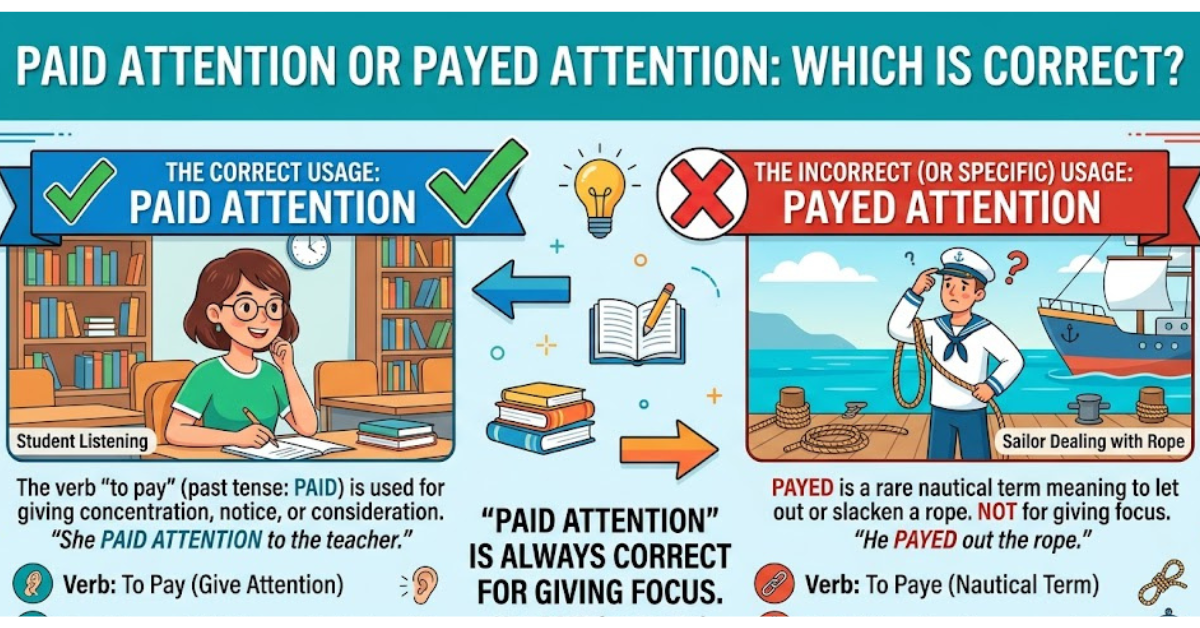
Have you ever stopped mid-sentence and wondered whether you should write paid attention or payed attention? You’re not alone. This is one of the most common grammar questions in English because both paid and payed are real words—but they aren’t interchangeable.
Understanding the difference can help you avoid mistakes in emails, essays, social media posts, and professional writing. In this guide, you’ll learn which phrase is correct, why it works, when payed is actually used, and how to remember the rule for good.
The Quick Answer: Paid Attention or Payed Attention?
The correct phrase is:
Paid attention
Incorrect in almost all contexts:
Payed attention
When you’re talking about focusing, listening carefully, noticing something, or giving consideration to something, the correct past tense of pay attention is paid attention.
Examples
- She paid attention during the lecture.
- I wish I had paid attention to the instructions.
- The students paid attention to the teacher’s explanation.
In each example, paid is the proper past tense and past participle of the verb pay.
Why Is “Paid Attention” Correct?
The phrase pay attention is an idiom that means:
- To focus on something
- To listen carefully
- To observe or notice something
Since the verb is pay, its standard past tense is paid.
Present Tense
- I pay attention.
- They pay attention.
Past Tense
- I paid attention.
- They paid attention.
Present Perfect
- I have paid attention.
- She has paid attention.
In standard English grammar, paid is the accepted form whenever you’re referring to giving money, attention, respect, or consideration.
Is “Payed Attention” Ever Correct?
In ordinary writing and conversation, payed attention is considered incorrect.
However, the word payed does exist in English. It simply has a very specific meaning unrelated to attention.
Specialized Uses of “Payed”
The term payed is primarily used in nautical and maritime contexts.
Examples include:
- Sailors payed out rope from a ship.
- Workers payed the seams of a wooden vessel with tar to make it waterproof.
These uses are rare and mostly found in historical, maritime, or technical writing.
Important Rule
If you’re talking about:
- Attention
- Money
- Respect
- Tribute
- Compensation
Use paid, not payed.
Understanding the Verb “Pay”
One reason people become confused is that many English verbs form the past tense by simply adding -ed.
For example:
| Present | Past |
| Play | Played |
| Walk | Walked |
| Jump | Jumped |
| Pay | Paid |
The verb pay is irregular.
Instead of becoming payed in most situations, it changes to paid.
This irregular pattern is similar to:
| Present | Past |
| Say | Said |
| Make | Made |
| Sell | Sold |
| Pay | Paid |
Because English contains many irregular verbs, learners often assume payed follows the standard rule, leading to mistakes.
Common Examples of “Paid” in Everyday English
The word paid appears in many common expressions.
Paid Attention
- He paid attention to the warning signs.
Paid Respect
- The community paid respect to the veterans.
Paid a Bill
- She paid the electricity bill yesterday.
Paid a Visit
- We paid a visit to our grandparents.
Paid the Price
- The company paid the price for poor management decisions.
In all these examples, paid is the correct form.
Why Do People Write “Payed Attention”?
Several factors contribute to this common error.
1. English Spelling Patterns
Most verbs become past tense by adding -ed.
People naturally assume:
- Play → Played
- Stay → Stayed
- Pay → Payed
Unfortunately, English doesn’t always follow predictable rules.
2. Autocorrect Confusion
Since payed is technically a legitimate English word, some spell-checkers may not flag it as an error.
3. Non-Native English Learning
English learners often apply regular grammar rules before learning irregular verb forms.
4. Similar Pronunciation
When spoken quickly, paid and payed sound nearly identical, making written mistakes more likely.
How to Remember the Correct Form
A simple memory trick can help.
Think of Money
Consider this sentence:
- I paid for my coffee.
Now compare:
- I paid attention in class.
The same verb form applies.
If you wouldn’t write:
I payed for my coffee.
Then you shouldn’t write:
I payed attention.
Easy Formula
Pay + Past Tense = Paid
Whether it’s money, respect, attention, or effort, the past tense is usually paid.
Paid Attention vs. Payed Attention: Side-by-Side Comparison
| Feature | Paid Attention | Payed Attention |
| Grammatically correct? | Yes | No |
| Standard English usage | Yes | No |
| Used in education and business writing | Yes | No |
| Accepted by style guides | Yes | No |
| Related to maritime terminology | No | Rarely |
For everyday communication, paid attention is always the right choice.
Examples in Real-World Contexts
Workplace Communication
Correct:
- The team paid attention to customer feedback.
Incorrect:
- The team payed attention to customer feedback.
Academic Writing
Correct:
- Researchers paid attention to emerging trends.
Incorrect:
- Researchers payed attention to emerging trends.
Personal Conversation
Correct:
- I should have paid attention when you explained it.
Incorrect:
- I should have payed attention when you explained it.
These examples show how naturally paid attention fits into modern English.
Related Grammar Mistakes to Avoid
People who confuse paid attention or payed attention often struggle with other irregular verbs as well.
Common Examples
| Incorrect | Correct |
| Buyed | Bought |
| Bringed | Brought |
| Catched | Caught |
| Thinked | Thought |
| Payed | Paid |
Learning these irregular forms can significantly improve writing accuracy.
Key Takeaways
- Paid attention is the correct phrase in standard English.
- Payed attention is generally incorrect.
- The verb pay becomes paid in the past tense.
- Payed exists only in specialized nautical and maritime contexts.
- When referring to focus, concentration, or noticing something, always use paid attention.
- Remember: if you can say “paid money,” you can say “paid attention.”
Frequently Asked Questions
Is it paid attention or payed attention?
The correct phrase is paid attention. The word payed is rarely used and does not apply when referring to focus or concentration.
Why is payed attention considered wrong?
Because the standard past tense of the verb pay is paid. In modern English, payed attention is considered a grammatical mistake.
Is payed a real word?
Yes. Payed is a legitimate English word used mainly in maritime contexts, such as paying out rope or sealing ship seams.
Can I use payed instead of paid?
Not in ordinary writing. For attention, money, respect, and similar expressions, paid is the correct form.
What does paid attention mean?
It means focusing on, listening to, observing, or carefully considering something.
How can I remember the difference?
Think of the sentence “I paid for lunch.” The same past-tense form applies in “I paid attention.” If paid works for money, it works for attention too.
Conclusion
When deciding between paid attention or payed attention, the answer is straightforward: paid attention is the correct expression in standard English. While payed exists as a specialized nautical term, it doesn’t belong in everyday phrases about focus, listening, or awareness.
By remembering that the past tense of pay is usually paid, you’ll avoid a common grammar mistake and write with greater confidence. The next time you encounter this question, you’ll know exactly which form deserves your attention—and which one doesn’t.