Have you ever heard someone say, “That’s a mighty pretty sunset,” only for it to sound more like “purty” or “purdy”? If so, you’re not alone. Many people wonder about purty or purdy, whether one spelling is correct, and what these words actually mean.
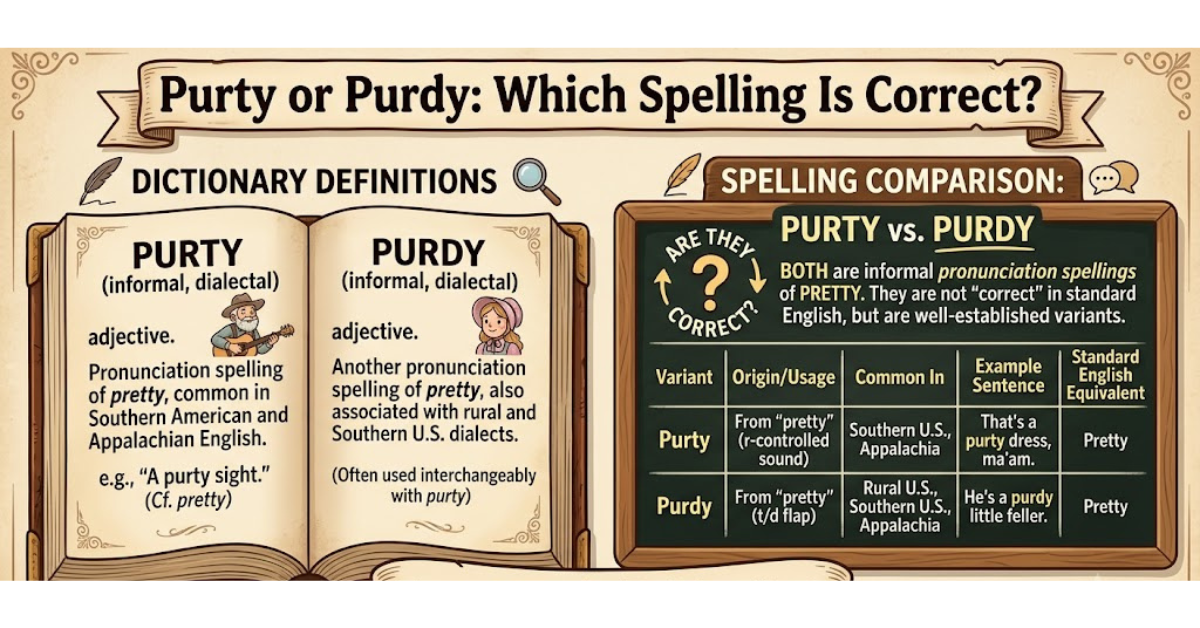
The short answer is that both purty and purdy are informal spellings that represent regional pronunciations of the word pretty. However, their usage, popularity, and context can vary. In this guide, you’ll learn the meaning of these terms, where they come from, when to use them, and how they differ from standard English.
Understanding Purty and Purdy
At their core, both purty and purdy are nonstandard spellings of the word pretty.
In spoken English, particularly in some Southern American dialects, pretty is often pronounced differently from standard pronunciation. Writers sometimes spell the word phonetically to capture that accent or speech pattern.
For example:
- Standard English: “That is a pretty dress.”
- Dialect representation: “That is a purty dress.”
- Alternative dialect representation: “That is a purdy dress.”
The intended meaning remains the same: attractive, pleasant, or appealing.
Is It Purty or Purdy?
The answer depends on context.
Purty
Purty is generally the more widely recognized phonetic spelling of pretty.
Examples:
- “You look purty today.”
- “That’s a purty little house.”
- “The flowers are purty this time of year.”
Writers often use purty in:
- Fiction
- Humor
- Southern-themed writing
- Character dialogue
Purdy
Purdy is another phonetic variation, though it appears less frequently. In some accents, the “tt” sound in pretty can sound closer to a soft “d,” leading to the spelling purdy.
Examples:
- “That’s a purdy horse.”
- “What a purdy view.”
While both forms are understandable, purty tends to be more common in literature and online usage.
The Origin of Purty and Purdy
To understand why these spellings exist, it helps to look at how language evolves.
English speakers often modify pronunciation based on:
- Regional dialects
- Cultural influences
- Historical speech patterns
- Local traditions
In many Southern American dialects, words are pronounced differently than in standard American English. Writers frequently use alternative spellings to represent those spoken sounds.
This practice is common with many words:
| Standard Word | Dialect Variation |
| Pretty | Purty / Purdy |
| Going to | Gonna |
| Want to | Wanna |
| Them | ‘Em |
| You all | Y’all |
These variations help convey personality, setting, and authenticity in writing.
Why People Search for Purty or Purdy
Many internet users encounter these words in:
Books and Novels
Authors often use dialect spelling to create realistic dialogue.
Example:
“You’re lookin’ mighty purty this evening.”
This helps readers imagine the speaker’s accent.
Movies and Television
Characters from rural or Southern backgrounds may use expressions containing purty or purdy.
Social Media
Many people use these spellings playfully.
Examples:
- “That’s a purty puppy!”
- “What a purdy sunset.”
Song Lyrics
Country, folk, and regional music sometimes include dialect spellings to reflect authentic speech.
Which Spelling Should You Use?
If you’re writing formal English, neither spelling is appropriate.
Use:
Pretty
Examples:
- “The garden looks pretty.”
- “She wore a pretty dress.”
Avoid:
Purty
Purdy
in:
- Academic papers
- Business communications
- Professional emails
- News articles
When Purty or Purdy Is Acceptable
These spellings work well in:
- Creative writing
- Character dialogue
- Humorous content
- Social media captions
- Regional storytelling
The goal is usually to represent a particular accent or tone.
Purty vs. Purdy: Side-by-Side Comparison
| Feature | Purty | Purdy |
| Meaning | Pretty | Pretty |
| Formal English | No | No |
| Common Usage | More common | Less common |
| Dialect Representation | Southern and rural speech | Southern and rural speech |
| Found in Fiction | Frequently | Occasionally |
| Standard Dictionary Entry | Usually not | Usually not |
Linguistic Perspective: Why Spellings Change
Language experts refer to spellings like purty and purdy as eye dialect.
Eye dialect occurs when writers intentionally alter spelling to suggest pronunciation, even though the meaning remains unchanged.
Examples include:
- Goin’ instead of going
- Ol’ instead of old
- Ya instead of you
- Purty instead of pretty
Writers use eye dialect to:
- Build character identity
- Show regional speech
- Create authenticity
- Add humor or personality
Examples of Purty and Purdy in Sentences
Using Purty
- “That’s a purty cabin by the lake.”
- “You sure look purty tonight.”
- “Those are some purty flowers.”
Using Purdy
- “What a purdy little kitten.”
- “That’s a purdy landscape.”
- “The sky looks purdy this evening.”
In both cases, the intended meaning is simply “pretty.”
Common Misconceptions
Purty and Purdy Are Separate Words
Not exactly.
They are alternative spellings meant to reflect pronunciation rather than distinct vocabulary terms.
One Is Correct and One Is Wrong
Neither is considered standard English. Both are informal representations of spoken language.
They Have Different Meanings
In nearly all contexts, they mean the same thing as pretty.
Practical Writing Tips
If you’re unsure whether to use purty, purdy, or pretty, follow these guidelines:
Use Pretty When:
- Writing professionally
- Completing school assignments
- Publishing formal content
- Communicating with a broad audience
Use Purty When:
- Writing Southern-style dialogue
- Creating fictional characters
- Adding regional flavor
- Using humor or casual speech
Use Purdy When:
- Mimicking a specific pronunciation
- Following a character’s established voice
- Creating stylistic dialogue choices
Key Takeaways
- Both purty and purdy are informal spellings of pretty.
- They are commonly used to represent regional or Southern pronunciations.
- Neither spelling is considered standard English.
- Purty is generally more common than purdy.
- Use pretty in formal writing and professional communication.
- Use purty or purdy primarily in creative or informal contexts.
Frequently Asked Questions
Is purty a real word?
Purty is considered a dialect or informal spelling of pretty. It appears in literature, dialogue, and regional speech but is not standard formal English.
Is purdy correct English?
Purdy is not standard English. It is a phonetic spelling used to reflect certain accents or dialects where pretty sounds like “purdy.”
Which is more common, purty or purdy?
Purty is generally more common in books, online writing, and popular culture. It is the spelling most people recognize when representing a Southern accent.
Do purty and purdy mean the same thing?
Yes. Both words typically mean the same thing as pretty: attractive, pleasing, or beautiful.
Can I use purty in professional writing?
No. Professional and academic writing should use the standard spelling pretty. Dialect spellings are best reserved for informal or creative contexts.
Why do authors write purty instead of pretty?
Authors use purty to reflect a character’s accent, regional background, or speaking style. It helps create a more authentic and memorable voice.
Conclusion
The debate over purty or purdy is less about right versus wrong and more about pronunciation and style. Both spellings are informal ways of representing how some speakers pronounce the word pretty, particularly in Southern or regional dialects. While purty is generally the more common variation, both forms carry the same meaning.
For formal writing, stick with pretty. For storytelling, dialogue, or casual expression, purty and purdy can add personality and regional flavor. Understanding the difference helps you choose the right word for the right audience and communicate more effectively.