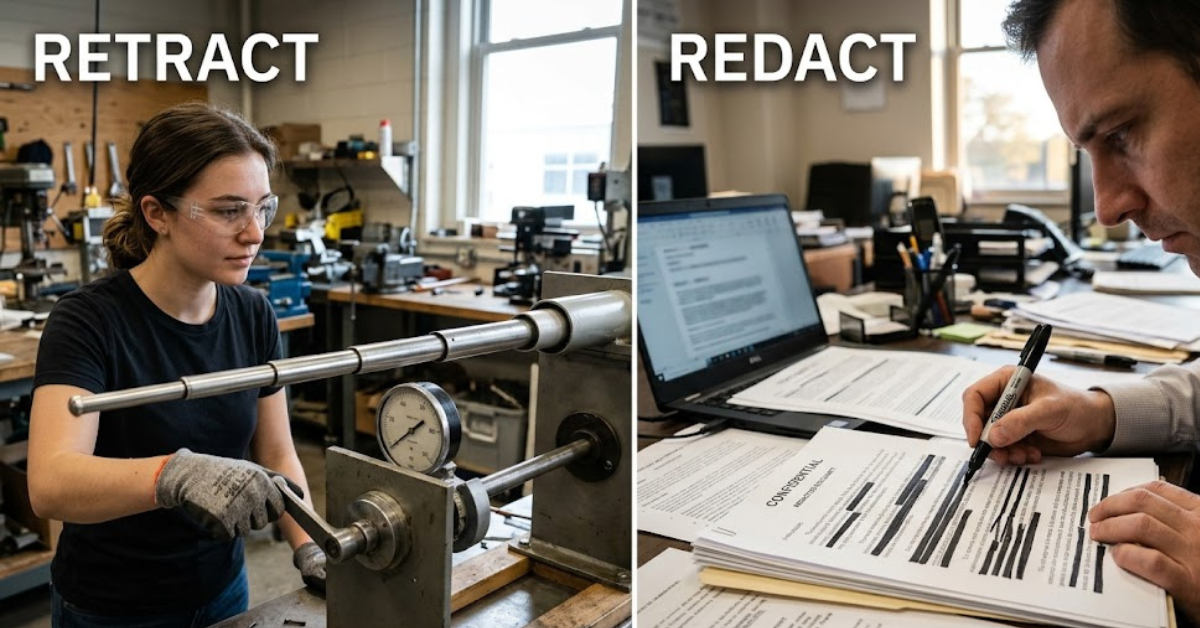
Many English words sound similar but carry completely different meanings. One pair that often causes confusion is retract vs redact. At first glance, these words appear closely related because they share similar spellings and are frequently used in professional, legal, and publishing contexts. However, their meanings are entirely different.
Understanding the retract vs redact meaning is important for writers, journalists, lawyers, students, and anyone who works with documents or public statements. Using the wrong word can lead to misunderstandings, especially in formal communication.
This guide explains the difference between retract and redact, when to use each word, practical examples, common mistakes, and simple memory tricks to help you remember them correctly.
What Does Retract Mean?
The word retract means to withdraw, take back, or formally reverse a statement, claim, opinion, or action.
A person retracts something when they admit it was incorrect, misleading, or no longer valid.
Retract Definition
Retract (verb): To withdraw or take back a statement, accusation, promise, or claim.
Examples of Retract
- The newspaper retracted the inaccurate report.
- The witness retracted his earlier statement.
- The company retracted its misleading advertisement.
- She decided to retract her accusation after new evidence emerged.
In each example, something that was previously stated or presented is being withdrawn.
What Does Redact Mean?
The word redact means to edit, prepare, or remove sensitive information from a document before it is shared publicly.
Today, redact is most commonly associated with hiding confidential or private information.
Redact Definition
Redact (verb): To remove or obscure sensitive information from a document before publication or release.
Examples of Redact
- The agency redacted personal information from the report.
- Lawyers redacted the names of minors in court documents.
- The company redacted financial details before publishing the records.
- Sensitive addresses were redacted from the released files.
In these examples, information is not withdrawn entirely—it is selectively hidden.
Retract vs Redact Meaning
The easiest way to understand the retract vs redact meaning is to focus on what happens to the information.
Retract
When you retract something:
- You take it back.
- You withdraw it completely.
- You reverse a statement or claim.
Example:
- The author retracted the article after discovering factual errors.
Redact
When you redact something:
- You remove specific details.
- You hide confidential information.
- You keep the document but edit certain parts.
Example:
- The author redacted private names before publishing the article.
The distinction is simple:
Retract = withdraw.
Redact = edit or conceal.
Retract vs Redact: Key Differences
Although the words are sometimes confused, their purposes are entirely different.
Retract
Used when:
- Correcting mistakes
- Withdrawing statements
- Reversing claims
- Admitting errors
Common contexts:
- Journalism
- Public relations
- Academic publishing
- Personal communication
Redact
Used when:
- Protecting privacy
- Removing sensitive information
- Preparing legal documents
- Publishing government records
Common contexts:
- Law
- Government
- Corporate compliance
- Data protection
The core difference is that retracting removes the validity of a statement, while redacting removes parts of a document.
Retract vs Redact in Legal Documents
The legal field frequently uses both terms, but in very different ways.
Retract in Legal Contexts
A person may retract:
- A statement
- A testimony
- An accusation
- A claim
Example:
- The witness retracted portions of his testimony.
Redact in Legal Contexts
Lawyers often redact:
- Personal addresses
- Social Security numbers
- Medical information
- Confidential business data
Example:
- The court ordered the attorneys to redact sensitive information before filing the document publicly.
Retract vs Redact in Journalism
Journalism provides another clear example of the distinction.
When Journalists Retract
News organizations may retract:
- Incorrect stories
- False allegations
- Misleading reports
Example:
- The newspaper retracted the story after discovering major factual errors.
When Journalists Redact
Editors may redact:
- Confidential sources
- Personal identifiers
- Sensitive details
Example:
- The report was redacted to protect the identity of witnesses.
Common Examples of Retract
Here are situations where retract is the correct choice:
- Retracting a statement
- Retracting a claim
- Retracting an accusation
- Retracting an offer
- Retracting a published article
Example sentence:
- The spokesperson retracted the comments made during the interview.
Common Examples of Redact
Here are situations where redact is the correct choice:
- Redacting personal information
- Redacting names
- Redacting financial records
- Redacting confidential data
- Redacting legal documents
Example sentence:
- Officials redacted classified information before releasing the report.
Common Mistakes People Make
Because the words look similar, they are often misused.
Incorrect
- The government retracted citizens’ personal information from the document.
Correct
- The government redacted citizens’ personal information from the document.
Incorrect
- The newspaper redacted its false story.
Correct
- The newspaper retracted its false story.
A good rule is to ask:
- Are you taking something back? Use retract.
- Are you hiding part of a document? Use redact.
Memory Tricks for Retract vs Redact
Simple memory devices can make these words easier to remember.
Remember Retract
Think:
Retract = Take Back
Both phrases involve reversing something that was previously said or done.
Remember Redact
Think:
Redact = Edit
The letter “D” in redact can remind you of document.
You redact documents by removing sensitive information.
Origins of the Words
Understanding the origins can also help clarify their meanings.
Origin of Retract
Retract comes from the Latin word retractare, meaning “to draw back” or “withdraw.”
This explains why it involves taking something back.
Origin of Redact
Redact comes from the Latin word redigere, meaning “to arrange” or “edit.”
This reflects its connection to preparing and modifying documents.
Why the Difference Matters
Confusing retract and redact can create significant misunderstandings.
For example:
- Retracting a report means withdrawing it entirely.
- Redacting a report means releasing it with certain information removed.
In legal, governmental, and professional settings, that distinction is extremely important.
Frequently Asked Questions
What is the difference between retract and redact?
The main difference in retract vs redact is that retract means to withdraw or take back a statement, while redact means to remove or conceal information from a document.
What does retract mean?
Retract means to formally withdraw, reverse, or take back a statement, claim, or accusation.
What does redact mean?
Redact means to edit a document by removing sensitive, private, or confidential information.
Can a document be retracted?
Yes. A document can be retracted if it is officially withdrawn or declared invalid.
Can a document be redacted?
Yes. Documents are frequently redacted to protect confidential information before public release.
Do journalists retract or redact articles?
Journalists may retract an article if it contains major errors. They may redact portions of a document to protect sensitive information.
Which word is used in privacy protection?
Redact is the correct word when referring to privacy protection and the removal of confidential information.
Conclusion
Understanding retract vs redact is essential for clear and accurate communication. Although the words look and sound similar, they serve very different purposes. Retract means to withdraw or take back a statement, claim, or publication, while redact means to remove sensitive information from a document before sharing it.
Remember this simple distinction: retract removes the statement, redact removes part of the content. By mastering the retract vs redact meaning, you’ll avoid common mistakes and communicate more effectively in legal, professional, academic, and everyday situations. Whether you’re editing documents or discussing public statements, knowing the difference ensures your writing remains precise and credible.