Ever read a long message and wished someone had summarized it in just a few sentences? That’s exactly where TLDR meaning comes into play. This common internet abbreviation has become a key part of online communication, helping people quickly understand lengthy content without reading every word.
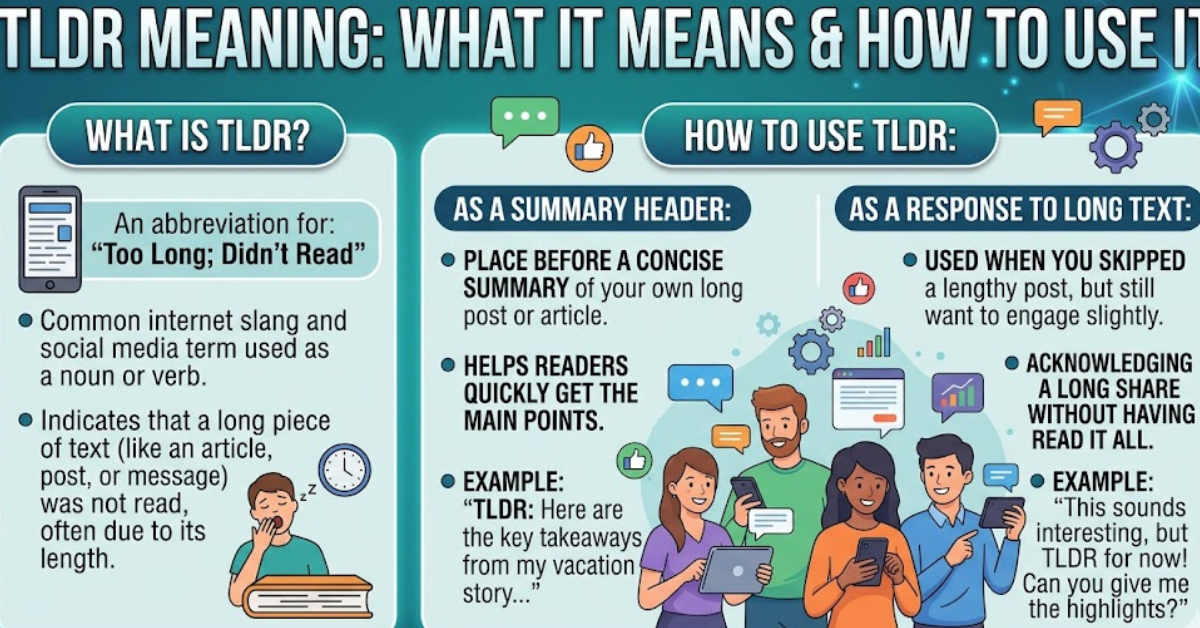
In simple terms, TLDR stands for “Too Long; Didn’t Read.” It is used to provide a brief summary of a long article, email, post, or message. Over the years, TLDR has evolved from a casual internet phrase into a widely accepted way of making content easier to consume.
What Does TLDR Mean?
The TLDR meaning is straightforward: “Too Long; Didn’t Read.” The phrase originated on online forums and social media platforms where users would comment on lengthy posts.
Today, TLDR is commonly placed before a short summary, allowing readers to grasp the main idea without going through the entire text.
For example:
Original text:
“Our company has made several changes to the employee policies, including updated working hours, new leave regulations, and revised communication guidelines.”
TLDR:
“New company policies include changes to work hours, leave rules, and communication standards.”
In this case, the TLDR provides the essential information in a quick and convenient format.
The Origin and History of TLDR
The term TLDR became popular during the early days of internet forums and message boards. It was often used as a humorous response to posts that people considered excessively long.
Initially, saying “TLDR” could sometimes imply that a piece of writing was too lengthy to read. However, the meaning has shifted over time. Today, many writers intentionally add a “TLDR” section to their articles, emails, and reports to improve readability.
The abbreviation can also appear in different formats, including:
- TLDR
- TL;DR
- tldr
- tl;dr
All versions carry the same meaning.
How to Use TLDR Correctly
Knowing when and how to use TLDR can make your communication clearer and more effective.
1. Summarizing Long Articles
Many blogs and online publications include a TLDR section near the beginning or end of an article.
Example:
TLDR: “This article explains the benefits, risks, and best practices of investing in stocks.”
2. Making Emails Easier to Read
In professional settings, a TLDR can save time by highlighting important details.
Example:
TLDR: “The meeting has been moved to Friday at 3 PM, and everyone should submit their reports beforehand.”
3. Social Media and Online Discussions
Social media users often use TLDR to summarize long threads, explanations, or stories.
For example:
“TLDR: I missed my flight because of traffic, but the airline booked me on the next available one.”
Why Is TLDR So Popular?
The internet is filled with long articles, endless messages, and constant updates. TLDR has become popular because it respects readers’ time.
Some of its main advantages include:
- Makes information easier to understand
- Saves time for busy readers
- Highlights the most important points
- Improves readability of long content
- Helps people quickly decide whether they want to read more
For content creators, adding a TLDR section can also improve user experience by providing instant value.
TLDR Meaning in Text Messages and Social Media
In texting and social platforms like Reddit, X (formerly Twitter), Facebook, and Instagram, TLDR is extremely common.
It can be used in two main ways:
- As a summary
- “TLDR: The movie was amazing, but the ending was confusing.”
- As a reaction
- “TLDR, can someone explain what happened?”
The second usage may sometimes sound dismissive, so it’s important to consider the tone and context.
TLDR vs Summary: What Is the Difference?
Although TLDR and summaries are similar, there are small differences.
| TLDR | Summary |
| Usually short and informal | Can be formal or detailed |
| Common online and in texts | Used in books, reports, and academic writing |
| Often one or two sentences | Can range from a paragraph to several pages |
In modern writing, TLDR has essentially become a quick, reader-friendly summary.
Should You Add a TLDR to Your Content?
Adding a TLDR section can be beneficial, especially for:
- Blog articles
- Business emails
- Reports
- Newsletters
- Social media posts
- Long guides
A good TLDR should be clear, concise, and focused on the main message.
Tips for Writing a Great TLDR
Follow these simple rules:
- Keep it under two or three sentences
- Focus on the most important information
- Avoid unnecessary details
- Use simple language
- Make it easy to understand at a glance
Common Misunderstandings About TLDR
Some people believe TLDR is always rude or insulting. While it originally had a sarcastic tone in some online communities, its modern use is usually helpful.
Many professionals, writers, and companies now use TLDR sections to make complex information more accessible.
FAQs
What is the full meaning of TLDR?
TLDR stands for “Too Long; Didn’t Read.” It is used to provide a short summary of lengthy content.
Is TLDR rude to use?
Not necessarily. A TLDR used as a helpful summary is usually polite. However, telling someone “TLDR” as a response to their message may come across as dismissive.
What does TLDR mean in texting?
In texting, TLDR means a quick version of a longer story or message. It allows someone to share the main point without explaining every detail.
Is TLDR an official English word?
TLDR is an internet acronym rather than a traditional English word, but it has become widely recognized in digital communication.
Where should I put a TLDR in an article?
A TLDR can be placed at the beginning to give readers an overview or at the end to summarize the key points.
Conclusion
Understanding the TLDR meaning helps you communicate more effectively in today’s fast-paced digital world. Whether you are reading a long article, writing an email, or posting on social media, TLDR offers a simple way to deliver the most important information quickly.
As online content continues to grow, using a clear and well-written TLDR can improve readability and keep your audience engaged. Explore more internet terms and digital communication tips to become more confident in the online world.