Have you ever come across the term PTSO and wondered what it actually means? You’re not alone. Acronyms can be confusing because the same letters often have different meanings depending on the context.
Understanding the ptso meaning is important, especially if you’ve seen it in a school newsletter, community organization, workplace document, or online discussion. In this guide, you’ll learn what PTSO stands for, where it’s commonly used, how it differs from similar terms, and why it plays an important role in many organizations.
What Does PTSO Mean?
The most common PTSO meaning is:
Parent-Teacher-Student Organization
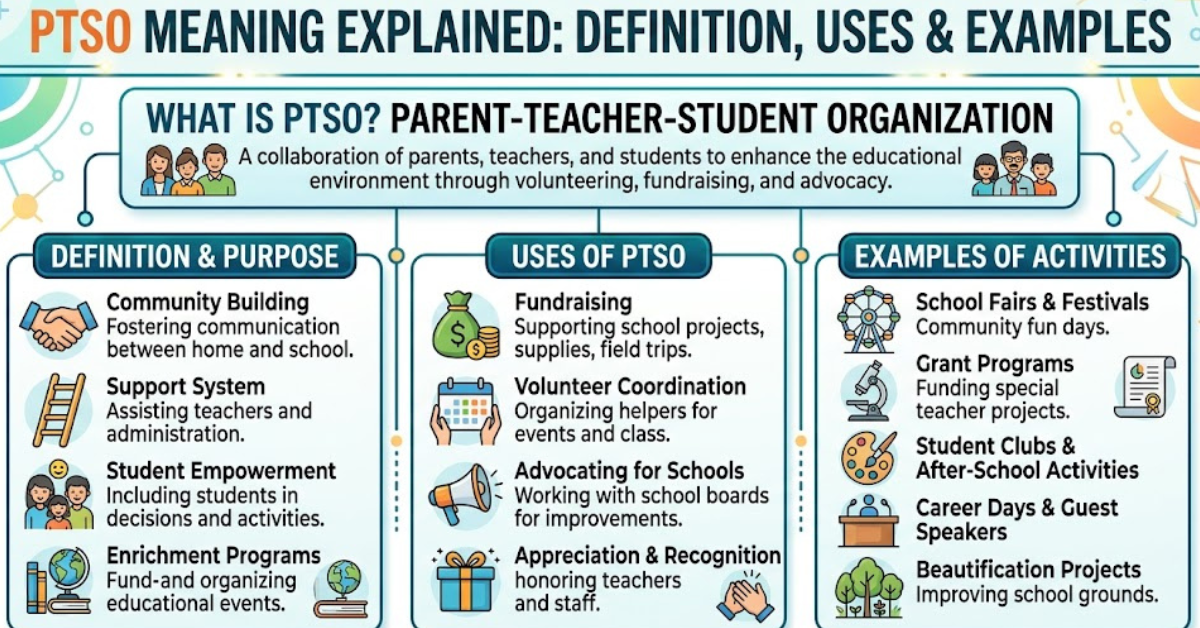
A PTSO is a school-based group that brings together parents, teachers, students, and sometimes school staff to support educational programs, student activities, fundraising efforts, and community engagement.
Unlike some traditional parent-focused organizations, a PTSO actively includes students in planning and decision-making processes.
Simple Definition
A PTSO is a collaborative organization designed to strengthen communication and cooperation between:
- Parents
- Teachers
- Students
- School administrators
The goal is to create a stronger educational environment that benefits everyone involved.
Why Do Schools Have PTSOs?
Schools establish PTSOs to encourage teamwork and community participation. Education works best when families, educators, and students work together toward common goals.
Common Objectives of a PTSO
A PTSO may focus on:
- Supporting student success
- Organizing school events
- Raising funds for educational programs
- Improving communication between families and schools
- Recognizing teacher achievements
- Funding classroom resources
- Promoting volunteer opportunities
These organizations often serve as a bridge between the school administration and the broader school community.
PTSO vs. PTA: What’s the Difference?
Many people confuse PTSO and PTA because both support schools. However, there are important distinctions.
| Feature | PTSO | PTA |
| Full Form | Parent-Teacher-Student Organization | Parent-Teacher Association |
| Student Involvement | Yes | Usually limited |
| National Affiliation | Independent | Affiliated with National PTA |
| Membership Rules | Flexible | Structured national guidelines |
| Dues Requirements | Determined locally | National and local dues |
Why Some Schools Choose a PTSO
Schools may prefer a PTSO because it:
- Offers greater flexibility
- Allows direct student participation
- Operates independently
- Keeps decision-making local
This flexibility often makes it easier to tailor activities to a school’s specific needs.
PTSO vs. PTO
Another related term is PTO.
What Is PTO?
PTO stands for:
Parent-Teacher Organization
A PTO includes parents and teachers but generally does not formally include students in leadership or membership roles.
Key Difference
The primary difference between PTO and PTSO is simple:
- PTO: Parents and teachers
- PTSO: Parents, teachers, and students
By adding students to the organization, schools encourage leadership development and greater student engagement.
How Does a PTSO Operate?
Most PTSOs function similarly to nonprofit community organizations.
Leadership Structure
A typical PTSO may include:
- President
- Vice President
- Secretary
- Treasurer
- Student representatives
- Committee chairs
These individuals help organize activities and oversee the group’s responsibilities.
Regular Activities
A PTSO often organizes:
- School carnivals
- Book fairs
- Fundraising campaigns
- Teacher appreciation events
- Graduation celebrations
- Volunteer programs
- Student leadership initiatives
Meetings are usually held monthly or quarterly.
Benefits of a PTSO
A well-run PTSO can have a positive impact on an entire school community.
Benefits for Students
Students gain:
- Leadership opportunities
- Community involvement experience
- Stronger school engagement
- Access to additional resources
Benefits for Parents
Parents receive:
- Better communication with educators
- Greater involvement in school decisions
- Opportunities to support their children’s education
Benefits for Teachers
Teachers often benefit through:
- Additional classroom support
- Volunteer assistance
- Funding for special projects
- Increased family engagement
Benefits for Schools
Schools may experience:
- Stronger community relationships
- Higher volunteer participation
- Enhanced educational programs
- Increased fundraising success
Common Examples of PTSO Contributions
Many schools rely on their PTSO to fund projects that might otherwise be difficult to afford.
Examples include:
- Playground improvements
- Technology purchases
- Library enhancements
- Student scholarships
- Educational field trips
- Arts and music programs
Even small contributions can significantly improve the student experience.
Can PTSO Have Other Meanings?
Yes. While Parent-Teacher-Student Organization is the most widely recognized definition, acronyms can vary across industries.
Depending on the context, PTSO may occasionally refer to specialized terms in:
- Government agencies
- Technical fields
- Healthcare organizations
- Business departments
However, when people search for the ptso meaning, they are usually referring to the school-based organization.
How to Identify the Correct Meaning
Ask yourself:
- Is the discussion related to education?
- Are parents, teachers, or students involved?
- Is the context a school event or fundraising effort?
If the answer is yes, the acronym almost certainly refers to a Parent-Teacher-Student Organization.
Why Student Participation Matters
One reason PTSOs have gained popularity is their emphasis on student involvement.
Students often provide valuable perspectives on:
- School culture
- Student needs
- Event planning
- Community projects
Including students helps create a more inclusive and responsive educational environment.
Real-World Example
Imagine a school planning a fundraising event.
In a traditional organization, parents and teachers may make all decisions. In a PTSO, students can contribute ideas about:
- Event themes
- Activities
- Marketing strategies
- Volunteer coordination
This collaborative approach often leads to stronger participation and better outcomes.
How to Join a PTSO
Getting involved is usually straightforward.
Steps to Join
- Contact your school office.
- Ask about upcoming meetings.
- Complete any membership forms.
- Attend events and volunteer opportunities.
- Consider serving on a committee.
Many organizations welcome participation regardless of experience level.
Key Takeaways
- The most common ptso meaning is Parent-Teacher-Student Organization.
- PTSOs bring together parents, teachers, students, and school staff.
- They support educational programs, fundraising, and community engagement.
- PTSOs differ from PTAs because they operate independently and include students.
- Student involvement helps create stronger school communities.
- These organizations benefit students, families, teachers, and schools alike.
Frequently Asked Questions
What does PTSO stand for in schools?
PTSO stands for Parent-Teacher-Student Organization. It is a school group that encourages collaboration among students, parents, teachers, and administrators.
Is a PTSO the same as a PTA?
No. While both support schools, a PTSO is typically independent and includes students, whereas a PTA is affiliated with the National PTA and follows its structure.
What is the difference between PTO and PTSO?
A PTO includes parents and teachers, while a PTSO includes parents, teachers, and students. The added student participation is the primary distinction.
Why are PTSOs important?
PTSOs help improve communication, organize events, raise funds, and strengthen the relationship between families and schools. They contribute to a more supportive educational environment.
Can students be leaders in a PTSO?
Yes. Many PTSOs encourage students to serve as representatives, committee members, or even officers, helping them develop leadership and teamwork skills.
Do all schools have a PTSO?
No. Some schools operate a PTA, PTO, or other parent involvement organization instead. The structure varies by school and district.
Conclusion
Understanding the ptso meaning is useful for anyone involved in education, whether you’re a parent, student, teacher, or school administrator. Most commonly, PTSO stands for Parent-Teacher-Student Organization, a group dedicated to improving the school experience through collaboration, fundraising, communication, and community involvement.
By bringing students into the conversation alongside parents and educators, PTSOs create a more inclusive and effective support system for schools. If your school has a PTSO, consider getting involved—you may be surprised by the positive impact a strong school community can have on student success.