
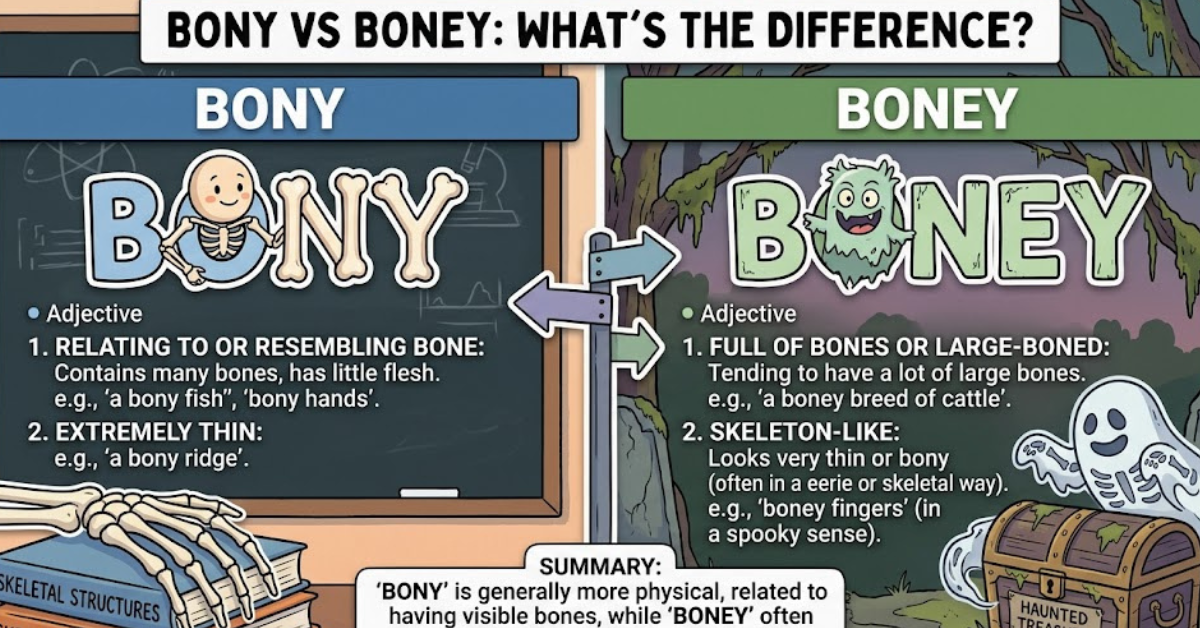
Have you ever typed a word, looked at it twice, and wondered whether it’s actually correct? If you’ve found yourself debating Bony vs Boney, you’re not alone. These two spellings appear similar, sound identical, and often seem interchangeable.
The confusion stems from the fact that both words exist in English, but one is far more common than the other. In this guide, you’ll learn the difference between Bony vs Boney, their meanings, correct usage, historical background, examples, and practical tips to help you choose the right spelling every time.
Understanding Bony vs Boney
At first glance, the difference appears to be nothing more than an extra letter. However, spelling preferences, dictionary standards, and regional usage all play a role.
What Does “Bony” Mean?
Bony is the standard and widely accepted spelling in modern English.
It is an adjective used to describe:
- Someone with prominent bones due to thinness
- Something made of or containing bones
- Physical features where bones are easily visible
Examples:
- The dog looked extremely bony after weeks without proper food.
- Her bony shoulders were visible beneath the dress.
- Archaeologists discovered several bony fragments at the excavation site.
Most major dictionaries, including Merriam-Webster, Oxford, and Cambridge, list bony as the primary spelling.
What Does “Boney” Mean?
Boney is a less common variant spelling of bony.
In some contexts, particularly older texts or certain regional dialects, “boney” has been used with the same meaning as “bony.” However, it is considered less standard in contemporary writing.
Examples:
- The old novel described a boney horse pulling a wagon.
- Some regional publications still occasionally use boney as a variant form.
Today, most editors and style guides prefer bony.
Which Spelling Is Correct?
The Modern Standard: Bony
If you’re writing for:
- Academic purposes
- Business communication
- Journalism
- Blogging
- Professional content
Use bony.
It is the preferred spelling in modern English and is recognized universally.
When Is Boney Acceptable?
“Boney” may appear in:
- Historical literature
- Regional dialect writing
- Creative storytelling
- Character dialogue reflecting local speech patterns
Outside these situations, using bony is usually the safest choice.
The History Behind Bony and Boney
Language evolves over time, and spelling variations were once much more common than they are today.
Before dictionaries standardized English spelling, writers often spelled words according to pronunciation or local custom. As a result, both bony and boney appeared in literature.
Over the centuries, publishers and language authorities gradually settled on bony as the preferred form. This process mirrors what happened with many other English words that once had multiple accepted spellings.
Today, bony dominates modern usage, while boney survives mainly as a historical or stylistic variation.
Bony vs Boney: Side-by-Side Comparison
| Feature | Bony | Boney |
| Modern Standard English | Yes | Rarely |
| Dictionary Preference | Primary spelling | Secondary variant |
| Common in Professional Writing | Yes | No |
| Seen in Historical Texts | Sometimes | Frequently |
| Recommended for SEO Content | Yes | No |
| Reader Familiarity | Very High | Moderate to Low |
Examples of Correct Usage
Understanding real-world examples can make the distinction much clearer.
Examples Using Bony
- The rescued cat was thin and bony.
- His bony fingers gripped the railing tightly.
- The fossil contained several bony structures.
Examples Using Boney
- The author described a boney old mule in the countryside.
- A few regional newspapers still use the spelling boney.
In most modern contexts, replacing “boney” with “bony” improves consistency and aligns with current language standards.
Why People Confuse Bony and Boney
Several factors contribute to the confusion.
Identical Pronunciation
Both words are pronounced the same way:
BOH-nee
Because there is no pronunciation difference, many writers assume both spellings are equally common.
Similar English Word Patterns
English contains many adjectives ending in:
- -y
- -ey
Examples include:
- Smoky / Smokey
- Nosey / Nosy
- Clayey
- Gooey
This inconsistency makes it difficult to know which spelling is considered standard.
Exposure to Different Sources
Readers may encounter “boney” in:
- Older books
- Historical documents
- Regional publications
- Character names and nicknames
This exposure can create uncertainty about which version to use.
Practical Tips for Remembering the Difference
If you struggle to remember the correct spelling, these tips can help.
Use Bony for Everyday Writing
Whenever you’re describing:
- Thin people
- Thin animals
- Bone-like structures
- Skeletal features
Choose bony.
Think About Dictionary Preference
Most dictionaries place bony as the main entry.
If your goal is clear communication, follow the standard form.
Follow Professional Style Guides
Editors, publishers, and content marketers almost always choose bony.
This makes it the best option for:
- Articles
- Reports
- Essays
- Website content
Common Mistakes to Avoid
Many writers accidentally make these errors:
Assuming Boney Is More Correct
Some people think the longer spelling appears more formal. In reality, bony is the preferred standard.
Mixing Spellings in the Same Document
Choose one spelling and stay consistent.
For professional writing, that spelling should generally be bony.
Ignoring Audience Expectations
Readers expect standard English usage. Using unusual variants can sometimes distract from your message.
How Search Engines Interpret Bony and Boney
However, content creators should generally use:
- The standard spelling
- The most commonly searched form
- Dictionary-approved usage
Since bony is far more common, it typically aligns better with user expectations and search behavior.
That said, discussing Bony vs Boney naturally within educational content can help address user intent and improve topical relevance.
Key Takeaways
- Bony is the standard spelling in modern English.
- Boney is an accepted but less common variant.
- Professional, academic, and online writing should generally use bony.
- “Boney” appears more often in historical texts and regional usage.
- Both words have the same pronunciation and nearly identical meanings.
- Consistency and audience expectations favor the spelling bony.
Frequently Asked Questions
Is bony or boney correct?
Both spellings exist, but bony is the preferred and standard spelling in modern English. Most dictionaries and style guides recommend using it.
Why do some people spell it boney?
“Boney” is a historical and regional variant that has survived in some forms of writing. It was more common before English spelling became standardized.
Is boney considered wrong?
Not necessarily. It is generally recognized as a variant spelling, but it is less common and not preferred in formal writing.
Which spelling should I use in professional content?
Use bony. It is the accepted modern standard and is more familiar to readers.
Do bony and boney have different meanings?
In most cases, no. They refer to the same concept and are used to describe something that has prominent bones or is made of bone.
Is boney used in American English?
It can be found occasionally, but bony is overwhelmingly more common in American English and is the spelling most writers choose.
Conclusion
The debate over Bony vs Boney is less about meaning and more about spelling preference. While both forms have historical legitimacy, bony has become the clear standard in modern English. It’s the spelling favored by dictionaries, publishers, educators, and professional writers.
When in doubt, choose bony for clarity, consistency, and credibility. Understanding this small but important distinction can help improve your writing and ensure you’re using English in the way most readers expect. Continue exploring language nuances like this, and you’ll become a more confident and effective communicator.