
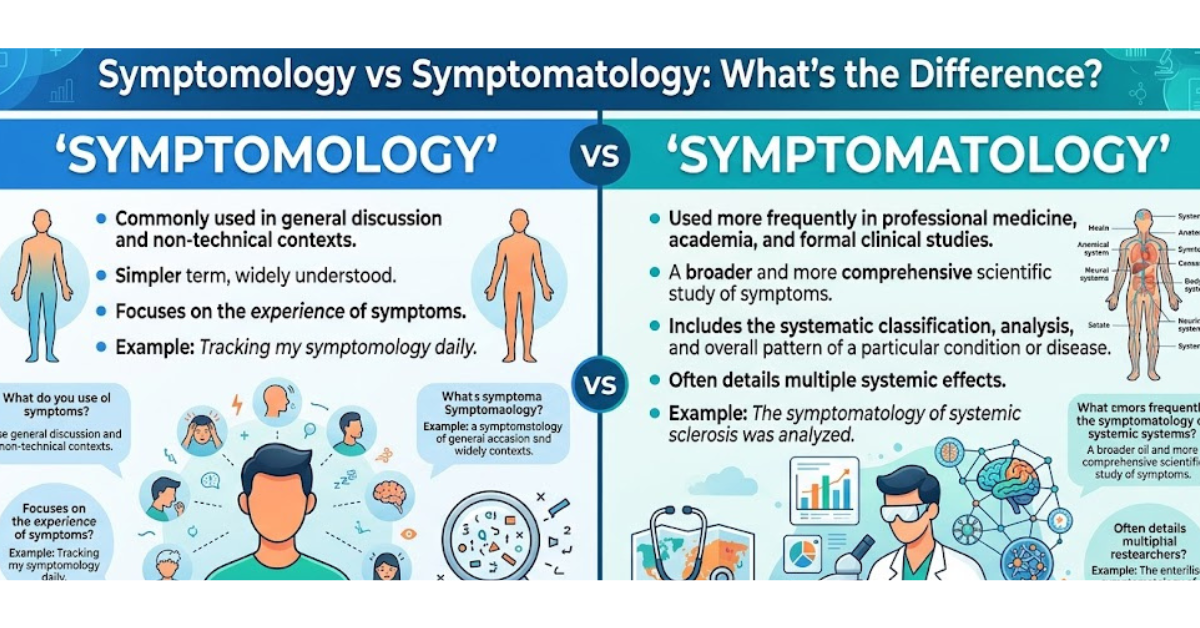
Have you ever come across the words symptomology and symptomatology and wondered whether they mean the same thing? You’re not alone. These two terms often appear in medical discussions, academic papers, healthcare websites, and even casual conversations about health. Yet many people are unsure which one is correct—or whether both are acceptable.
Understanding symptomology vs symptomatology is important for students, healthcare professionals, researchers, writers, and anyone interested in medical terminology. In this article, you’ll learn the meaning of each term, their origins, how they’re used, and why one is generally preferred in professional medical settings.
Understanding Symptoms and Medical Terminology
Before comparing the two words, it’s helpful to understand the root concept.
A symptom is a physical or mental change experienced by a person that may indicate a disease, injury, or health condition. Examples include:
- Headaches
- Fatigue
- Fever
- Nausea
- Dizziness
- Shortness of breath
Medical professionals often study groups of symptoms to identify illnesses, diagnose conditions, and develop treatment plans.
This is where terms like symptomology and symptomatology enter the conversation.
What Is Symptomology?
Symptomology is a term sometimes used to describe the study, collection, or analysis of symptoms associated with a disease or condition.
In general usage, people may say:
- “The symptomology of influenza includes fever and body aches.”
- “Researchers examined the symptomology of the disorder.”
While many people understand what the term means, it is not traditionally considered the standard medical term.
Why Symptomology Exists
The word likely developed through informal linguistic simplification. Since many fields use words ending in “-ology” to indicate a study or science, such as:
- Biology
- Psychology
- Sociology
- Neurology
People naturally assumed that symptomology follows the same pattern.
As a result, the term gained some popularity in casual writing, educational materials, and non-specialist discussions.
What Is Symptomatology?
Symptomatology is the established and traditionally accepted medical term.
It refers to:
- The study of symptoms.
- The collection of symptoms associated with a disease.
- The systematic analysis of symptom patterns.
Healthcare professionals, medical journals, universities, and clinical researchers overwhelmingly prefer this term.
For example:
- “The symptomatology of Parkinson’s disease varies among patients.”
- “Researchers investigated the symptomatology associated with long COVID.”
- “Understanding symptomatology helps improve diagnosis.”
Origin of Symptomatology
The term comes from:
- Greek symptoma meaning “occurrence” or “symptom”
- Suffix -logy through the intermediary formation -atology
Over time, symptomatology became the accepted medical expression for describing symptom patterns and their study.
Symptomology vs Symptomatology: The Key Differences
Although the two words are often used interchangeably, there are important distinctions.
| Feature | Symptomology | Symptomatology |
| Recognition in medicine | Less formal | Standard medical term |
| Academic acceptance | Limited | Widely accepted |
| Use in medical journals | Rare | Common |
| Dictionary inclusion | Present in some dictionaries | Universally recognized |
| Professional preference | Generally avoided | Preferred |
Which Term Is Correct?
If you’re writing for:
- Medical school
- Healthcare organizations
- Academic research
- Clinical documentation
- Scientific publications
Use symptomatology.
While symptomology is understood by many readers, it is often viewed as a nonstandard or less precise alternative.
Why Medical Professionals Prefer Symptomatology
Medical language values precision and consistency.
Healthcare professionals rely on standardized terminology to:
- Reduce ambiguity
- Improve communication
- Maintain scientific accuracy
- Support research collaboration
- Ensure clear documentation
Because symptomatology has a long-established place in medical literature, it remains the preferred choice.
Example in Clinical Practice
Consider a physician documenting a patient’s condition.
Preferred:
“The patient’s symptomatology includes chronic fatigue, headaches, and cognitive impairment.”
Less preferred:
“The patient’s symptomology includes chronic fatigue, headaches, and cognitive impairment.”
Both sentences are understandable, but the first aligns with professional medical standards.
Is Symptomology Wrong?
Not necessarily.
Language evolves over time, and many dictionaries now recognize symptomology because people use it frequently. However, recognition does not automatically make it the preferred technical term.
Think of it this way:
- Symptomology = Commonly understood and occasionally used.
- Symptomatology = Professionally accepted and academically preferred.
In everyday conversations, using symptomology is unlikely to cause confusion. In formal medical writing, however, symptomatology remains the safer choice.
Common Contexts Where Symptomatology Is Used
Medical Research
Researchers often analyze symptom patterns across populations.
Examples include:
- Cancer symptomatology
- COVID-19 symptomatology
- Neurological symptomatology
- Psychiatric symptomatology
Clinical Diagnosis
Doctors compare symptoms to known disease profiles.
This process helps identify:
- Infectious diseases
- Autoimmune disorders
- Mental health conditions
- Chronic illnesses
Medical Education
Medical students learn symptomatology to understand how diseases present in real patients.
Public Health Studies
Public health experts examine symptomatology trends during outbreaks and epidemics.
Examples of Symptomatology in Different Diseases
Understanding symptomatology becomes easier when viewed through real-world examples.
Influenza Symptomatology
Common symptoms include:
- Fever
- Chills
- Body aches
- Fatigue
- Cough
- Sore throat
Migraine Symptomatology
Typical symptoms include:
- Severe headache
- Light sensitivity
- Sound sensitivity
- Nausea
- Visual disturbances
Depression Symptomatology
May involve:
- Persistent sadness
- Low energy
- Sleep disturbances
- Loss of interest
- Difficulty concentrating
In each case, symptomatology refers to the overall symptom pattern associated with the condition.
How Search Engines Interpret Symptomology and Symptomatology
Modern search engines understand that these terms are closely related.
Someone searching for:
- Symptomology meaning
- Symptomatology definition
- Difference between symptomology and symptomatology
- Medical symptom terminology
is typically seeking the same information.
However, authoritative medical sources continue to prioritize symptomatology because of its stronger professional acceptance.
Practical Tips for Writers and Students
If you’re unsure which term to use, follow these guidelines:
Use Symptomatology When:
- Writing academic papers
- Creating healthcare content
- Publishing medical articles
- Preparing research reports
- Completing university assignments
Symptomology May Be Acceptable When:
- Writing informal content
- Having general conversations
- Explaining concepts to non-medical audiences
Quick Rule
When accuracy matters, choose symptomatology.
Key Takeaways
- Both terms relate to symptoms and disease patterns.
- Symptomatology is the standard medical and academic term.
- Symptomology is used by some speakers and writers but is less formal.
- Healthcare professionals overwhelmingly prefer symptomatology.
- Using symptomatology improves clarity and credibility in professional contexts.
- Understanding the distinction helps avoid terminology errors in medical writing.
Frequently Asked Questions
Is symptomology a real word?
Yes. Many dictionaries recognize symptomology because it is widely used. However, it is generally considered less formal than symptomatology in medical contexts.
What is the difference between symptomology and symptomatology?
The primary difference is acceptance and usage. Symptomatology is the established medical term, while symptomology is a less common alternative often used informally.
Which term should I use in academic writing?
You should use symptomatology. It is the preferred term in research papers, medical journals, textbooks, and professional healthcare communication.
Do doctors use symptomology?
Most doctors, researchers, and healthcare professionals use symptomatology rather than symptomology when documenting or discussing diseases.
Can symptomology and symptomatology be used interchangeably?
In casual conversation, they often can be. In formal medical or academic settings, symptomatology is the more accurate and accepted choice.
Why is symptomatology considered the standard term?
It has a longer history in medical literature and has been consistently adopted by academic institutions, researchers, and healthcare organizations worldwide.
Conclusion
The debate around symptomology vs symptomatology comes down largely to professional preference and linguistic accuracy. While both words relate to the study and description of symptoms, symptomatology remains the recognized standard in medicine, healthcare, and academic research.
If you’re writing for a professional audience, preparing coursework, or creating health-related content, choosing symptomatology will help ensure clarity and credibility. Understanding this subtle distinction can improve your communication and make your medical writing more precise. As you continue exploring medical terminology, paying attention to these details can make a significant difference in both understanding and professionalism.