
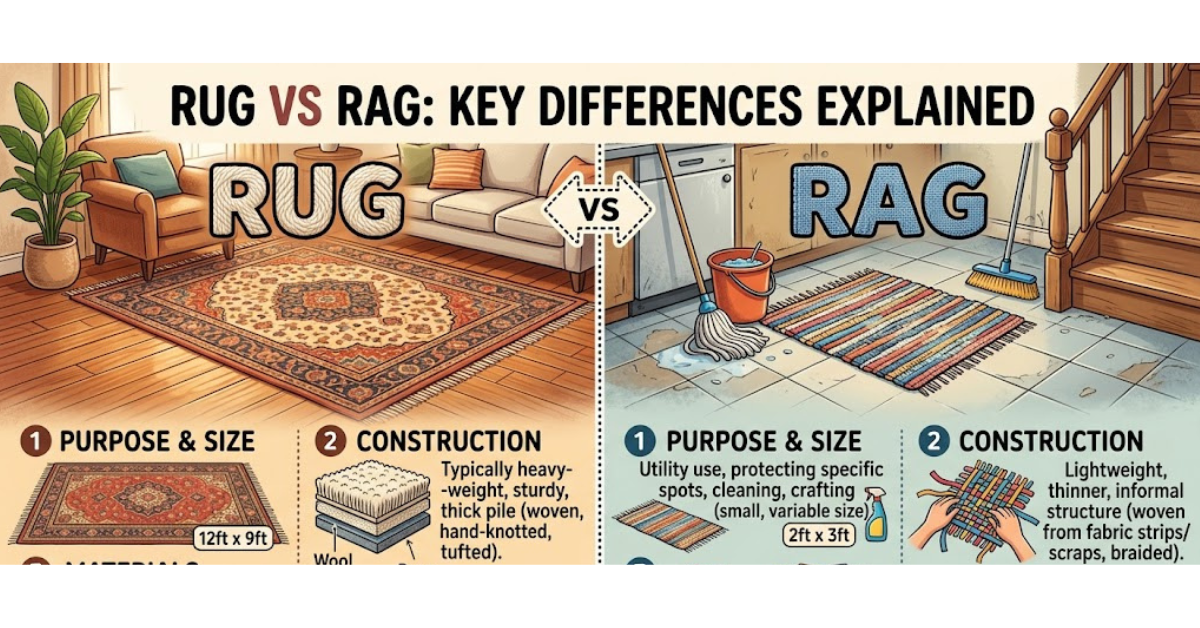
Have you ever heard someone use the words rug and rag interchangeably and wondered if they actually mean the same thing? While the two words sound similar, they refer to completely different items with distinct purposes.
Understanding Rug Vs Rag is useful for everyday communication, home décor discussions, cleaning tasks, and even shopping. Whether you’re furnishing a room or grabbing something to wipe up a spill, knowing the difference can help you avoid confusion.
In this guide, you’ll learn what rugs and rags are, how they are used, their key differences, and common situations where people mix them up.
What Is a Rug?
A rug is a piece of thick textile material designed to cover part of a floor. Rugs are commonly used for decoration, comfort, insulation, and protection of flooring surfaces.
Unlike wall-to-wall carpeting, a rug is movable and typically covers only a specific area of a room.
Common Features of a Rug
- Made from wool, cotton, synthetic fibers, jute, or silk
- Used as a decorative home furnishing
- Available in various sizes, colors, and patterns
- Provides comfort underfoot
- Helps reduce noise and improve room aesthetics
Examples of Rugs
- Persian rugs
- Area rugs
- Shag rugs
- Outdoor rugs
- Handmade woven rugs
A living room, bedroom, hallway, or office often contains one or more rugs to enhance appearance and comfort.
What Is a Rag?
A rag is a piece of old cloth or fabric, often repurposed for cleaning, wiping, polishing, or dusting.
Rags are generally made from worn-out clothing, towels, sheets, or other textile materials that are no longer useful for their original purpose.
Common Features of a Rag
- Usually inexpensive or recycled
- Primarily used for cleaning tasks
- Made from cotton, microfiber, or other absorbent materials
- Easy to wash and reuse
- Often cut into smaller pieces
Examples of Rags
- Cleaning rags
- Dusting cloths
- Shop rags used in garages
- Polishing cloths
- Industrial wiping rags
You might use a rag to clean windows, wipe kitchen counters, polish furniture, or remove grease from tools.
Rug Vs Rag: Side-by-Side Comparison
The easiest way to understand Rug Vs Rag is through a direct comparison.
| Feature | Rug | Rag |
| Purpose | Floor covering | Cleaning cloth |
| Appearance | Decorative and attractive | Functional and simple |
| Size | Usually large | Usually small |
| Material | Wool, cotton, synthetic fibers, silk | Cotton, microfiber, recycled fabric |
| Cost | Can range from affordable to expensive | Usually inexpensive |
| Location | Floors and living spaces | Cleaning areas, workshops, kitchens |
| Durability | Designed for long-term use | Intended for repeated cleaning tasks |
This comparison highlights how different these two household items actually are.
Origins of the Words
Understanding the history of these words can provide additional context.
Origin of “Rug”
The word “rug” dates back several centuries and originally referred to a coarse woolen fabric. Over time, it evolved to describe decorative floor coverings used in homes and public spaces.
Origin of “Rag”
The word “rag” comes from older Germanic languages and has long been associated with torn or worn pieces of cloth. Historically, rags were valuable materials that could be recycled into paper and other products.
Common Uses of Rugs
Rugs serve both practical and decorative purposes.
Interior Design
Interior designers often use rugs to define spaces within a room and add visual interest.
For example:
- Separating a seating area in an open-concept home
- Adding color to a neutral room
- Creating a focal point
Comfort
A rug makes hard flooring surfaces more comfortable to walk on, especially in colder climates.
Floor Protection
Rugs help protect:
- Hardwood floors
- Tile flooring
- Laminate surfaces
They reduce scratches and everyday wear.
Noise Reduction
Large rugs absorb sound and reduce echoes, making rooms feel quieter and more comfortable.
Common Uses of Rags
Rags are valued for their practicality and versatility.
Household Cleaning
People use rags to:
- Wipe countertops
- Clean mirrors
- Dust furniture
- Mop spills
Automotive Maintenance
Mechanics often keep rags nearby to clean tools, remove grease, and wipe engine components.
Painting Projects
Painters use rags to:
- Clean brushes
- Remove excess paint
- Create decorative paint effects
Industrial Applications
Factories and workshops frequently rely on durable rags for maintenance and cleaning tasks.
Why People Confuse Rug and Rag
Despite their differences, several factors contribute to confusion.
Similar Pronunciation
The words differ by only one vowel sound:
- Rug = /rʌg/
- Rag = /ræg/
For language learners, this subtle distinction can be challenging.
Similar Materials
Both items are made from textiles or fabric, leading some people to assume they are closely related.
Language Learning Challenges
English learners often encounter both words early in their studies and may struggle to remember which term refers to a floor covering and which refers to a cleaning cloth.
How to Remember the Difference
A simple memory trick can help.
Rug = Room
Both words contain the letter “u.”
Think:
Rug → Used in a room.
Rag = Remove Dirt
Think:
Rag → Removes dirt.
These associations make it easier to remember the correct meaning.
Choosing the Right Rug for Your Home
If you’re shopping for a rug, consider these factors:
Size
Choose a rug that fits the room’s dimensions and furniture layout.
Material
Popular choices include:
- Wool for durability
- Cotton for affordability
- Synthetic fibers for easy maintenance
- Jute for natural aesthetics
Style
Select colors and patterns that complement your décor.
Maintenance
Some rugs require professional cleaning, while others can be vacuumed and spot-cleaned at home.
Choosing Effective Cleaning Rags
Not all rags perform equally well.
Best Materials
- Microfiber for dusting
- Cotton for absorbing spills
- Terry cloth for general cleaning
Reusability
Washable rags are more environmentally friendly than disposable wipes.
Intended Use
Keep separate rags for:
- Kitchen cleaning
- Bathroom cleaning
- Automotive work
- Furniture polishing
This prevents cross-contamination and improves hygiene.
Key Takeaways
- A rug is a decorative floor covering.
- A rag is a cloth used for cleaning and wiping.
- Rugs enhance comfort, style, and floor protection.
- Rags are practical tools for household and industrial cleaning.
- The words sound similar but have very different meanings and functions.
- Understanding Rug Vs Rag helps improve communication and vocabulary accuracy.
Frequently Asked Questions
Is a rug the same as a rag?
No. A rug is a floor covering used for decoration and comfort, while a rag is a piece of cloth used for cleaning and wiping surfaces.
Why do people confuse Rug Vs Rag?
The words sound similar and both involve fabric materials, which can lead to misunderstanding, especially among English learners.
Can a rug become a rag?
Yes. In some cases, an old or damaged rug may be cut into smaller pieces and repurposed for cleaning, effectively becoming a rag.
Which is more expensive: a rug or a rag?
A rug is generally much more expensive because it is designed as a home furnishing. A rag is usually inexpensive or made from recycled fabric.
What materials are commonly used in rugs?
Common rug materials include wool, cotton, silk, jute, polyester, nylon, and polypropylene.
What is the best fabric for cleaning rags?
Microfiber and cotton are among the most popular choices because they are absorbent, durable, and reusable.
Conclusion
When comparing Rug Vs Rag, the distinction is straightforward once you understand their purposes. A rug is designed to enhance and protect living spaces, while a rag is a practical cleaning tool used for wiping, polishing, and maintenance.
Although both are fabric-based items, their functions, appearance, value, and everyday uses are entirely different. By remembering these differences, you’ll communicate more accurately and make better choices when decorating your home or tackling cleaning tasks. Keep these insights in mind the next time you hear someone mention a rug or a rag, and you’ll know exactly which one they mean.