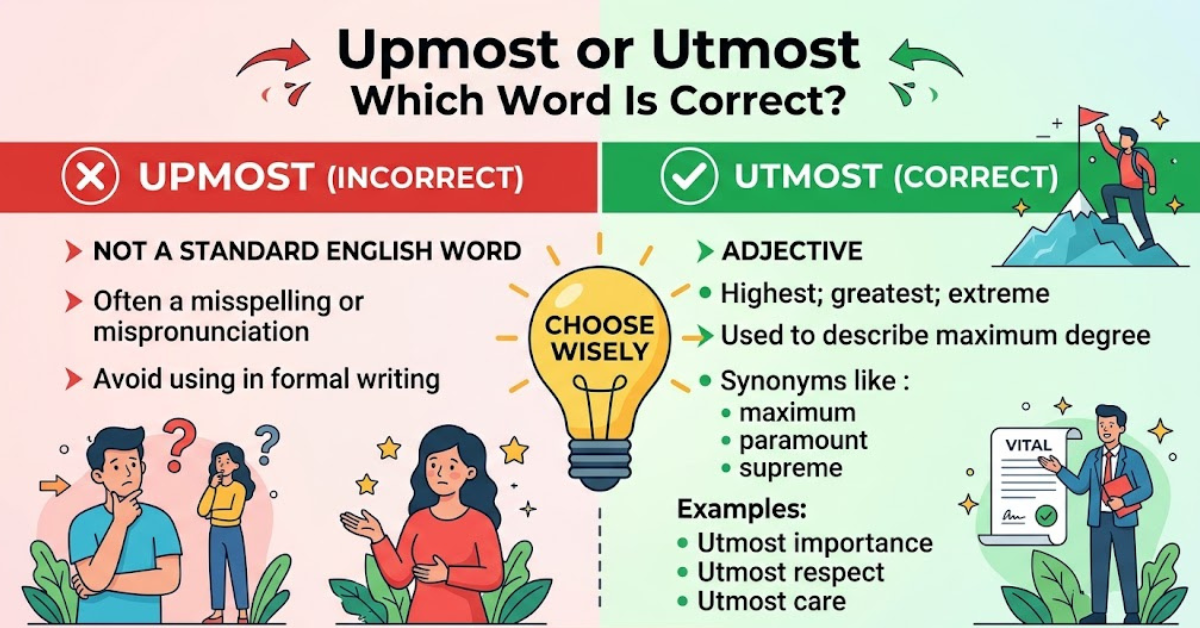
Have you ever written an email saying, “I’ll do my upmost,” only to wonder later if it was actually correct? You’re not alone. The confusion between upmost or utmost is one of the most common word-choice mistakes in English.
While the two words look similar and sound somewhat alike, they have different meanings and uses. In most situations, the word people intend to use is utmost, not upmost.
In this guide, you’ll learn the difference between the two words, when to use each one, examples from everyday writing, common mistakes to avoid, and simple memory tricks that make choosing the right word easy.
Understanding the Difference Between Upmost and Utmost
The confusion often arises because both words end in “-most” and can appear in similar contexts. However, their meanings are distinct.
What Does Utmost Mean?
Utmost means:
- The greatest degree
- The highest level
- The maximum amount possible
- Extreme importance or effort
It is commonly used when discussing seriousness, effort, respect, care, or importance.
Examples of Utmost
- We appreciate your cooperation and give this matter our utmost attention.
- She handled the project with the utmost professionalism.
- Your safety is of the utmost importance.
- He tried with the utmost determination to succeed.
In these examples, utmost refers to the highest possible level of effort, importance, or quality.
What Does Upmost Mean?
Upmost refers to something that is physically highest in position or nearest the top.
Although it is a real word, it is rarely used in modern English.
Examples of Upmost
- The bird sat on the upmost branch of the tree.
- Snow covered the mountain’s upmost peak.
Even in these cases, many writers prefer the word uppermost, which sounds more natural and is more commonly used today.
Why People Confuse Upmost and Utmost
Several factors contribute to the confusion:
Similar Pronunciation
The words sound somewhat alike in casual speech, making them easy to mix up.
Common Expression Errors
People frequently hear phrases such as:
- “With the utmost respect”
- “Of utmost importance”
- “My utmost effort”
Over time, some mistakenly replace utmost with upmost.
Spellcheck Doesn’t Always Help
Since both words exist in English dictionaries, spellcheck tools may not flag the mistake.
Upmost vs Utmost: Side-by-Side Comparison
| Feature | Utmost | Upmost |
| Meaning | Greatest degree or extent | Highest physical position |
| Usage Frequency | Very common | Rare |
| Modern English | Widely used | Uncommon |
| Example | Utmost care | Upmost branch |
| Common Phrases | Utmost importance, utmost respect | Rarely used phrases |
The key takeaway is simple: if you’re talking about effort, importance, respect, care, or seriousness, utmost is almost certainly the correct choice.
Common Phrases That Use Utmost
Many established English expressions include this word.
Of Utmost Importance
Used when something is extremely important.
Example:
Data security is of utmost importance to the company.
With the Utmost Respect
A polite phrase often used when disagreeing or expressing appreciation.
Example:
With the utmost respect, I have a different opinion.
Utmost Care
Describes handling something very carefully.
Example:
The fragile artwork was transported with the utmost care.
Utmost Effort
Refers to giving one’s best possible effort.
Example:
The team put forth their utmost effort during the competition.
Is Upmost Ever Correct?
Yes, but only in specific situations involving physical height or position.
Historical Usage
Historically, upmost appeared more frequently in literature and descriptive writing. Over time, however, uppermost became the preferred choice for most writers.
Modern Alternatives
Instead of upmost, modern English often uses:
- Uppermost
- Highest
- Topmost
- Upper
Example
Less common:
- The climber reached the upmost point.
More natural:
- The climber reached the uppermost point.
- The climber reached the highest point.
Easy Trick to Remember the Difference
A simple memory aid can prevent mistakes.
Think of “Utmost” as Ultimate
Both words begin with “ut”.
- Utmost = Ultimate level
- Greatest effort
- Highest importance
- Maximum degree
Think of “Upmost” as Up
The word starts with “up.”
- Up = Higher position
- Top location
- Physical elevation
This association makes choosing the right word much easier.
Examples in Professional Writing
Understanding real-world usage can help reinforce the distinction.
Business Communication
Correct:
- Customer satisfaction is our utmost priority.
Incorrect:
- Customer satisfaction is our upmost priority.
Academic Writing
Correct:
- Researchers must exercise the utmost caution.
Incorrect:
- Researchers must exercise the upmost caution.
Legal Documents
Correct:
- The information shall remain confidential with the utmost security measures.
Incorrect:
- The information shall remain confidential with the upmost security measures.
In professional settings, using the wrong word may affect credibility and clarity.
Common Mistakes to Avoid
When deciding between these two words, avoid these frequent errors:
Mistake #1: Using Upmost for Importance
Incorrect:
- This issue is of upmost importance.
Correct:
- This issue is of utmost importance.
Mistake #2: Using Upmost for Respect
Incorrect:
- I have upmost respect for her achievements.
Correct:
- I have utmost respect for her achievements.
Mistake #3: Assuming They Are Interchangeable
Although they look similar, they are not synonyms in modern English.
Why Correct Word Choice Matters
Language influences how others perceive your writing.
Whether you’re drafting:
- Emails
- Academic papers
- Business proposals
- Website content
- Social media posts
Using the correct term demonstrates attention to detail and professionalism.
Small language choices can make a significant difference in how clearly your message is understood.
Key Takeaways
- Utmost means the greatest degree, highest level, or maximum extent.
- Upmost refers to something physically highest in position.
- Most people who write “upmost” actually mean “utmost.”
- Common phrases include “utmost importance,” “utmost respect,” and “utmost care.”
- In modern English, upmost is rarely used and is often replaced by uppermost.
- Remember: Utmost = Ultimate, Upmost = Up.
Frequently Asked Questions
Is it upmost or utmost respect?
The correct phrase is utmost respect. It means the highest level of respect possible and is the standard expression in English.
Is “upmost importance” correct?
No. The correct phrase is utmost importance because it refers to the highest degree of importance, not physical position.
Is upmost a real word?
Yes, upmost is a legitimate English word. However, it is uncommon and typically refers to something located at the highest point.
Which word is more commonly used?
Utmost is far more common in modern English. It appears frequently in business, academic, legal, and everyday communication.
Can I use upmost and utmost interchangeably?
No. They have different meanings. Utmost relates to degree or importance, while upmost relates to physical location.
What is another word for utmost?
Depending on context, alternatives include:
- Maximum
- Greatest
- Extreme
- Highest
- Ultimate
- Supreme
Conclusion
The debate over upmost or utmost is easier to resolve once you understand their meanings. In the vast majority of situations, utmost is the word you need. It expresses the greatest degree of effort, care, importance, or respect and appears in many common English phrases.
Upmost, while technically correct in certain contexts, is rarely used today and generally refers to something physically located at the highest point.
The next time you’re writing an email, report, or message, remember the simple rule: if you mean the highest level of something, choose utmost. Your writing will be clearer, more accurate, and more professional.