
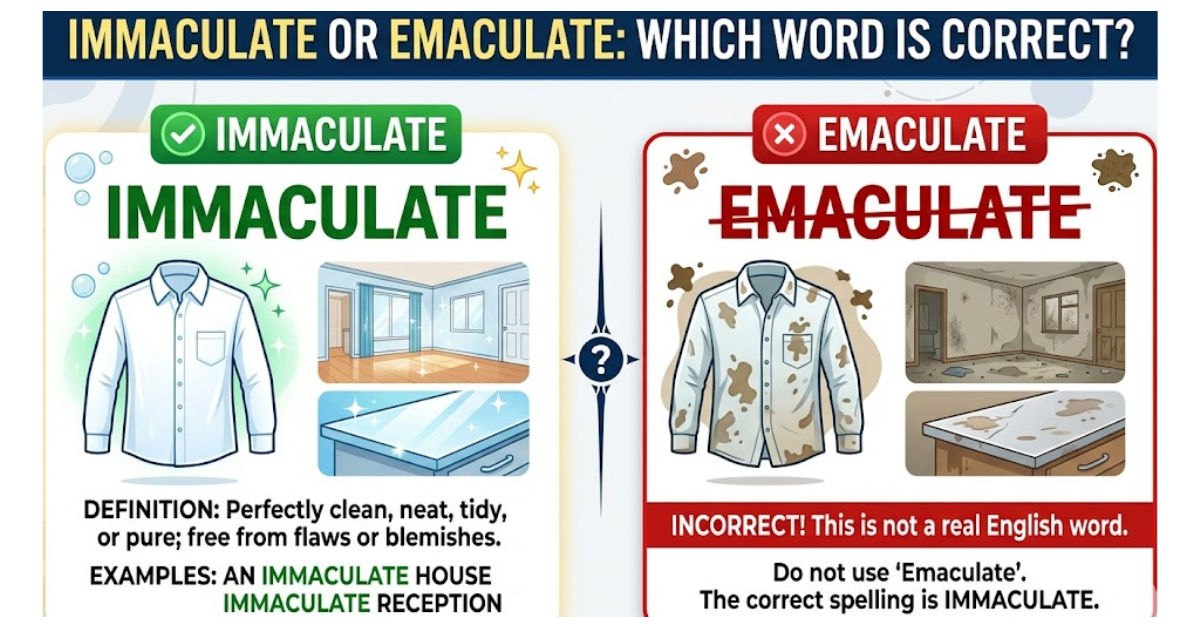
Have you ever typed immaculate or emaculate and wondered which one is actually correct? You’re not alone. Many English learners and native speakers confuse these two terms because they sound somewhat similar when spoken. However, only one of them is a recognized English word.
The correct spelling is immaculate. The word emaculate does not exist in standard English dictionaries. Understanding the meaning, usage, and common spelling mistakes can help you communicate more confidently.
Is It Immaculate or Emaculate?
The simple answer is: immaculate is correct, while emaculate is incorrect.
- Immaculate — a real English adjective meaning perfectly clean, flawless, or free from mistakes.
- Emaculate — a misspelling and not accepted as a standard English word.
This confusion often happens because of pronunciation differences, autocorrect errors, or unfamiliarity with the word’s spelling.
What Does Immaculate Mean?
The word immaculate describes something that is exceptionally clean, perfect, or without any defects. It can refer to physical appearance, work quality, organization, or behavior.
Examples of Immaculate in a Sentence
- The hotel room was immaculate, with every surface shining.
- She maintained an immaculate garden throughout the year.
- His presentation was immaculate, with no errors or missing details.
- The vintage car was kept in immaculate condition.
Common related terms include:
- Spotless
- Flawless
- Perfect
- Pristine
- Neat
- Well-maintained
Why Do People Write Emaculate Instead of Immaculate?
The mistake between immaculate or emaculate usually comes from the way people hear the word.
Several factors contribute to the confusion:
- Similar pronunciation – The beginning sound may seem like “em” in casual speech.
- Typing mistakes – The letters “i” and “e” are easily confused.
- Lack of familiarity – People who rarely see the word written may guess its spelling.
Remember this simple trick:
“Immaculate starts with ‘I’ because it means something ideal and impressive.”
Origin and History of the Word Immaculate
The term immaculate comes from the Latin word immaculatus, which means “unstained” or “without a spot.”
It combines:
- in- meaning “not”
- macula meaning “spot” or “stain”
Over time, the word entered English and came to describe anything perfectly clean, pure, or without flaws.
Common Phrases Using Immaculate
You will often see the word in everyday English expressions, including:
Immaculate Condition
Used to describe an object, vehicle, house, or item that looks almost brand new.
Example:
The antique furniture remained in immaculate condition after decades.
Immaculate Appearance
Describes someone who is extremely neat and well-groomed.
Example:
The businessman arrived with an immaculate appearance.
Immaculate Performance
Refers to a flawless achievement with no mistakes.
Example:
The athlete delivered an immaculate performance during the championship.
How to Remember the Correct Spelling of Immaculate
If you struggle with immaculate or emaculate, try these memory techniques:
- Always start the word with “Im”, not “Em.”
- Think of the phrase “Impressive and immaculate” because both start with “Im.”
- Read and use the word regularly in sentences.
Repeated exposure makes correct spelling easier to remember.
Immaculate vs Other Similar Words
Although emaculate is incorrect, there are several words that share a similar meaning with immaculate.
| Word | Meaning |
| Immaculate | Completely clean or flawless |
| Pristine | In original, perfect condition |
| Spotless | Having no dirt or marks |
| Perfect | Without any mistakes |
| Neat | Organized and tidy |
Choosing the right word depends on the context, but immaculate is often the strongest way to describe something exceptionally well-maintained.
FAQs
Is emaculate a real word?
No, emaculate is not a recognized English word. It is considered a spelling mistake of immaculate.
What is the correct spelling: immaculate or emaculate?
The correct spelling is immaculate. The version spelled with an “e” at the beginning is incorrect.
What does immaculate mean?
Immaculate means perfectly clean, spotless, flawless, or free from imperfections.
How do you pronounce immaculate?
Immaculate is pronounced as ih-MAK-yuh-lit.
Can immaculate describe a person?
Yes. It can describe a person’s appearance, clothing, manners, or work when they are extremely neat, polished, or flawless.
Conclusion
When comparing immaculate or emaculate, the correct choice is always immaculate. It is a well-established English word used to describe something spotless, perfect, and free from flaws, while emaculate is simply a common misspelling.
By understanding its meaning, origin, and proper usage, you can avoid this mistake in your writing and speak with greater confidence. Continue expanding your vocabulary and explore more English language guides to improve your grammar and spelling skills.