
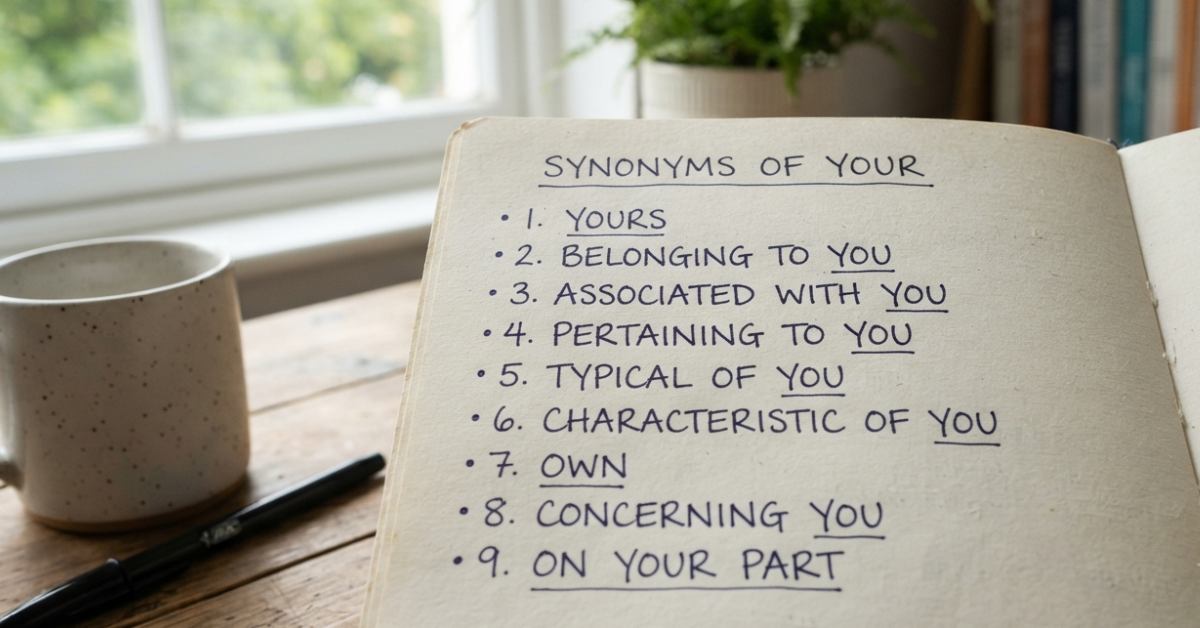
If you’ve ever searched for synonyms of your, you may have discovered that the answer isn’t as straightforward as looking up a regular vocabulary word. Unlike nouns, verbs, or adjectives, “your” is a possessive determiner, which means it shows ownership rather than describing something. Because of that, it doesn’t have true synonyms in the traditional sense.
However, there are many words and phrases that can replace your depending on the context. Whether you’re writing an email, an academic paper, a business proposal, or creative content, understanding the best alternatives can make your writing more varied, natural, and engaging.
This guide explains the meaning of your, explores its closest alternatives, and shows you how to use them correctly in different situations.
What Does “Your” Mean?
The word your is a possessive determiner used before a noun to indicate that something belongs to the person or people being addressed.
For example:
- Your phone is ringing.
- I received your message.
- Please submit your application.
In each sentence, your indicates ownership or association.
Are There True Synonyms of Your?
Technically, no.
Because your is a grammatical determiner rather than a descriptive word, dictionaries generally do not list direct synonyms.
Instead, writers replace your using:
- Alternative sentence structures
- Different pronouns
- Possessive nouns
- Formal or informal wording
The best replacement always depends on the context.
Common Alternatives to “Your”
Although they are not exact synonyms, these expressions often serve the same purpose.
Yours
Used when the noun has already been mentioned.
Example:
- This notebook is yours.
- The decision is yours.
One’s
Useful in formal or academic writing when referring to people generally.
Example:
- One should protect one’s privacy.
- Improving one’s skills takes time.
His or Her
When referring to a specific individual.
Example:
- Every student should bring his or her ID.
Their
Often used as a gender-neutral alternative.
Example:
- Every employee should update their password.
The
Sometimes ownership can be implied instead of stated.
Instead of:
- Raise your hand.
You can write:
- Raise the hand.
However, this structure is uncommon in everyday English and often sounds unnatural.
Synonyms of Your in Different Contexts
The best replacement depends entirely on what you’re writing.
In Business Writing
Instead of repeating your, try:
- Your company → the organization
- Your team → the team
- Your proposal → the proposal
This improves readability by reducing repetition.
In Academic Writing
Formal alternatives include:
- One’s
- The student’s
- The participant’s
- The researcher’s
These expressions often sound more objective.
In Creative Writing
Authors frequently vary sentence structure rather than replacing the word directly.
For example:
Instead of:
Your eyes sparkled.
You might write:
Those bright eyes sparkled with excitement.
When Should You Keep Using “Your”?
Sometimes the simplest choice is the best one.
Continue using your when:
- Giving instructions
- Speaking directly to readers
- Writing emails
- Creating website content
- Explaining steps
- Producing conversational articles
Using your creates a direct connection with the audience.
Examples of “Your” in Sentences
Here are some common examples:
- Don’t forget your keys.
- Your opinion matters.
- Please update your profile.
- Your hard work paid off.
- Always back up your files.
- Thank you for your support.
These examples demonstrate why your remains one of the most commonly used possessive words in English.
Tips for Avoiding Repetition
If you find yourself using your too often, try these strategies.
Rewrite the Sentence
Instead of:
Your business should improve your marketing.
Try:
Businesses should improve their marketing strategies.
Use Possessive Nouns
Instead of:
Your manager approved your request.
Try:
The manager approved the request.
Change the Subject
Instead of:
Your goal is to increase productivity.
Try:
Increasing productivity is the primary goal.
Small changes often make writing smoother and more engaging.
Common Grammar Mistakes
Many English learners confuse similar words.
Your vs. You’re
Your shows possession.
Example:
- Your laptop is on the desk.
You’re means you are.
Example:
- You’re doing a great job.
Remember:
- Your = possession
- You’re = you are
Your vs. Yours
Your comes before a noun.
Example:
- Your jacket.
Yours replaces the noun.
Example:
- The jacket is yours.
Understanding this distinction improves both writing accuracy and clarity.
Why Context Matters
There is no universal replacement for your because language depends on context.
For example:
| Original | Possible Alternative |
| Your car | The vehicle |
| Your report | The report |
| Your opinion | One’s opinion (formal) |
| Your password | Their password (generic) |
| Your house | The house (if ownership is already clear) |
Choosing the right alternative depends on the audience, purpose, and writing style.
Frequently Asked Questions
What are the synonyms of your?
Strictly speaking, your has no direct synonyms because it is a possessive determiner. Depending on the context, alternatives include yours, one’s, their, his or her, or a rewritten sentence.
Is “your” a pronoun?
No. Your is a possessive determiner because it modifies a noun. Yours is the possessive pronoun.
Can I replace “your” with “the”?
Sometimes, but only when ownership is already understood. In most everyday writing, your sounds more natural.
What’s the difference between “your” and “yours”?
Your comes before a noun, while yours replaces the noun entirely.
Example:
- Your book.
- The book is yours.
Why does “your” have no true synonym?
Because it serves a grammatical function rather than describing meaning. Possessive determiners generally don’t have exact dictionary synonyms.
How can I avoid repeating “your”?
Rewrite sentences, use possessive nouns, change sentence structure, or replace repeated phrases where appropriate.
Conclusion
Searching for synonyms of your often leads to an important grammar lesson: your doesn’t have true synonyms because it functions as a possessive determiner rather than a descriptive word. Nevertheless, writers have many effective alternatives depending on the context, including yours, one’s, their, possessive nouns, or simple sentence rewrites.
Understanding how and when to replace your helps create clearer, more engaging writing without sacrificing meaning. Whether you’re writing professionally, academically, or creatively, choosing the right alternative can improve readability while keeping your communication natural and effective. The key is not to eliminate your, but to use it thoughtfully and vary your sentence structure when repetition becomes distracting.