English contains many word pairs that look similar but carry completely different meanings, and extent vs extant is a classic example. At first glance, these words seem related because they share the same starting letters, but they actually belong to entirely different categories in grammar and meaning.
Understanding the difference is important for academic writing, reading comprehension, and professional communication. One word refers to degree or scope, while the other refers to existence, especially in historical or biological contexts.
This guide explains extent vs extant meaning, differences, pronunciation, usage, examples, and memory tricks in a simple, clear, and practical way.
What Is the Difference Between Extent vs Extant?
The key difference lies in meaning:
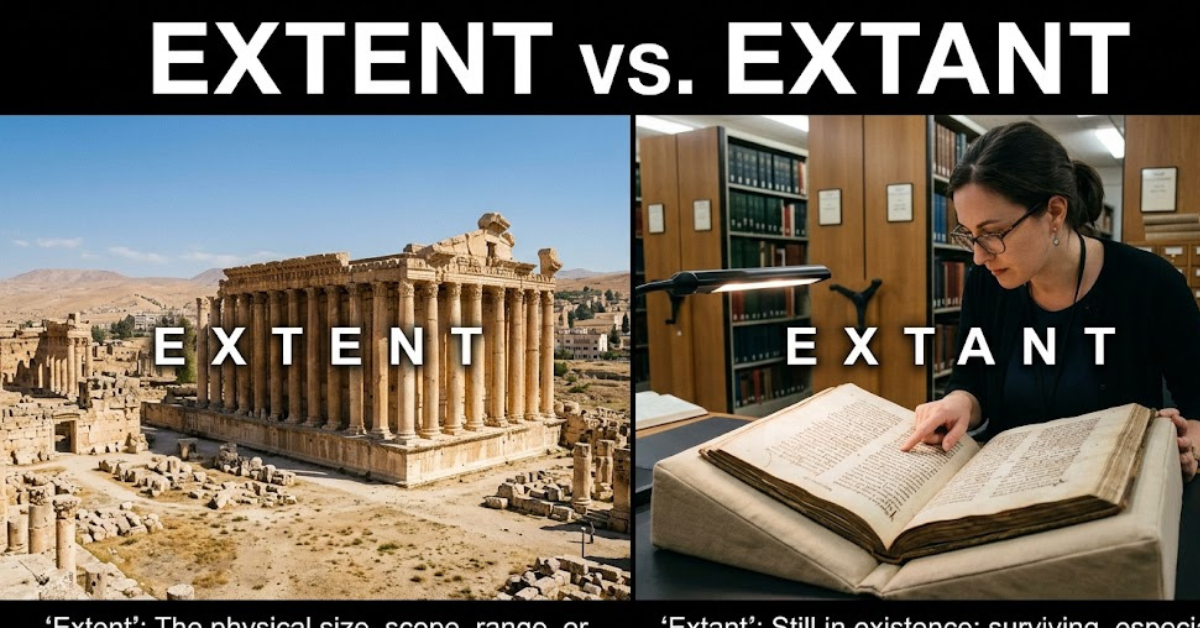
- Extent refers to the range, level, or degree of something.
- Extant refers to something that still exists or is still alive, especially from the past.
Even though they look similar, they are not interchangeable in any context.
Extent vs Extant Meaning
To clearly understand extent vs extant, let’s break them down separately.
Meaning of Extent
“Extent” refers to how far something reaches or the degree to which something happens.
Examples:
- The extent of the damage was severe.
- We don’t know the full extent of the problem.
- To what extent do you agree with the statement?
It is commonly used in academic writing, analysis, and formal communication.
Meaning of Extant
“Extant” means something that still exists, especially something old or from the past that has survived.
Examples:
- This is the oldest extant manuscript.
- Few extant species of dinosaurs exist today (birds are considered descendants).
- The building is one of the few extant structures from that era.
It is often used in history, biology, archaeology, and literature.
Extent vs Extant Pronunciation
Another reason extent vs extant causes confusion is pronunciation.
- Extent: /ɪkˈstent/
- Extant: /ˈek.stənt/ or /ɪkˈstænt/ (varies by accent)
Because they sound somewhat similar, especially in fast speech, spelling and context are crucial.
How to Use “Extent” Correctly
“Extent” is widely used in everyday and academic English.
Extent in Questions
Examples:
- To what extent is this true?
- Do we understand the extent of the issue?
Extent in Description
Examples:
- The extent of the damage surprised everyone.
- We measured the extent of the land.
Extent in Formal Writing
Examples:
- The extent of pollution is increasing.
- His influence extends to a great extent in politics.
How to Use “Extant” Correctly
“Extant” is less common and usually appears in formal or specialized fields.
Extant in Historical Context
Examples:
- The extant copies of the manuscript are rare.
- This is one of the few extant records from ancient Rome.
Extant in Biology
Examples:
- Extant species of reptiles are widespread.
- Scientists study extant organisms to understand evolution.
Extant in Academic Writing
Examples:
- Only a few extant sources confirm this theory.
- The extant literature on the topic is limited.
Why People Confuse Extent and Extant
Several factors contribute to the confusion:
Similar Spelling Pattern
Both words start with “ext-” and end with similar sounds.
Academic Context Overlap
Both are often used in formal writing, increasing exposure together.
Fast Reading and Typing
Quick reading leads to visual mistakes between the two words.
Limited Familiarity With “Extant”
Many learners rarely encounter “extant,” making it harder to recognize.
Easy Memory Tricks
Simple associations can help you remember the difference.
Remember Extent = Extent of Something
Think:
- Extent = extent of damage
- Extent = how much or how far
It always relates to degree or range.
Remember Extant = Exists Today
Think:
- Extant = exists
- Extant = still alive or surviving
If it exists now or survived history, it is extant.
Common Examples Using Extent
Here are practical examples of “extent” in use:
- The extent of the fire was massive.
- We don’t know the full extent of his involvement.
- To what extent is technology helpful?
- The extent of her knowledge is impressive.
Common Examples Using Extant
Here are examples of “extant” in context:
- The museum preserves extant artifacts.
- This is one of the few extant letters from the author.
- Extant species are studied by scientists.
- The building is the only extant structure of its kind.
Extent vs Extant in Academic Writing
These words are especially important in formal writing.
Extent in Analysis
Used when measuring:
- impact
- size
- range
- degree
Example:
- The study measures the extent of climate change effects.
Extant in Research
Used when discussing:
- surviving documents
- historical records
- living species
Example:
- Researchers analyzed extant manuscripts from the medieval period.
Why Context Matters
Because pronunciation does not clearly separate them, context becomes essential.
- “Extent of damage” refers to measurement.
- “Extant manuscripts” refers to surviving items.
The surrounding words make the meaning clear.
FAQs
What is the difference between extent vs extant?
Extent refers to degree or range, while extant means still existing, especially from the past.
Are extent and extant pronounced the same?
They sound similar but are not identical in all accents.
What does extent mean?
Extent means how far something reaches or the degree of something.
What does extant mean?
Extant means something that still exists or has survived from the past.
Why do people confuse extent and extant?
Because they look similar in spelling and appear in formal writing.
Where is extant commonly used?
It is commonly used in history, biology, and academic research.
Conclusion
Understanding extent vs extant becomes easy once you focus on meaning instead of appearance. Extent refers to the range or degree of something, while extant refers to something that still exists, especially from historical or biological contexts.
Although the words look similar, they serve very different purposes in English writing. Recognizing this distinction improves reading comprehension, academic accuracy, and professional communication.
Mastering word pairs like these helps strengthen vocabulary and ensures clearer, more precise expression in both formal and everyday English.